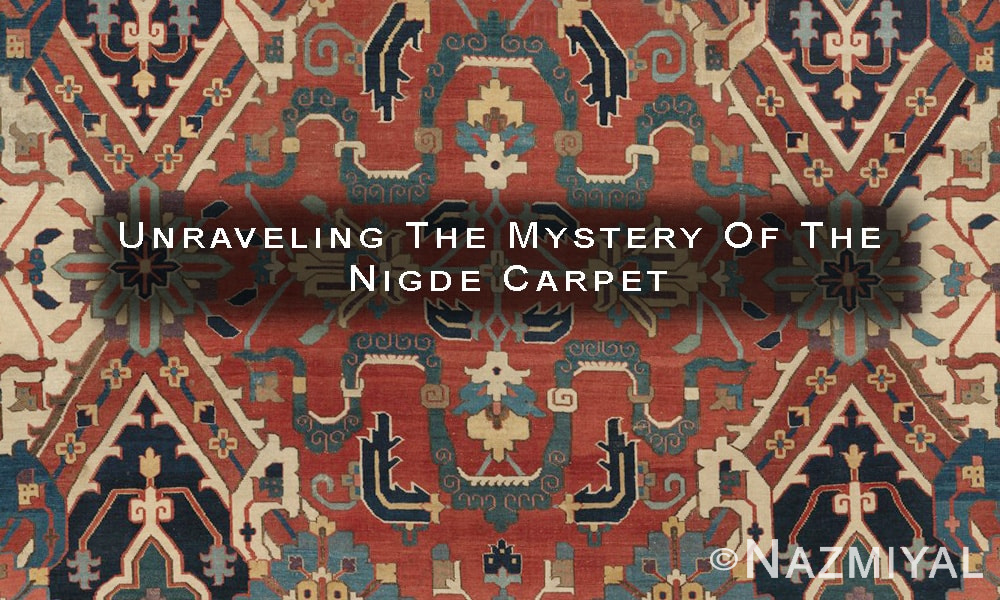
The Caucasian region has been in the business of rug making for a very long time. There are plenty of factors that impacted Caucasian designs, as they were under the rule of several different cultures. Caucasian carpet designs are very distinct in both coloring and pattern. They are usually characterized by a strong and dominant color palette with small variations in color accents, as well as bold, geometric tribal patterns.
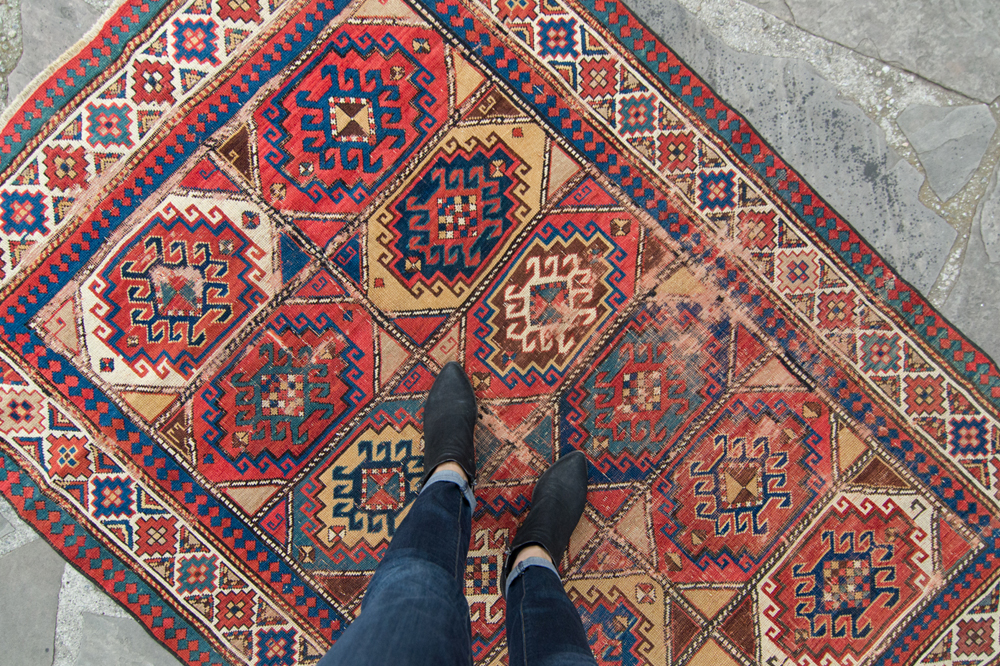
Geometric patterns are largely inspired by Ottoman influences, while the floral elements common in Caucasian rugs most likely find their roots in Russian designs. The ornamental qualities of Caucasian rugs as well as animal and figural motifs are evidence of the large Persian influence in the region. These three distinct cultures combine to form a completely new amalgamation of design adopted by the indigenous Caucasians and their own cultural histories, making these rugs a completely unique textile style.
The Caucasus – A Mountain of Languages
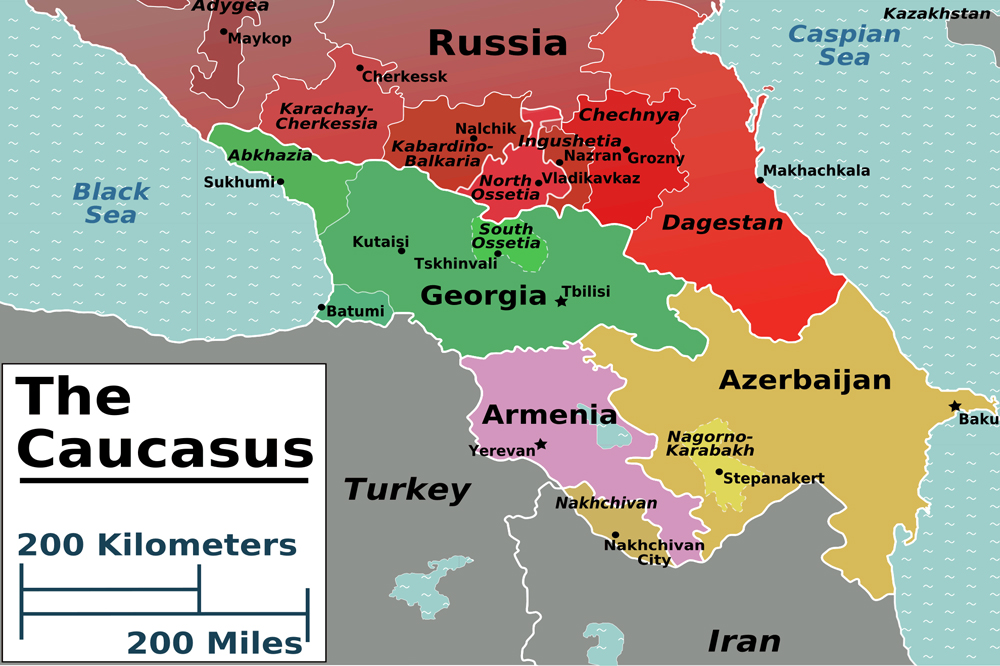
“The Caucasus” is a region of land between Eastern Europe and Western Asia, specifically between the Black and Caspian Seas. The Greater Caucasus mountain range further divides the land into the North Caucasus, or Ciscaucasia, and the South Caucasus, also known as Transcaucasia. Culturally, the Caucasus is a “borderland” and has been influenced by centuries of different reigning empires, making it a mixing pot of language, religion, and people. Their cultural diversity led to geographers at the time referring to it as “a mountain of tongues”. Today, the region is made up of the countries Armenia, Azerbaijan, Georgia, and the southern part of Russia.
Like many Eastern societies, the Caucasus is an ancient land with an ancient history. Records acknowledging the region date back to the 13th century BC and it’s recognized as one of the earliest known populated areas. The Caucasian region that makes up today’s Armenia is the world’s oldest Christian nation, having adopted the religion in 301 AD.
The term “caucasian” is probably something you’ve heard of, referring to a racial classification used for people of European ancestry. This terminology didn’t actually come around until the 18th century by a German anthropologist who wanted to categorize human racial demographics. It also has Biblical origins, as Noah’s Ark was said to have landed in the Caucasus mountains and Europeans were thought to have descended from him, while other races were believed to have different Biblical origins. It’s worth noting that whenever a reference is made to “Caucasian people” in this blog, that means people from the Caucasus region, not people of European descent.
Caucasian Rug Trade
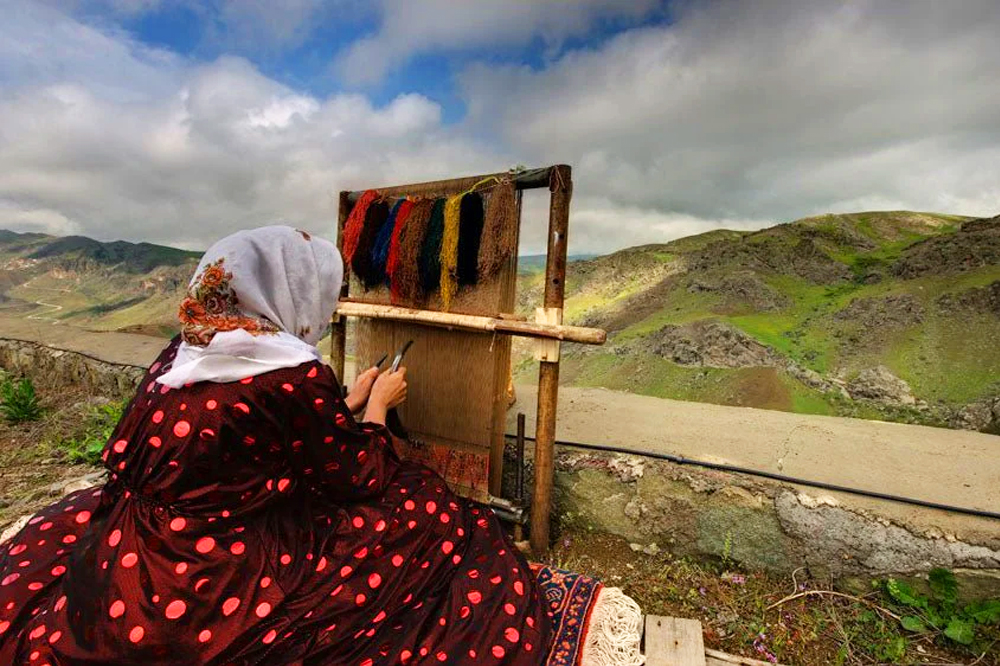
The Caucasus was an important point during the Silk Road, making up the northwestern region of the trade network. A crucial geographical marker, the Caucasus connected the Mediterranean to Asia and served as a point of export for Eastern trade into Europe. The Persian and Byzantine empires were especially involved in the region, fighting for control of the territory. Carpets made in the Caucasus gained in popularity among the noble class in Europe, especially with their Turkish and Persian influences, as textiles from both cultures were highly coveted. Caucasian rugs are seen as decorative pieces in the backgrounds of many important paintings coming from the Netherlands, enough to grant the popular gul motif the nickname “Memling gul”, after Flemish painter Hans Memling.
The Caucasian History of Art and Design
The Caucasian region was one that underwent several changes regarding the ruling power. Never united as one country, this mass of land was a continuously coveted territory. Over the ages, various empires controlled it. The Achaemenid, Roman, Byzantine, Mongol, and Ottoman empires were some of the notable ruling cultures. The Safavid, Afsharid, and Qajar dynasties of what was then Persia also held power in the Caucasus for a period of time. Aside from the changes in ruling powers, the Caucasian people were made up of several tribes that were nomadic up until the early 20th century.
An interesting phenomenon in culture and art came out of the region because of this. Caucasians had their own personal histories with the land but these outside influences made their mark, as new design conventions were adopted into Caucasian artwork. This is certainly the case with their carpets, where a few key motifs and design styles are staples mixed in with diverse patterns and color palettes.
This is made further true because of the nomadic lifestyle of many indigenous societies in the Caucasus. These societies were made up of a mix of ethnic groups and all produced unique tribal textiles with natural dyes and wool fibers. Culturally and design-wise, the rugs they produced could be divided into five different styles: Kazak, Shirvan, Kuba, Dagestan, and Karabakh. Each has an overarching emphasis on geometric form and strong colors, but they differ otherwise.
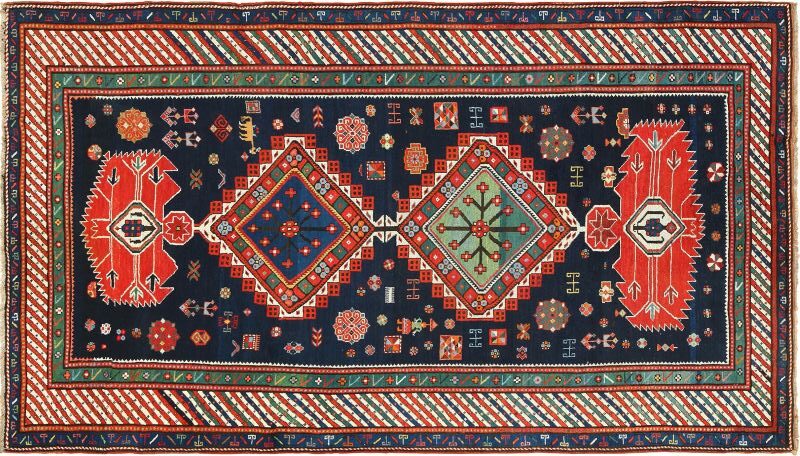
Kazak
Kazak rugs of the Caucasus come from the southern Transcaucasian region. Influenced by Persian, Turkish, and Russian culture, Kazak rugs themselves have a diverse array of styles. Kazaks have a strong folk art influence to them, with stylized figures of animals and a strong, limited color palette. Central medallion configurations were a popular design feature in Kazak rugs. Geometric shapes inspired by Turkish design conventions such as diamonds and polygons were also common.
Shirvan
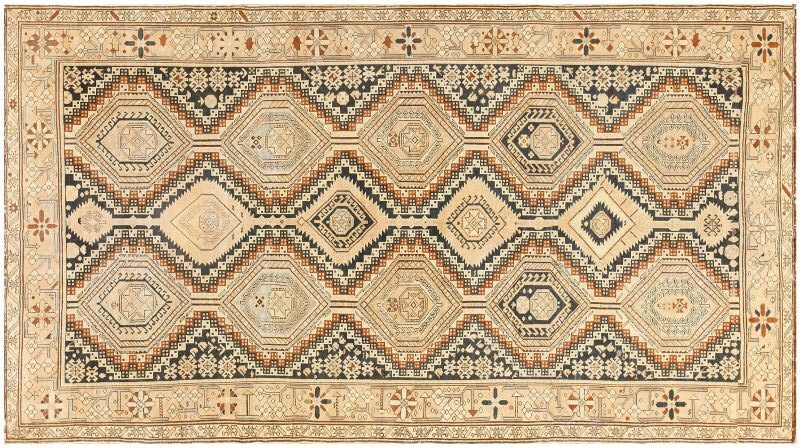
Now part of Azerbaijan, the Shirvan region produced many beautiful rugs. Its name of “Shirvan” has Persian origins, meaning “cypress tree”. Shirvan rugs are known for symmetrical compositions and intricate patterns that mixed tribal and floral elements. Tree of life configurations and central medallions bordered by pictorial patterns are common characteristics of Shirvan rugs. While most of these rugs are made of wool, antique Shirvans sometimes have a silk or cotton foundation. Color-wise, Shirvans favor a rich and diverse palette of contrasting shades of blues, ivories, and blacks.
Kuba
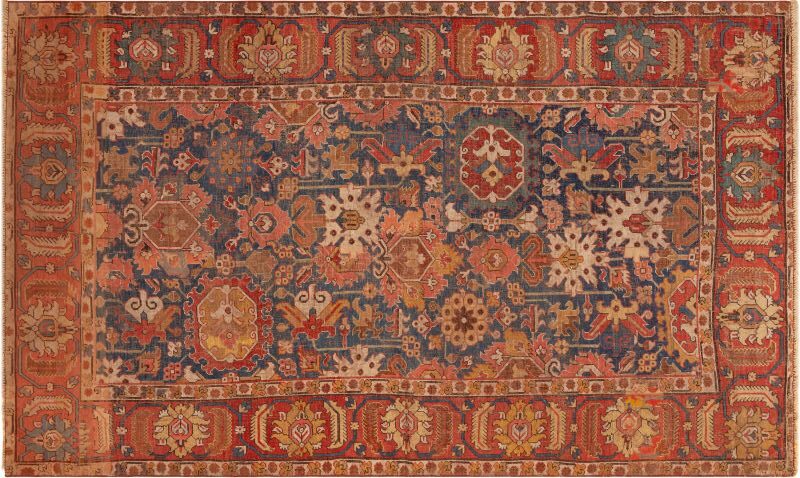
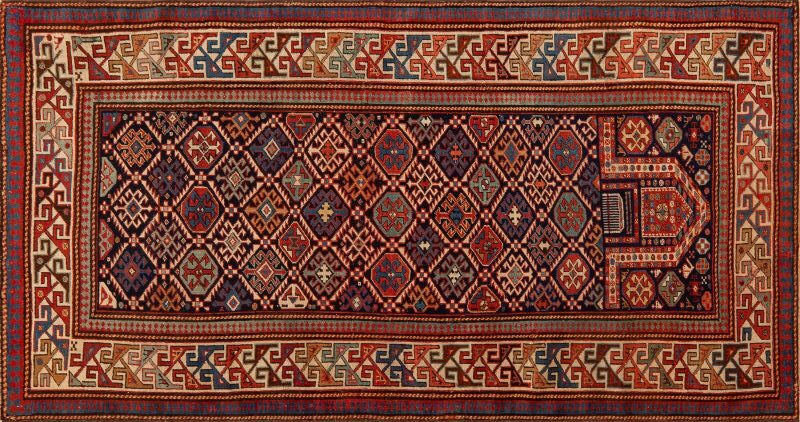
Also known as “Quba”, Kuba rugs are named after a city in modern-day Azerbaijan and reside in the eastern Caucasus between Shirvan and Daghestan. Kuba rugs are quite diverse, both in their use and their aesthetic. Populated by the Lezghi people, Azeri Turks, and occasional Tchetchen nomads, various influences resulted in the making of the Kuba rug. While Kubas also utilize medallion designs, they tend to favor an allover configuration rather than a central one. Kuba rug compositions can stray between symmetrical and asymmetrical and are known for small meticulous details. Kuba carpets are decorative as well as functional, often smaller in size and serving as prayer rugs.
Dagestan
Hailing from the Eastern part of the Caucasus is the Dagestan rug style. Dagestan can be translated to “land of the mountains” and was under Persian rule during the 13th to 19th century. The Dagestan region’s proximity to that of Kuba and Shirvan makes it similar to textiles produced in both those areas. These carpets had wool foundations and used a soft variation of colors like blues and reds with highlighted accents of gold or green. Dagestan rugs tend to be on the smaller side with allover designs reliant on the repetition of small motifs. Stripes and floral elements as well as geometric abstractions were common Dagestan staples. Occasionally, simplified mihrab or niche designs were incorporated into the carpets to add a religious element, suggesting their use as prayer rugs as well.
Karabagh
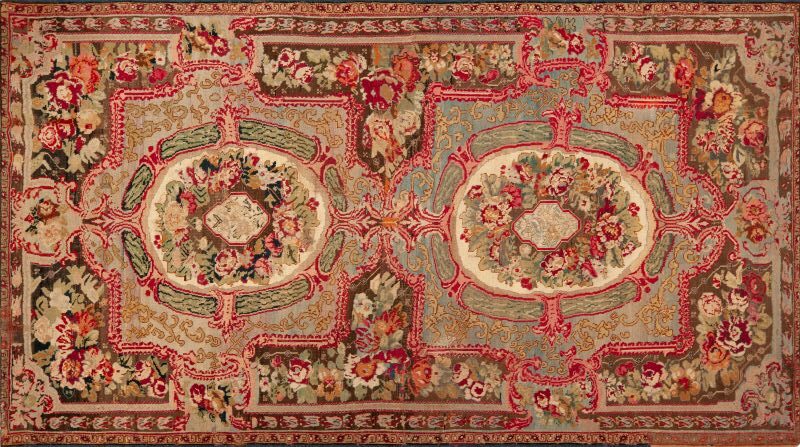
From the South Caucasus, Karabagh rugs are rooted in Armenian tradition. These textiles are recognizable through their uniquely decorative flair. Karabagh rugs tend to favor floral designs and lattice patterns rendered in saturated color reminiscent of French textiles. While most Caucasian carpets are pile-rugs, Karabagh rugs tend to have an exceptionally long pile. In terms of construction, Karabaghs are often made using the Ghiordes Turkish knot technique. Typically long, rectangular textiles, Karabaghs often fit into the “runner rug” category.
Geometric Abstractions of the Natural World
Without a doubt, geometric patterns are the overarching design element to unite the different styles of Caucasian rugs. Rugs from this region historically have been abstracting natural world features into geometric shapes to display on their rugs. Whether purely decorative or symbolic, there are plenty of motifs that reappear across different styles of Caucasian rugs.
Common Caucasian Motifs
The gul shape, sometimes referred to as the Memling gul, is an octagonal medallion design staple of Caucasian rugs, though not exclusive to the Caucasus. The gul medallion most likely originated in ancient Persia, though it’s found throughout Central and West Asia. Guls oftentimes include hook and “s” designs within its octagonal shape and represent celestial bodies like stars. Its name is derived from the Persian word for “flower”.
The Lezghi star motif is one that most commonly appears in Kuba style rugs. This star design is typically quite large with about a dozen points, giving the overall medallion a serrated edge aesthetic. Some feature a smaller, eight pointed star in its center within the larger design, and are often surrounded by other geometric shapes. This motif originated in the northeastern region of Caucasus with the nomadic Lezghi tribe.
Boteh, or paisley designs are another common element of Caucasian rugs. This is a motif still popular as modern embellishments, though its origins date back to ancient Persia. The paisley pattern appears as a teardrop shape with botanical decorative elements. While the paisley designs are especially common in Shirvan rugs, they aren’t exclusive to the Caucasus, appearing in many Indian textiles as well.
The Mihrab design is a uniquely religious element commonly found in prayer rugs, or rugs with Islamic ties. The design is a reference to a physical architectural element called the “Mihrab”. This design is a pointed arch found in the wall of Mosques. This niche always points towards Mecca, serving as a prayer directional guide for Muslim attendees. This pointed arch shape is often replicated towards the top of prayer rugs, indicating the textile’s function as a prayer rug for its user.
Final Thoughts
The Caucasus is a region of land between Europe and Asia, with the Black and Caspian Seas on either side. Today, the region is made up of Azerbaijan, Georgia, Armenia, and part of southern Russia. It’s home to some of the earliest known societies and has an interesting cultural history given its history of varying reigning empires, as well as its nomadic local cultures. Textiles produced from this region are diverse in both design and color, though all share a theme of geometric patterned elements.
- The Caucasus is an ancient region of Eurasia home to modern-day Azerbaijan, Georgia, and Armenia
- Rugs produced in the Caucasus vary design-wise due to its many foreign and domestic cultural influences
- Caucasian rugs are very diverse in terms of design depending on region and cultural background
- Geometric motifs are common across all kinds of Caucasian rugs
Frequently Asked Questions
Which modern countries make up the Caucasus region?
The Caucasus region is made up of Azerbaijan, Georgia, Armenia, and part of Southern Russia. This region is located in between the Black Sea and the Caspian Sea.
What is the most common design characteristic of Caucasian rugs?
Caucasian rugs are most commonly characterized by geometric stylizations, bold colors, and tribal motifs.
What were common cultural influences in Caucasian rug design?
Caucasian rugs were influenced most notably by Persian and Anatolian culture as well as that of local nomadic indigenous peoples.
Where can I find authentic Caucasian rugs?
The best way to find authentic rugs from the Caucasus region is through trusted collectors. The Nazmiyal Collection offers a large selection of antique Caucasian rugs.