Popular Searches
Large rugs | Oversized rugs | Floral rugs | Allover rugs | Medallion layouts | Shop by color | Rug size guide
Quick Navigation
At-a-Glance: Moroccan Rugs
- Origin: Morocco — regional and tribal production across the Atlas Mountains, Saharan regions, and Atlantic coast
- Common eras: Late 19th century onward; many prized examples are mid-20th century
- Weave / texture: Pile (often thick) • shag pile • flatweave (kilim-style) • mixed-technique pieces
- Materials: Wool is most common — often high-lanolin mountain wool; some pieces incorporate mixed fibers depending on region and purpose
- Typical sizes: Small room-size rugs • long runners and gallery proportions • oversized statement pieces
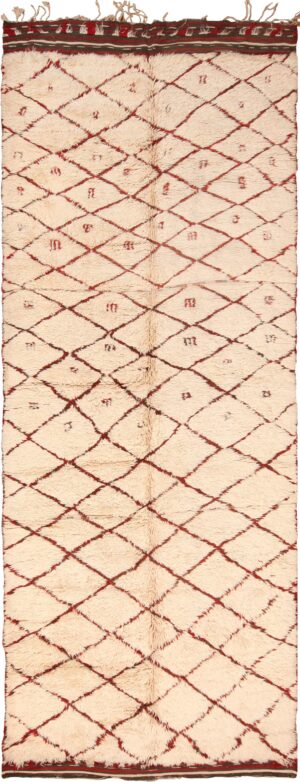
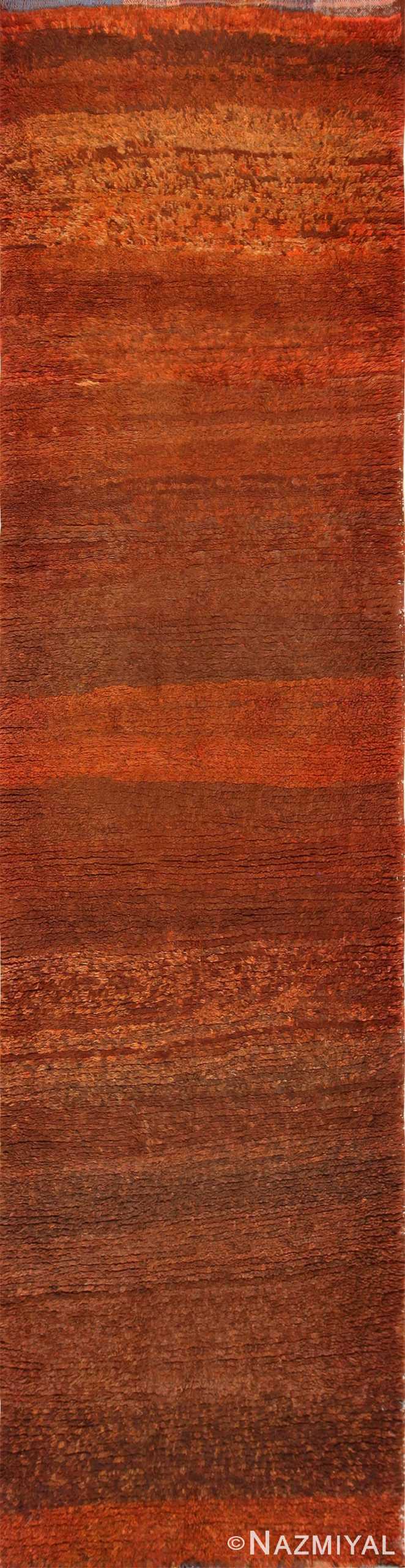
- Palette: Ivory-and-dark contrasts (especially Beni Ourain) • saturated primaries (Azilal) • earthy reds and browns • occasionally softer neutrals
- What collectors look for: Confident hand-drawn geometry • authentic line quality • appealing texture and handle • balanced wear appropriate to the intended room
What Are Moroccan Rugs?
Moroccan rugs are handwoven textiles produced by the Amazigh (Berber) peoples and other tribal and regional communities across Morocco. Unlike the formal workshop traditions of Persia — where rugs were planned in advance through detailed design cartoons and woven by skilled craftsmen in specialized ateliers — Moroccan rugs emerged primarily from domestic and tribal weaving practices. Women weavers typically produced these textiles for household use, embedding personal and community symbolism into the patterns rather than following standardized design systems.
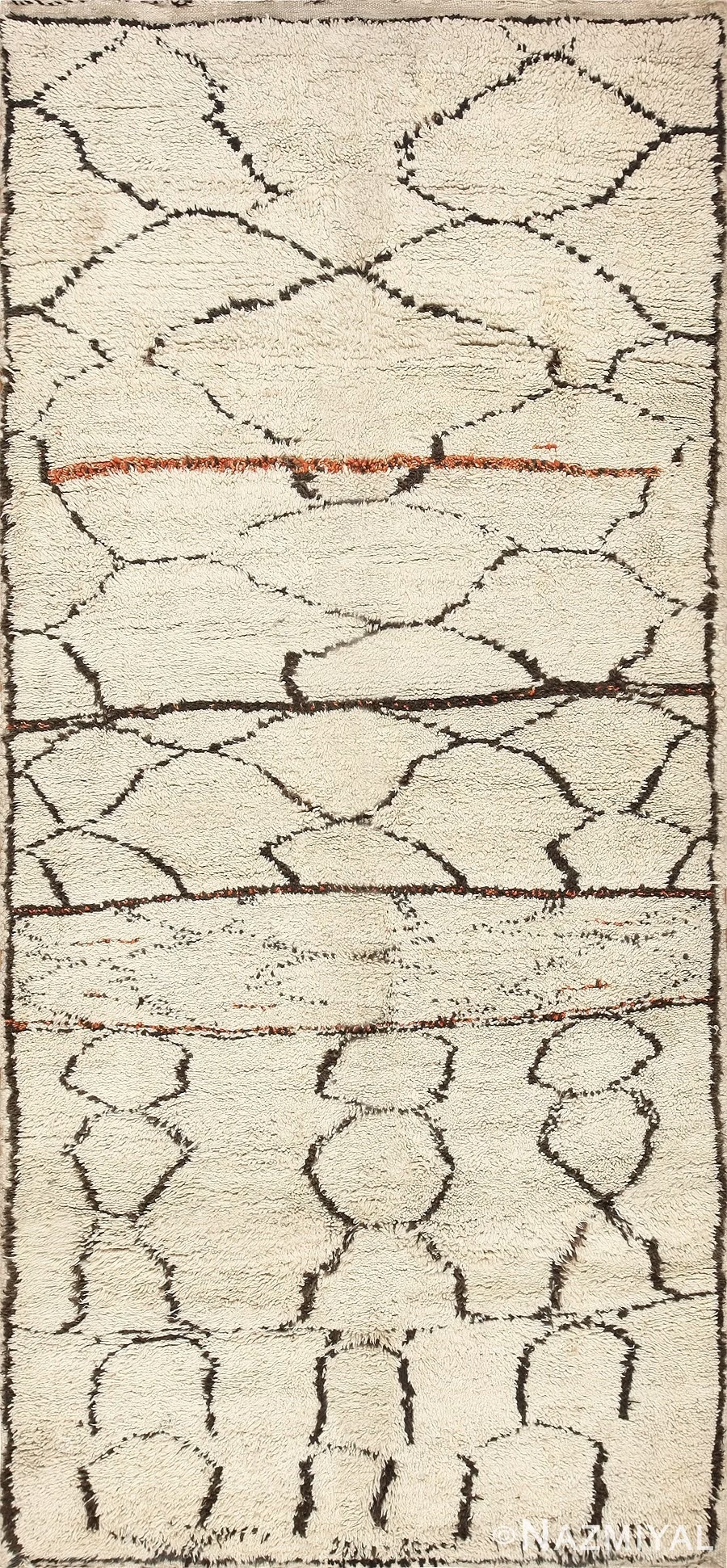
This domestic and personal origin is precisely what gives Moroccan rugs their distinctive character: open fields, bold geometry, expressive hand-drawn line quality, and a sense of individual authorship that no workshop rug can replicate. The geometry is not decorative in the conventional sense — many motifs carry protective, fertility, or spiritual meanings specific to the tribe or village of origin.
As Jason Nazmiyal notes: “What makes a great Moroccan rug is the same thing that makes a great piece of modern art — the confidence of the hand. The line quality is everything. When you see a Beni Ourain or a strong Azilal with that direct, unself-conscious drawing, there is nothing else in the rug world quite like it.”
The History and Cultural Context of Moroccan Rugs
The weaving traditions of Morocco are ancient, rooted in the Amazigh (Berber) cultures of North Africa that predate the Arab conquest of the 7th century and the later Arabization of Moroccan culture. The Amazigh people of the Atlas Mountains — the Middle Atlas, High Atlas, and Anti-Atlas ranges — developed distinct regional weaving traditions that encoded their spiritual beliefs, social structures, and natural environment into textile form.
For much of their history, Moroccan rugs were made for use within the community — as wedding gifts, household furnishings, and ceremonial objects — rather than for export. This changed dramatically in the 20th century, when European artists and intellectuals began traveling to Morocco and encountering these textiles. The graphic simplicity and bold geometry of Moroccan weaving resonated strongly with the modernist movement: the Bauhaus architects, Le Corbusier, and later the American minimalists all found in Moroccan rugs a visual language that complemented their own aesthetic values.
By the mid-20th century, Moroccan rugs — particularly the ivory-and-dark Beni Ourain pieces from the Middle Atlas — had become fixtures in the homes and studios of avant-garde designers and artists. Their appeal lay in exactly what distinguished them from the established Oriental rug tradition: no borders, no medallions, no formal symmetry — just confident geometry and extraordinary texture.
Today, Moroccan rugs are among the most collected and widely used antique textiles in Western interior design, prized equally by serious collectors and interior designers working in everything from minimalist contemporary to maximalist bohemian aesthetics.
For further reading: What Are the Different Styles and Types of Moroccan Rugs?
Why Nazmiyal Collection
Nazmiyal Collection has been a trusted source for vintage and antique Moroccan rugs for over 44 years. When you are shopping for vintage Moroccan rugs online, trust comes from genuine expertise and honest presentation — not marketing claims.
- Unmatched Inventory Depth — A wide range of Moroccan looks: pile, shag, flatweave; minimal to colorful; small accent pieces to oversized statement rugs. Our selection covers the full spectrum of the tradition.
- Rigorous Authenticity Standards — Every piece is evaluated by specialists for materials, construction, and condition. Clear, accurate listings so the rug you love is the rug you receive.
- Expert Advisory — Practical guidance on scale, placement, and value from specialists with decades of hands-on experience with Moroccan textiles specifically.
As Rodolfo, our senior specialist with 45 years of experience, notes: “Moroccan rugs are among the most honest textiles in the world. The weaver’s hand is completely visible — there is no template, no cartoon, no workshop formula. That directness is exactly what makes them so powerful in a room, and so difficult to fake convincingly.”
Identification & Construction
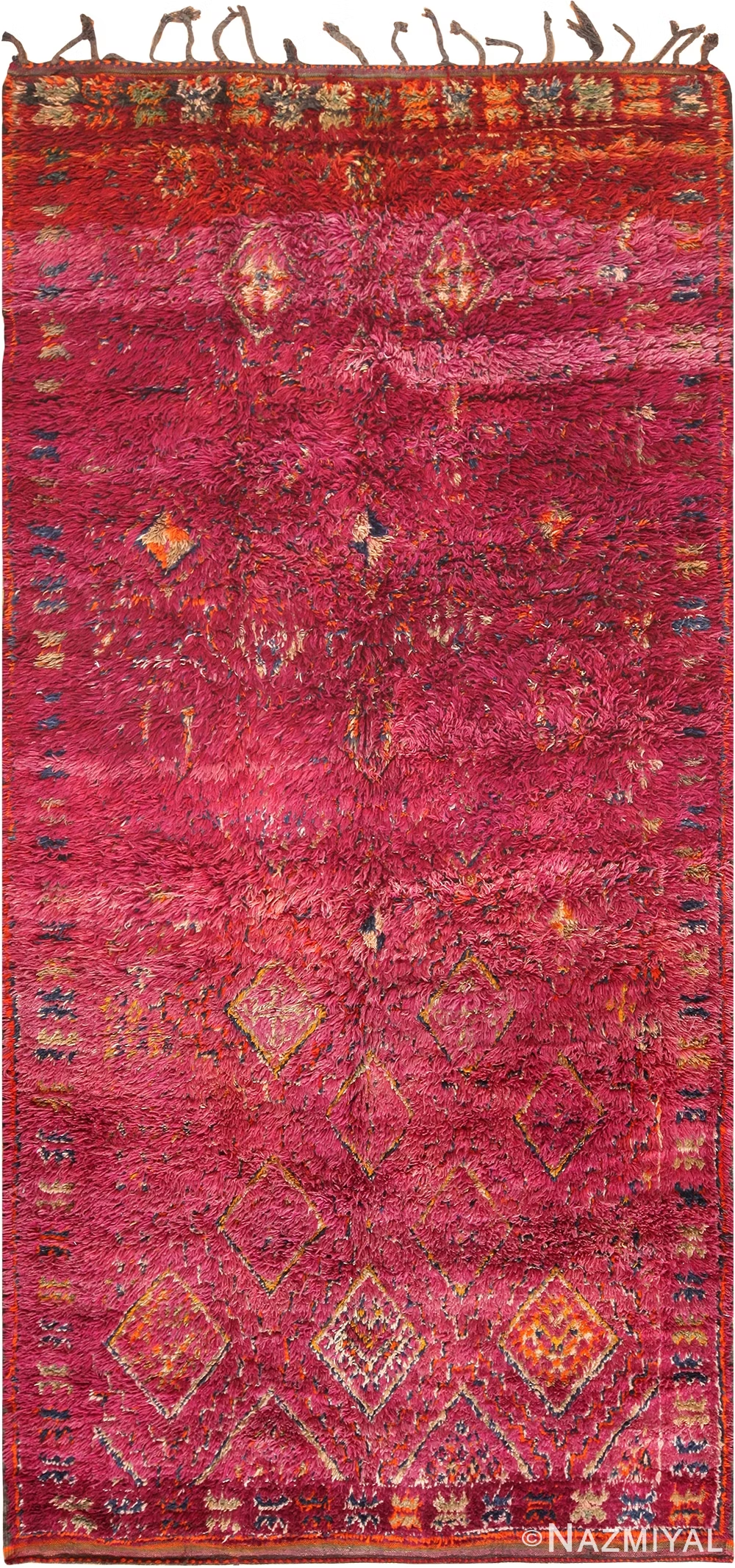
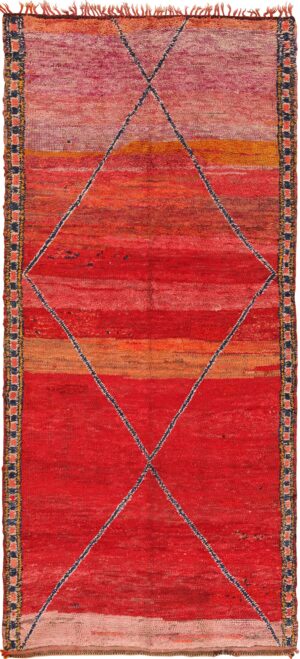
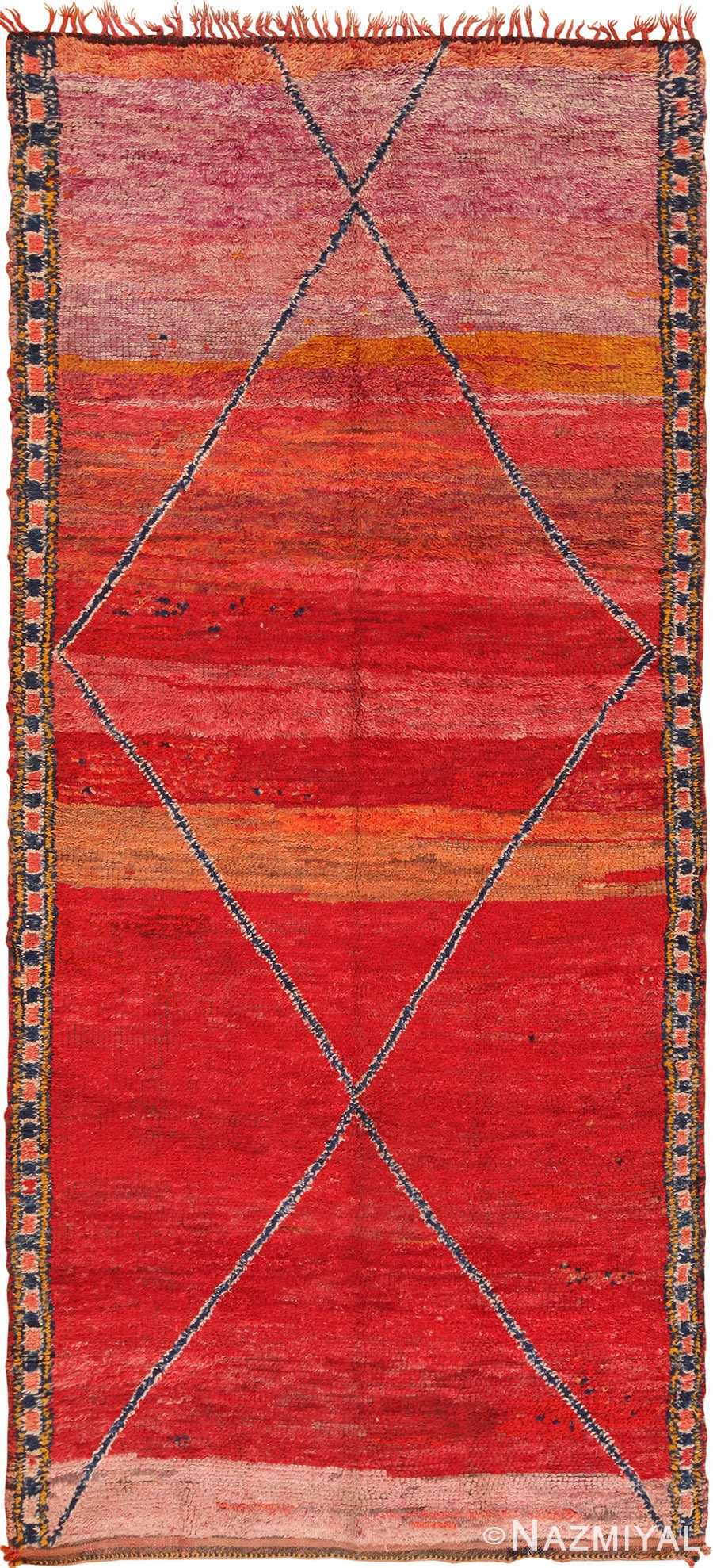
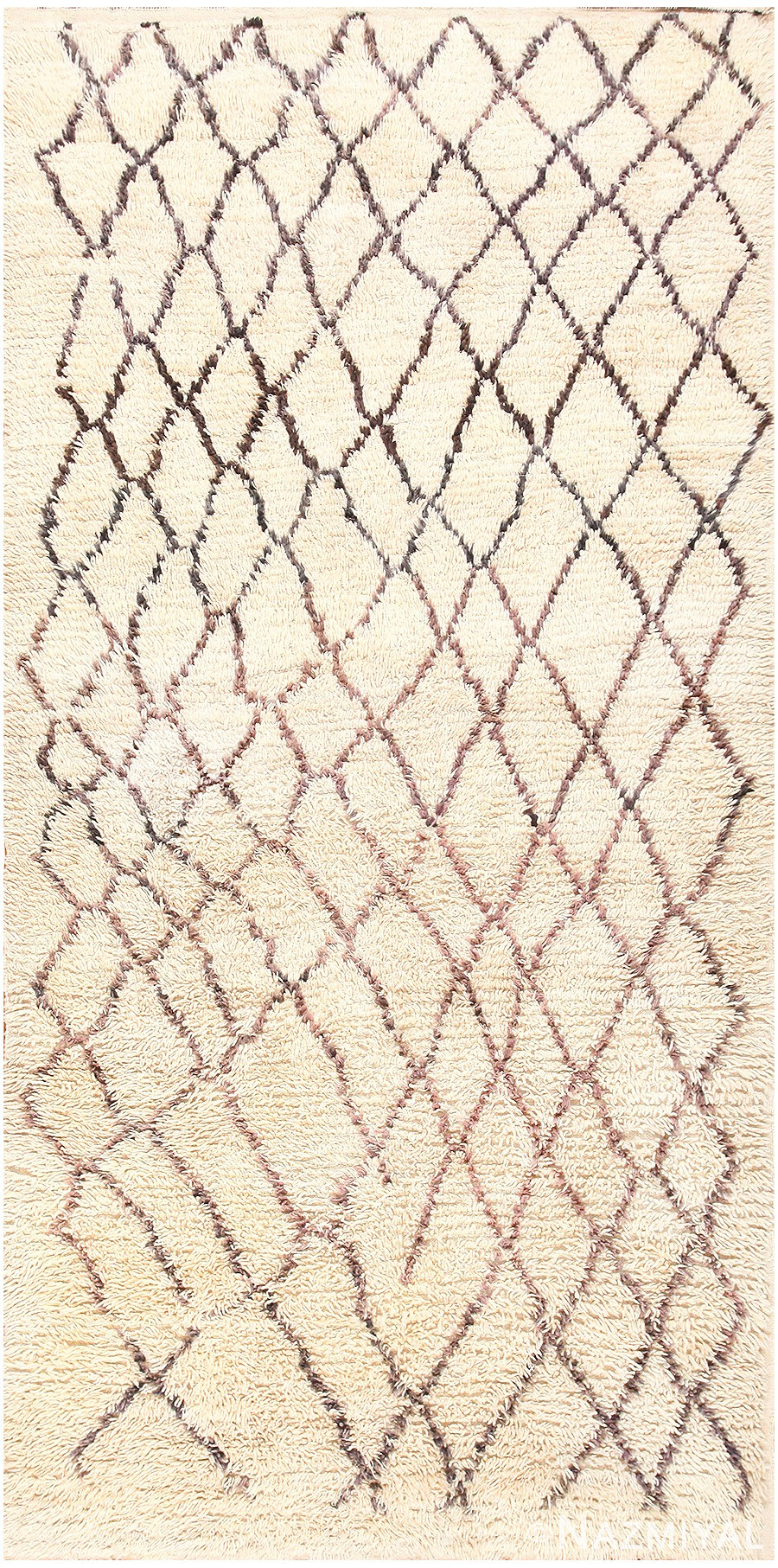
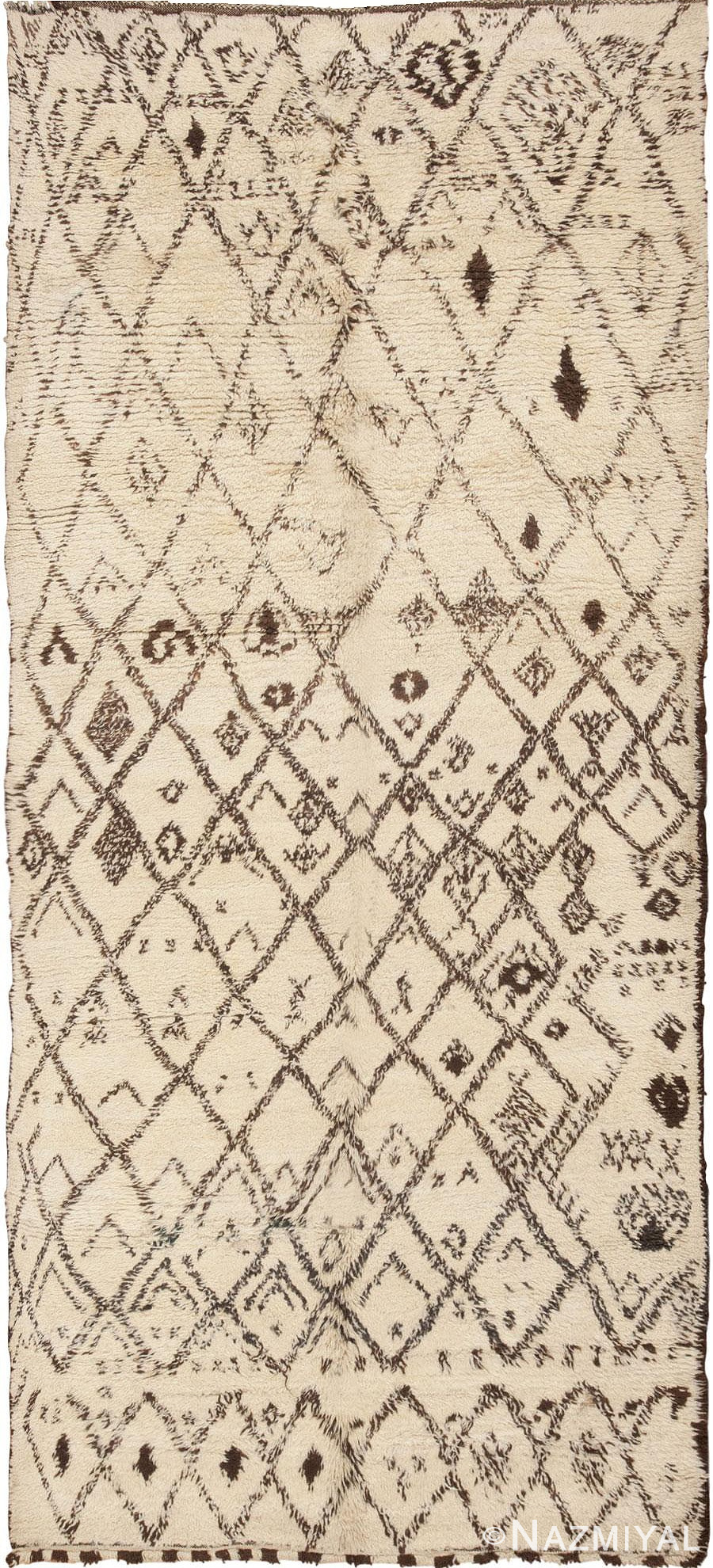
The most reliable way to identify a genuine vintage Moroccan rug is by its design character: open or lightly structured fields, bold geometric motifs — lozenges, diamonds, zigzags, or freehand line-work — and a hand-drawn quality that feels personal rather than workshop-standardized. Most Moroccan pieces are borderless or use minimal framing, which lets the field read like a modern artwork. This borderless composition is itself a key distinguishing feature from Persian and Turkish traditions where elaborate border systems are typical.
In construction terms, Moroccan rugs can be pile-woven (with varying pile heights, including shaggy surfaces) or flatwoven. Wool is the most common material — often high-lanolin mountain wool from sheep grazed at altitude, which gives the pile a characteristic warmth and resilience. Variation in handle is normal: some rugs feel dense and springy, while others feel more relaxed and pliable. Slight irregularities in pattern are expected and desirable — they are evidence of hand-drawing rather than mechanical reproduction.
If you are comparing origins and regional context across the wider rug world, start with our Rug origins hub.
Decorating & Placement
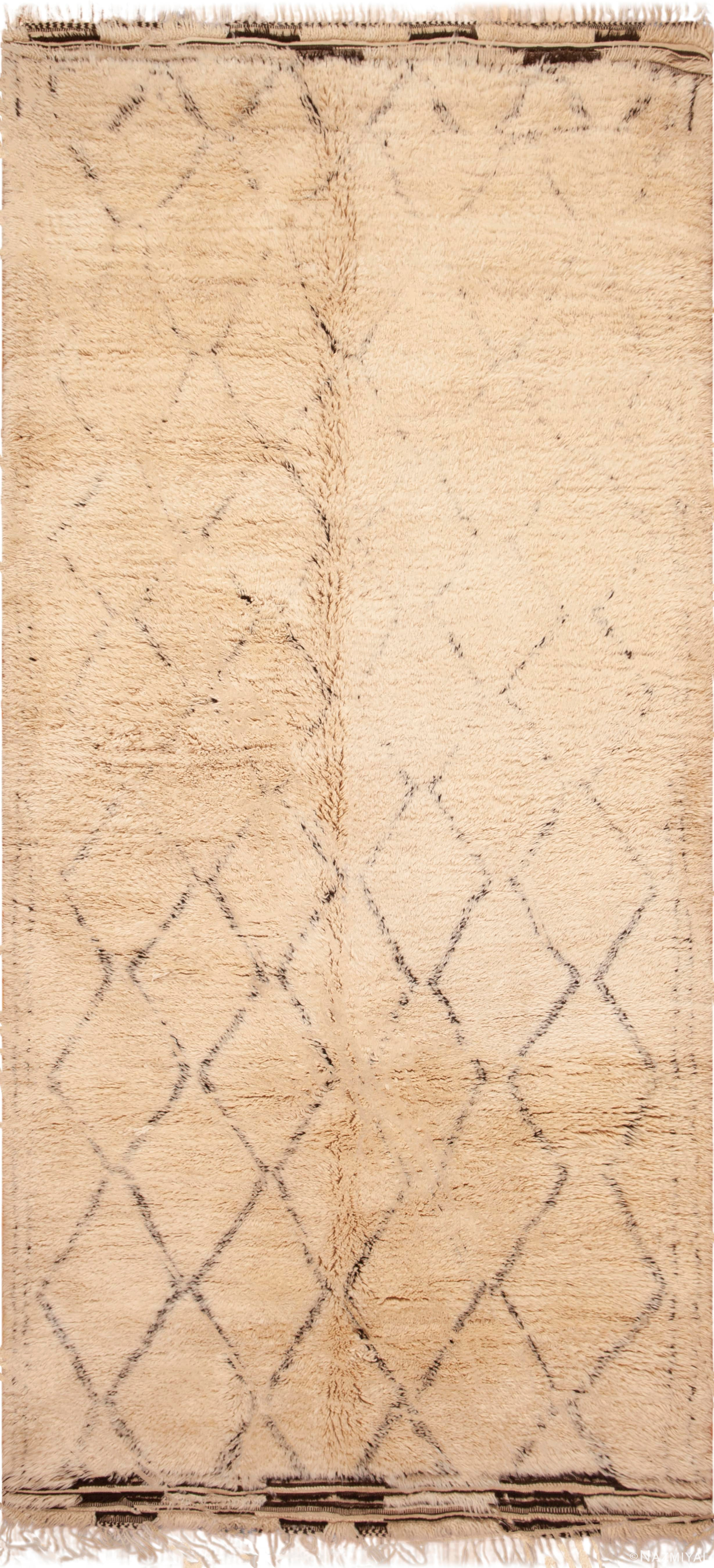
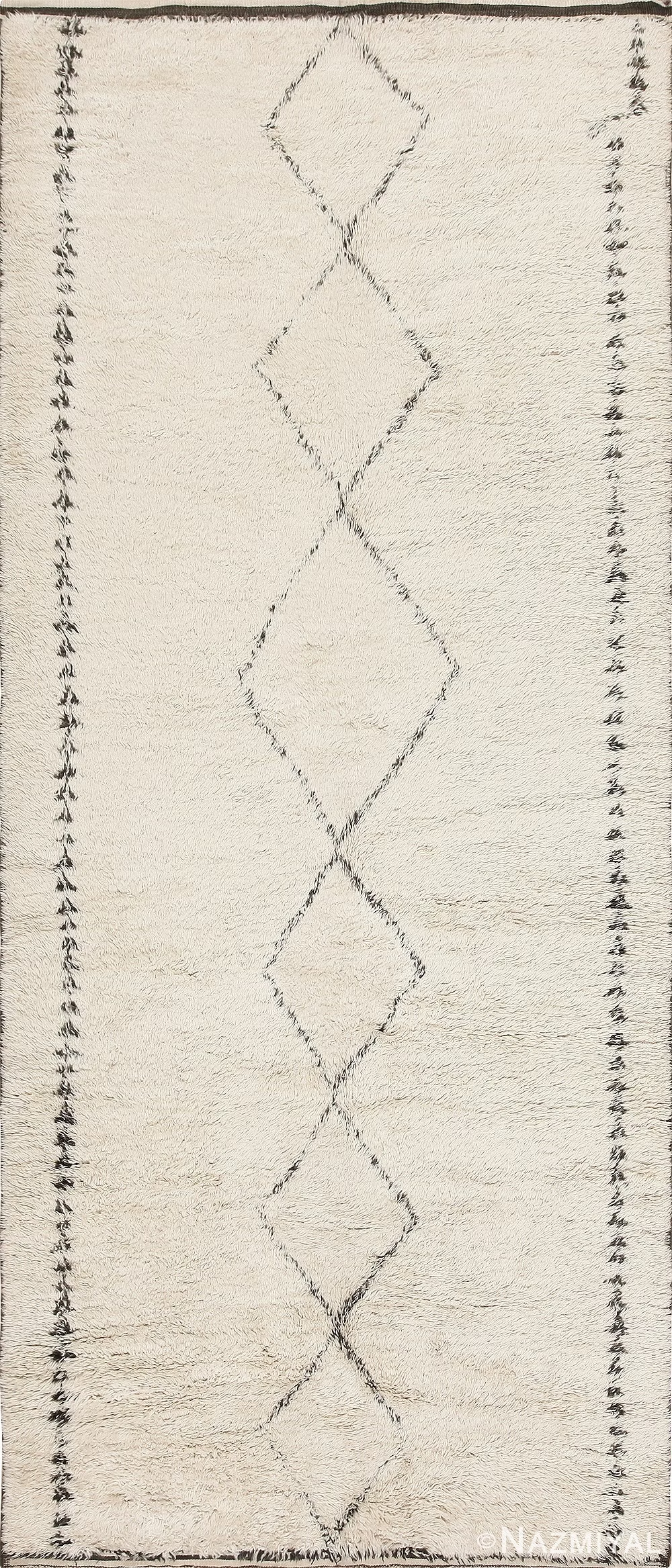
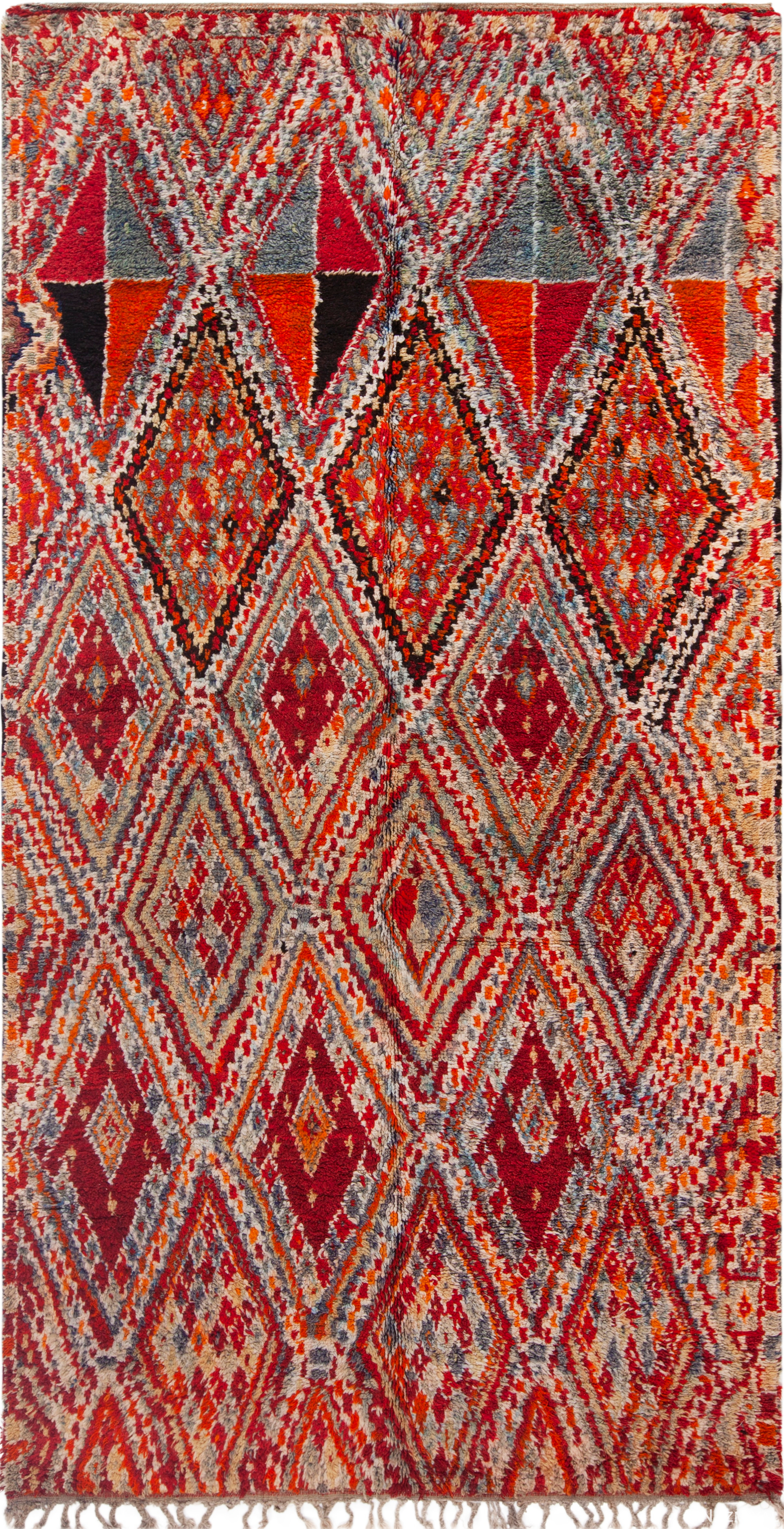
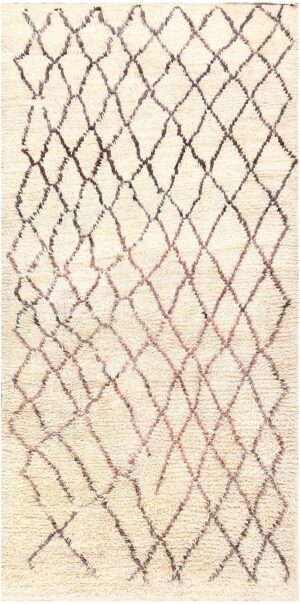
Designers often use Moroccan rugs as the element that sets the room’s energy — the graphic anchor around which everything else is arranged. An ivory-and-dark Beni Ourain lattice can calm and ground a space, providing a neutral base that lets furniture and art take the foreground. A color-forward Azilal or Boucherouite becomes the room’s focal point, pulling together disparate tones from across the space.
In living rooms, room-size Moroccan rugs unify seating areas with a crisp, graphic base that works particularly well with natural materials — linen, wood, leather, stone. In bedrooms, plush pile adds warmth and softness underfoot and creates a visual anchor for the bed. In hallways and galleries, longer-format Moroccan pieces create rhythm and visual interest without the weight that a heavily patterned Oriental runner would impose.
For a layered, collected look, Moroccan pieces pair naturally with curated antique rugs, clean-lined vintage rugs, and graphic modern rugs — especially when you repeat one or two tones from the rug in pillows, art, or upholstery.
Moroccan Rugs vs Moroccan Berber Rugs
Moroccan rugs are an umbrella category; Moroccan Berber rugs are a major and highly influential subset within that tradition. If your goal is a specific look — especially minimalist lattice designs and plush pile — this comparison helps you choose faster.
| Feature | Moroccan Rugs (all types) | Moroccan Berber Rugs |
|---|
| Design range | Broad: from colorful Azilal symbolism to graphic Beni Ourain minimalism to flatweave kilim geometry | Often emphasizes tribal symbolism, strong geometry, and a handmade personal line quality specific to Amazigh tradition |
| Texture | Can be pile, shag, or flatweave depending on region and tribe | Frequently pile-focused including plush and shag textures, though regional variation exists |
| Best use | Choose based on the room’s mood: calm neutrals or high-impact color; pile or flatweave | Ideal when you want a modernist, minimalist foundation with strong tactile presence and authentic tribal character |
| How to shop | Decide first: pile vs flatweave, neutral vs color, and the right scale for your furniture layout | Focus on line quality, pile feel, and the balance of negative space to motif |
Moroccan sub-styles to explore:
Moroccan Beni Ourain rugs •
Moroccan Berber rugs •
Flat woven Moroccan kilims •
Moroccan shag rugs
Glossary
- Amazigh / Berber: Indigenous peoples of North Africa whose weaving traditions — stretching back centuries before the Arab conquest — include many of Morocco’s most iconic rug styles. The Amazigh are not one homogeneous group but a collection of distinct tribal communities with their own visual traditions.
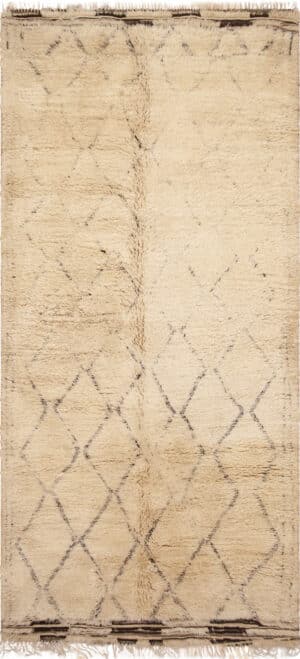
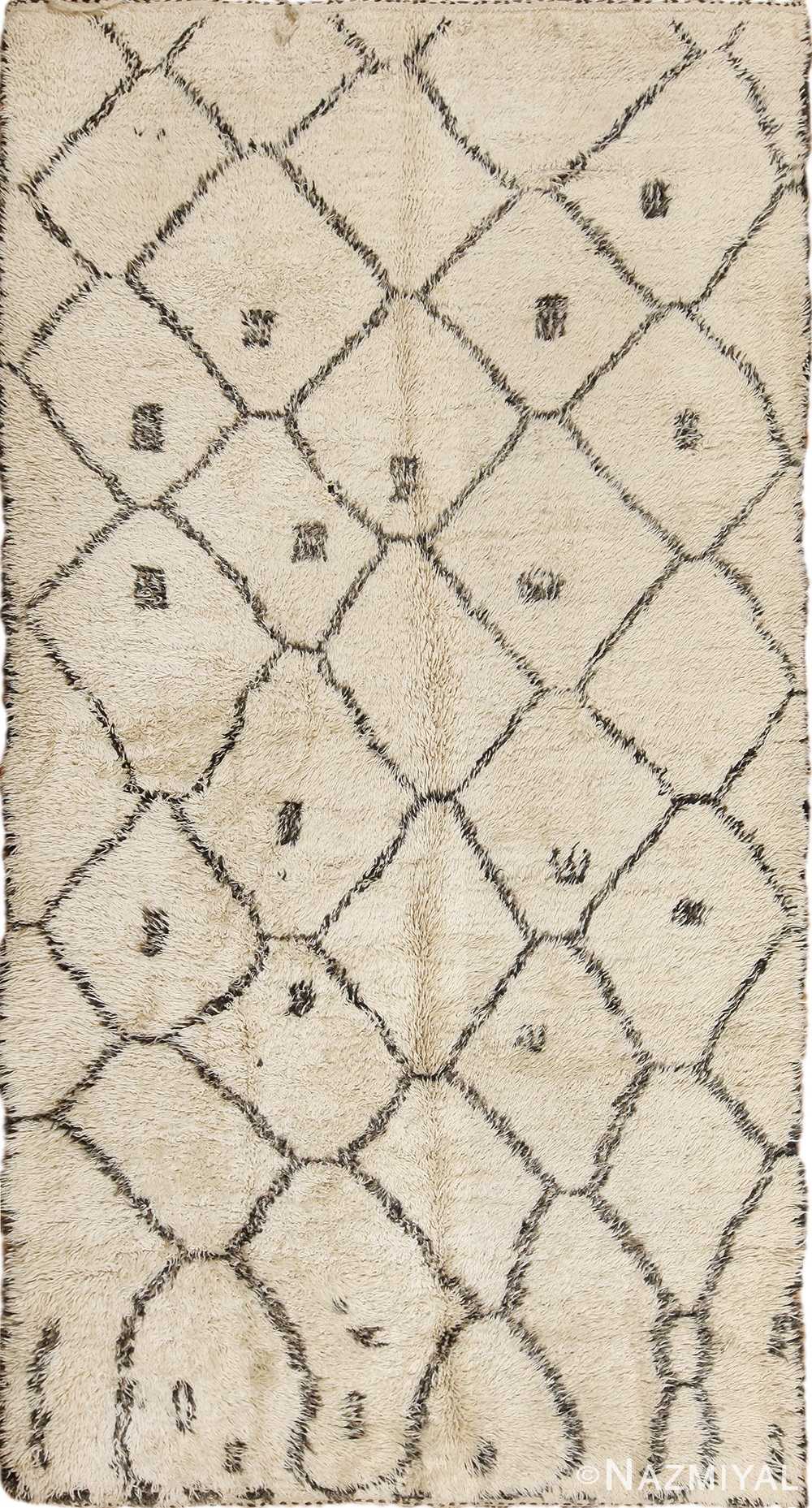
- Beni Ourain: A confederation of Berber tribes from the Middle Atlas Mountains, known for ivory-and-dark geometric pile rugs that became iconic in 20th-century modernist interiors.
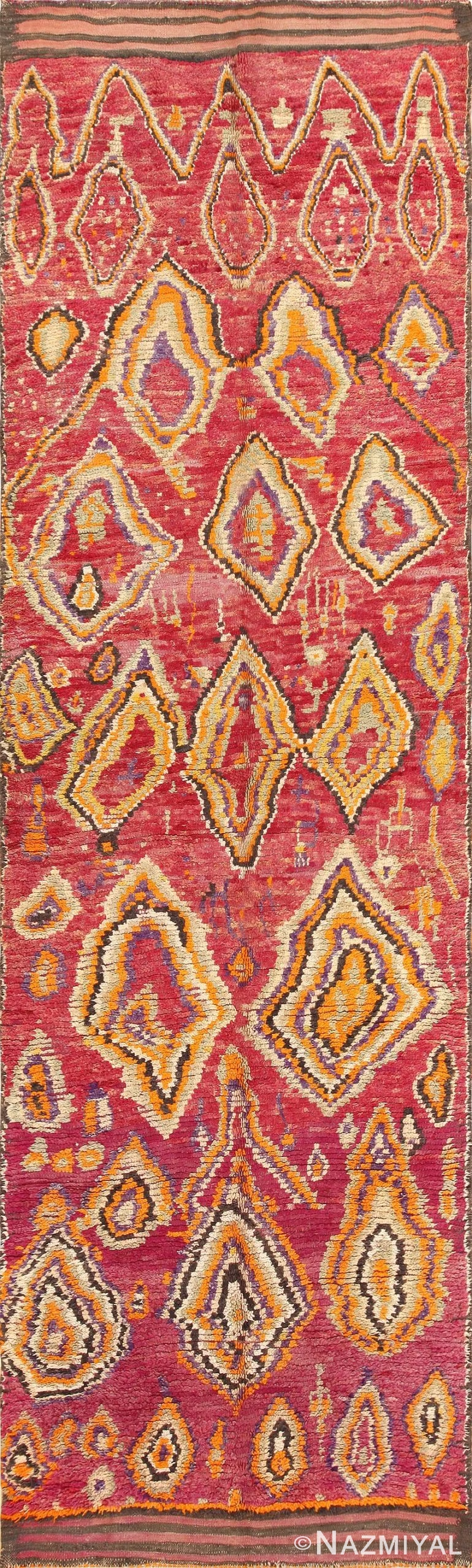
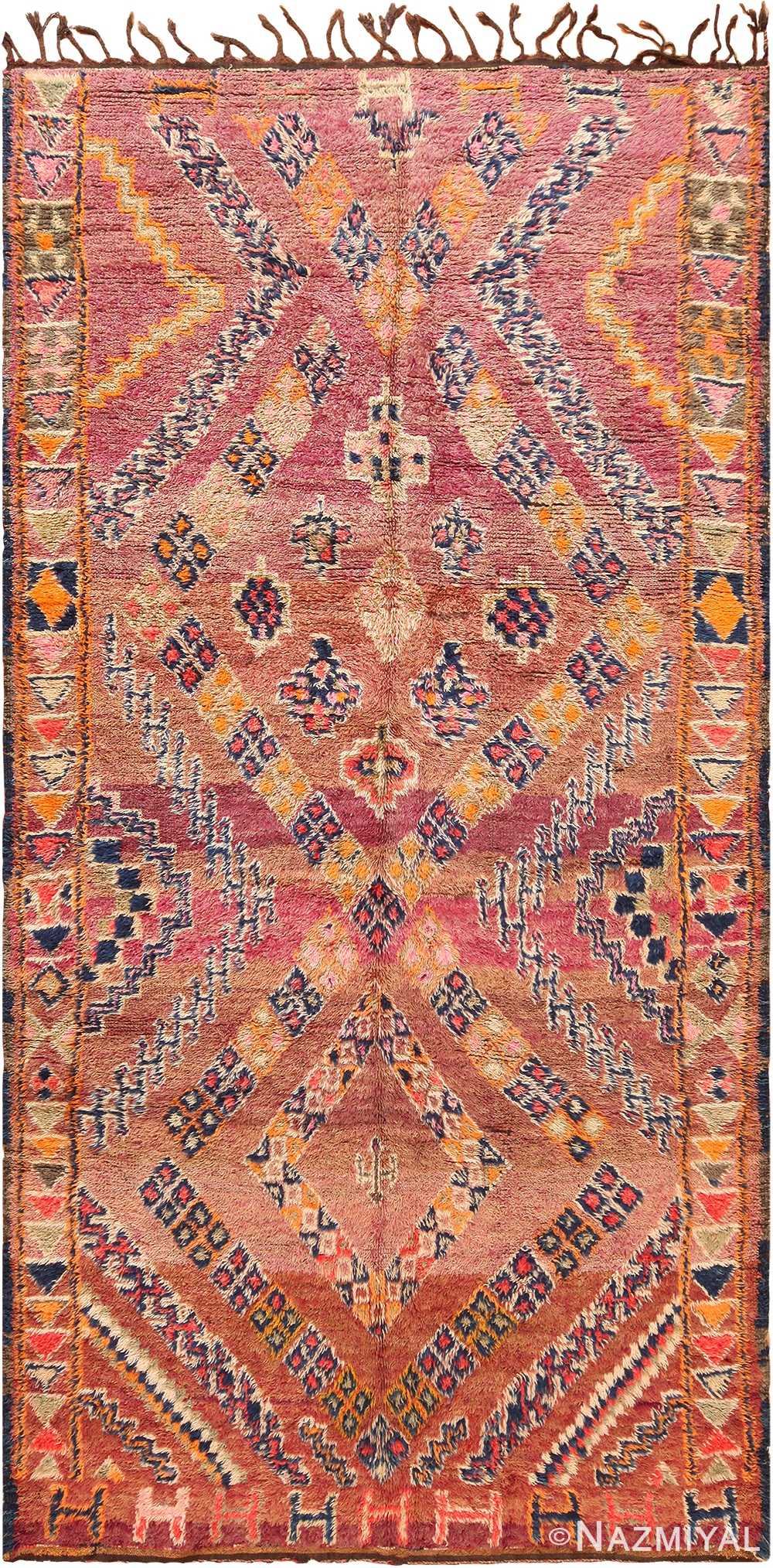
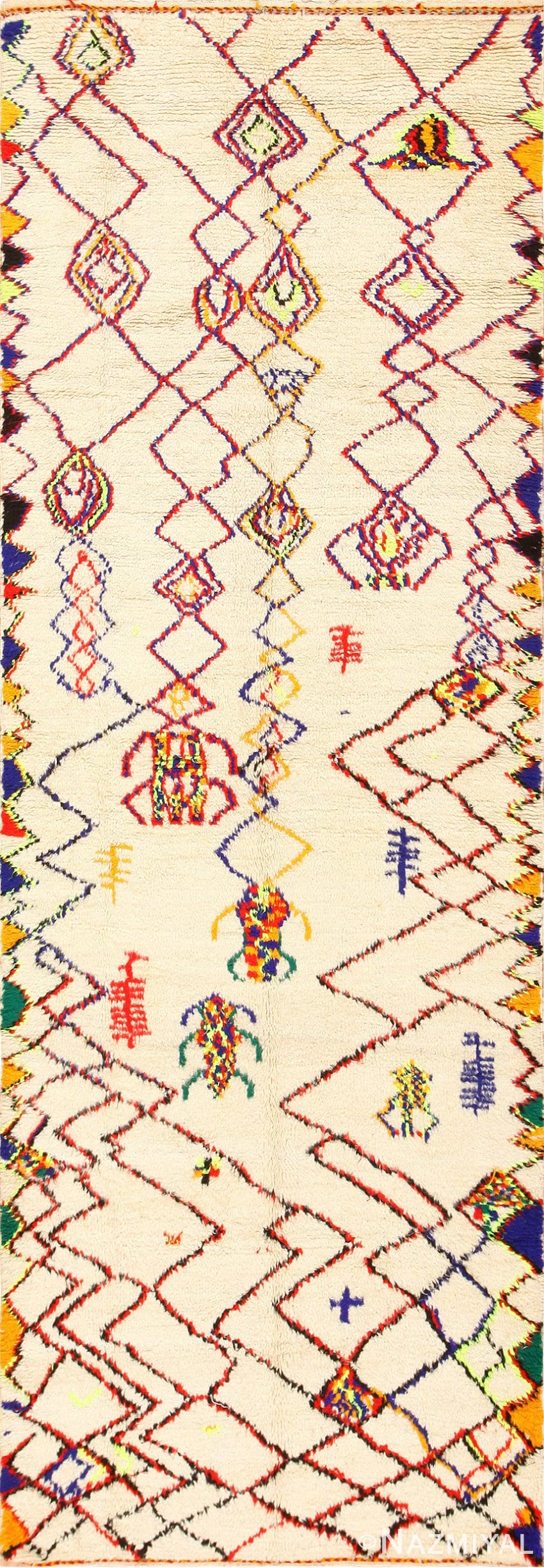
- Azilal: Rugs from the High Atlas region, typically more colorful than Beni Ourain, with playful and expressive geometry.
- Pile: The raised surface created by knots; pile height ranges from low and dense to plush and shaggy.
- Flatweave (kilim-style): A woven textile with no pile, typically more graphic and lighter in feel.
- Lozenge / diamond motif: A common geometric form in Moroccan design, used as a field structure or repeating emblem carrying protective or fertility symbolism.
For more terms, see the Rug glossary.
Frequently Asked Questions About Moroccan Rugs
What defines a Moroccan rug?
Moroccan rugs are handwoven textiles produced by the Amazigh (Berber) peoples and other tribal communities of Morocco. They are distinguished by bold geometric design, open field compositions without formal borders, and a hand-drawn line quality that reflects individual and tribal authorship rather than workshop standardization. Construction ranges from thick pile weavings to flatwoven kilim-style textiles.
Are Moroccan rugs always Berber?
Many of the most collectible Moroccan rugs are rooted in Amazigh (Berber) tribal traditions, but Moroccan rugs as a category includes multiple regional approaches and workshop contexts within Morocco. Beni Ourain, Azilal, and Boucherouite are all distinct Berber traditions, but there are also flatwoven kilims and other Moroccan textiles from different communities and contexts.
Why did Moroccan rugs become so popular in Western interior design?
Mid-20th-century modernist designers and architects — including Le Corbusier and later American minimalists — were drawn to Moroccan rugs precisely because they looked like modern art. No borders, no medallions, no formal symmetry — just bold geometry, extraordinary texture, and the direct expression of an individual weaver’s hand. That graphic quality made them natural companions to modernist furniture and architecture, and their influence has only grown since.
What is the difference between Beni Ourain and other Moroccan rugs?
Beni Ourain rugs come from a specific confederation of Berber tribes in Morocco’s Middle Atlas Mountains. They are characterized by ivory or cream pile with dark geometric motifs — typically lozenges or diamond lattice forms — and a plush, high-lanolin wool texture. Other Moroccan traditions like Azilal tend to be more colorful and expressive, while Boucherouite rugs use recycled fibers for a more eclectic aesthetic.
Are vintage Moroccan rugs durable enough for everyday use?
Many are hard-wearing, especially pieces in wool pile construction. The high-lanolin mountain wool used in many Moroccan rugs is naturally resilient and ages well. Durability depends on weave density, existing condition, and how the rug will be used — a plush Beni Ourain in a low-traffic bedroom will last very differently than the same piece in a high-traffic entryway.
Do Moroccan rugs work in modern interiors?
Exceptionally well — this is one of the defining qualities of the tradition. Moroccan geometry and open fields are widely used in minimalist and contemporary rooms because they read as graphic and architectural rather than overly ornate. An ivory Beni Ourain can anchor almost any modern living room without competing with the furniture or art.
How do I choose the right size Moroccan rug?
Start with furniture layout. For living rooms, aim to fit the front legs of all seating on the rug — this defines the conversation area without requiring an enormous piece. For bedrooms, a large rug under the bed with significant exposure on both sides creates the most luxurious effect. For hallways and galleries, Moroccan runners and longer-format pieces work particularly well.
Can I buy a Moroccan rug remotely from Nazmiyal?
Yes. We provide detailed condition reports, precise measurements, and high-resolution photography for every piece. Our 3-day return policy applies to international purchases — if the rug is not right for your space, you may return it. Contact our team to begin.
Nazmiyal White-Glove Service
We make it easy to shop with confidence — whether you’re choosing a single statement piece or curating a full room.
Nazmiyal Collection has been a trusted source for antique rugs and vintage carpets for over 44 years. Our NYC gallery curates one-of-a-kind pieces with an emphasis on authenticity, provenance, and lasting decorative value.
Need help? Call us at (212) 545-8029 or contact our team to work with a rug specialist.

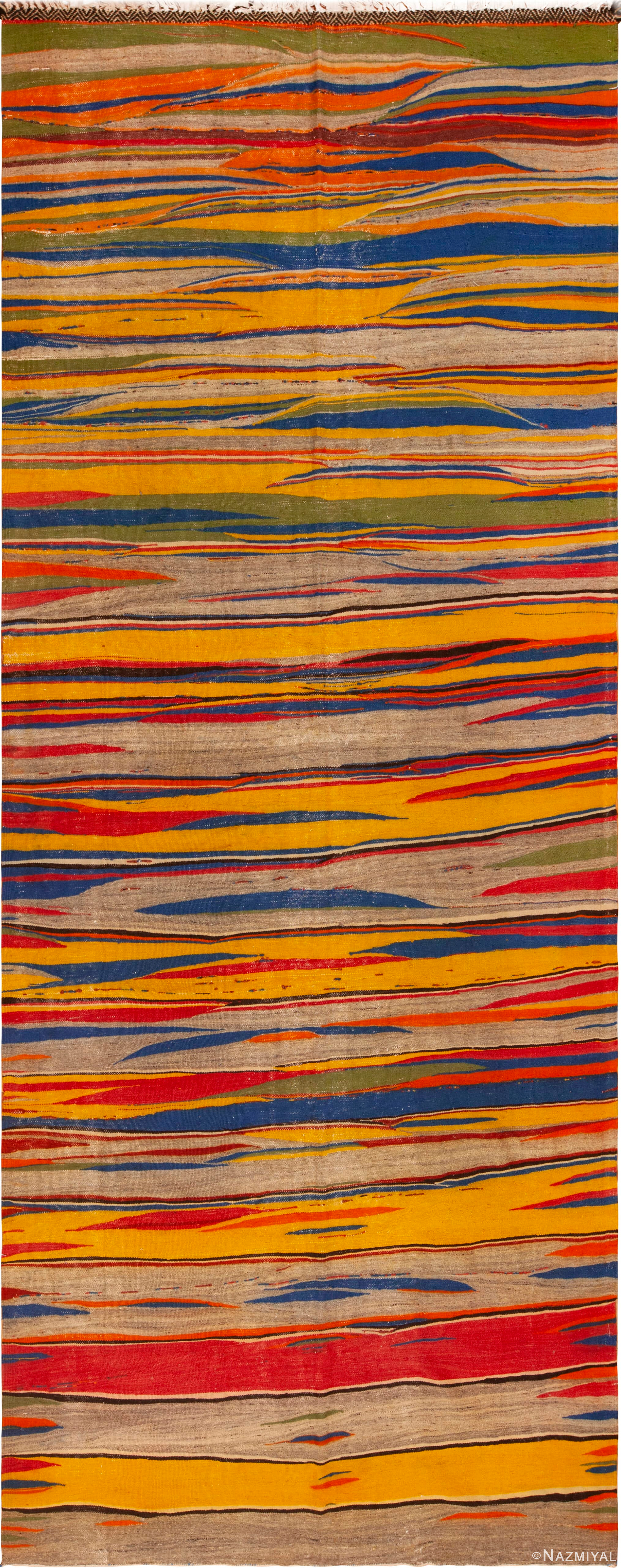
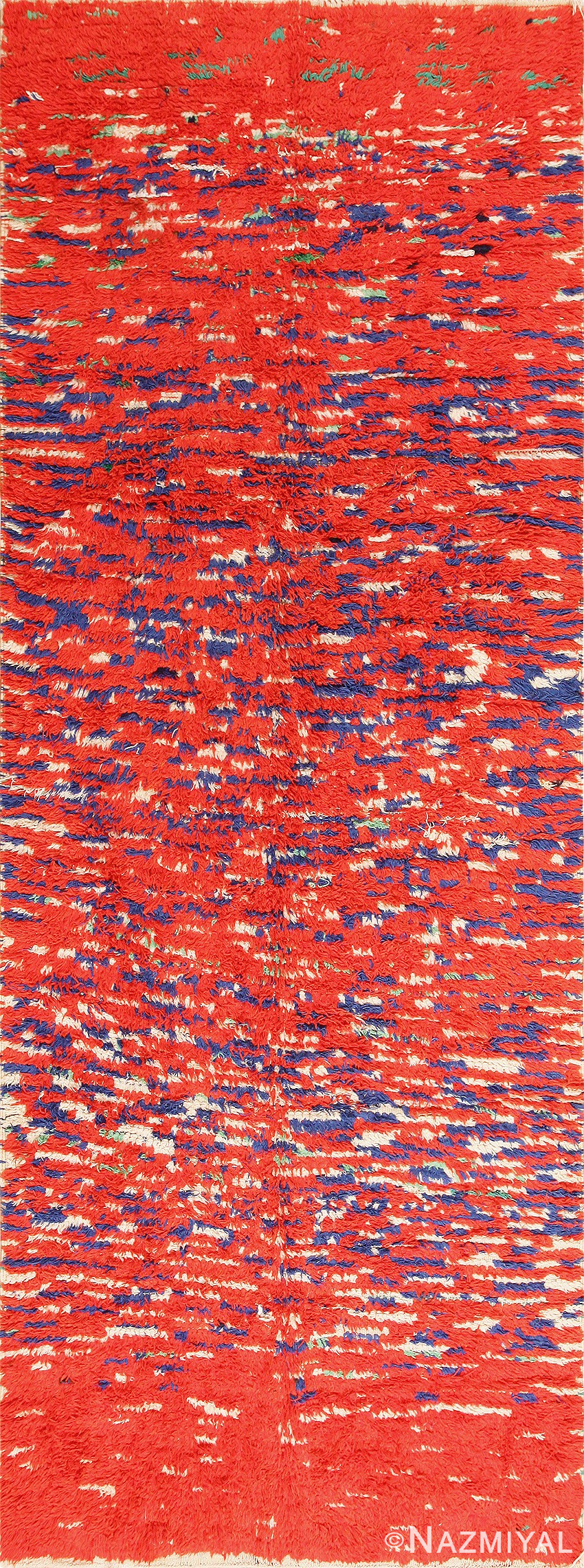
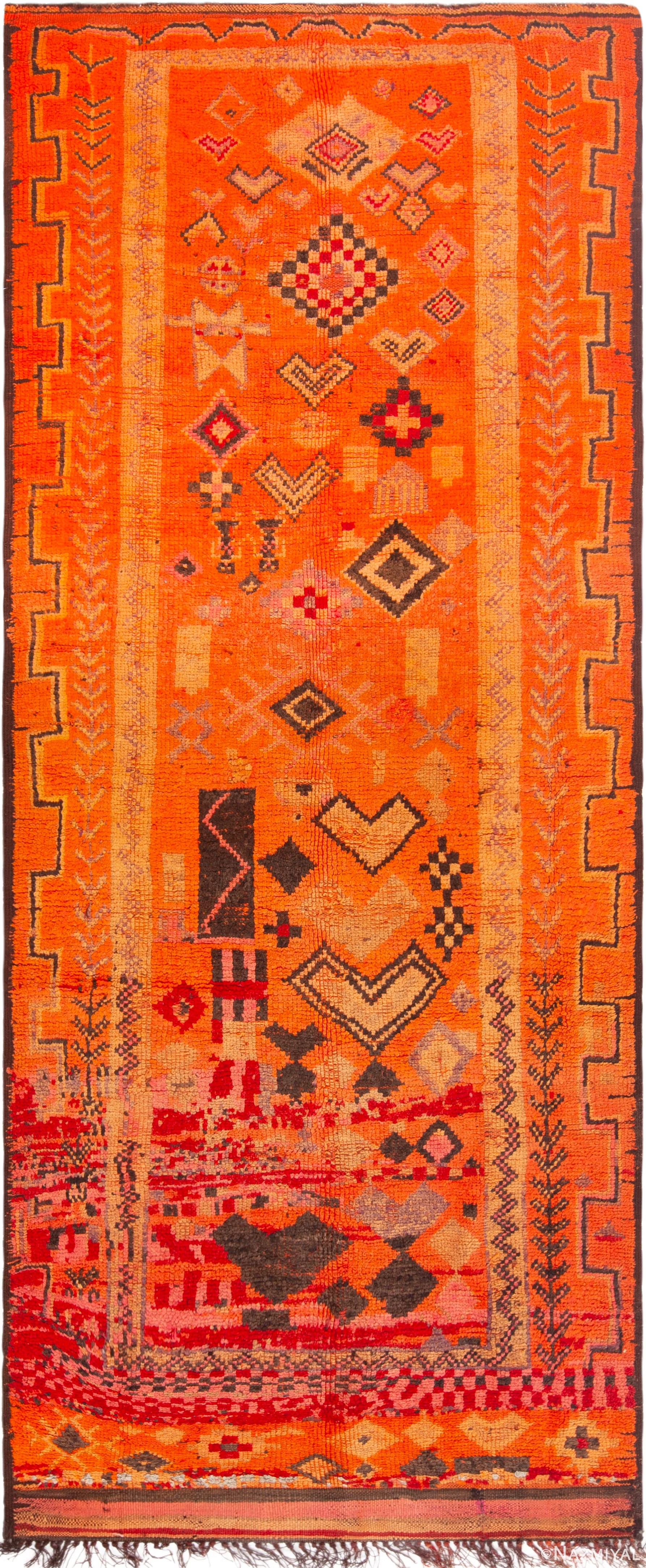
 Size: 3 ft 9 in x 14 ft 6 in (1.14 m x 4.42 m)
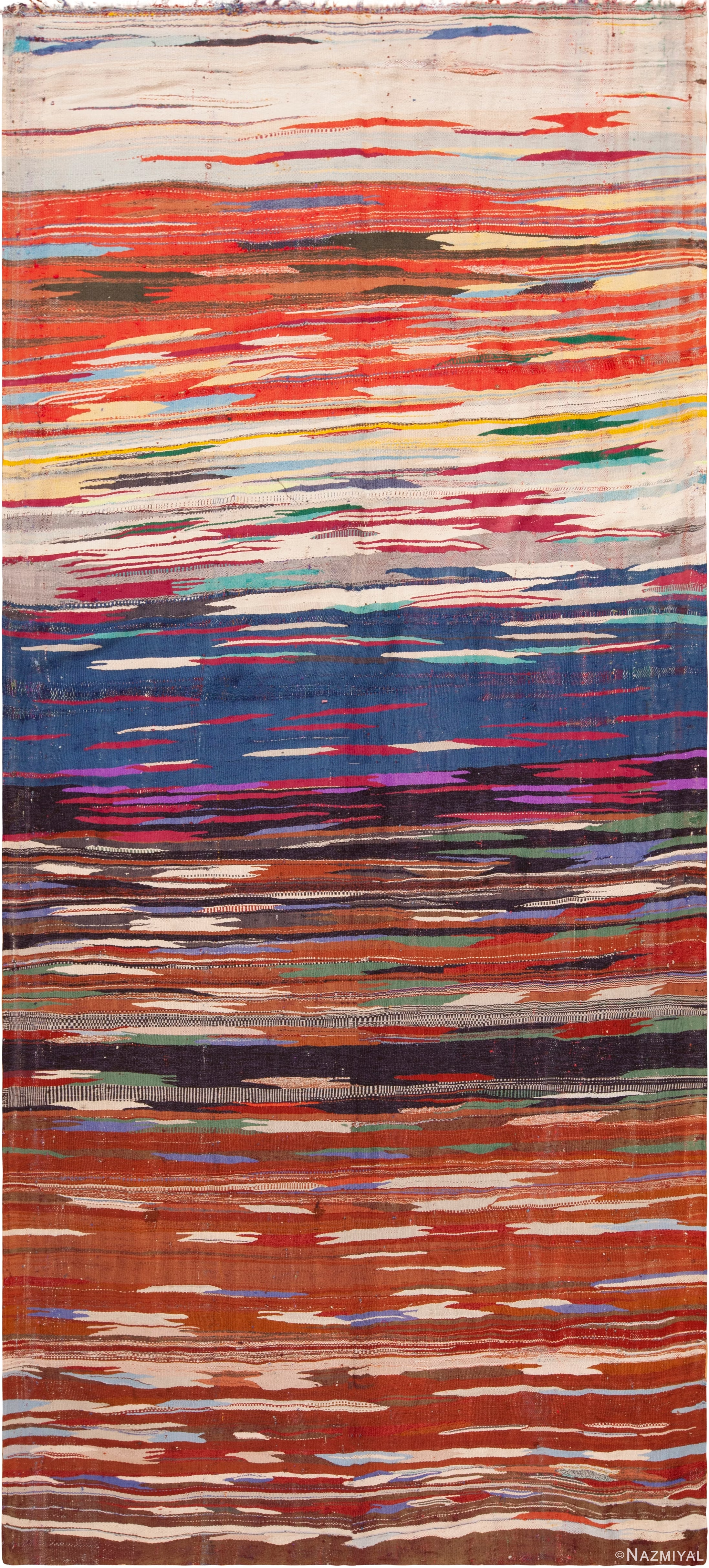
 Size: 5 ft 8 in x 13 ft 10 in (1.73 m x 4.22 m)
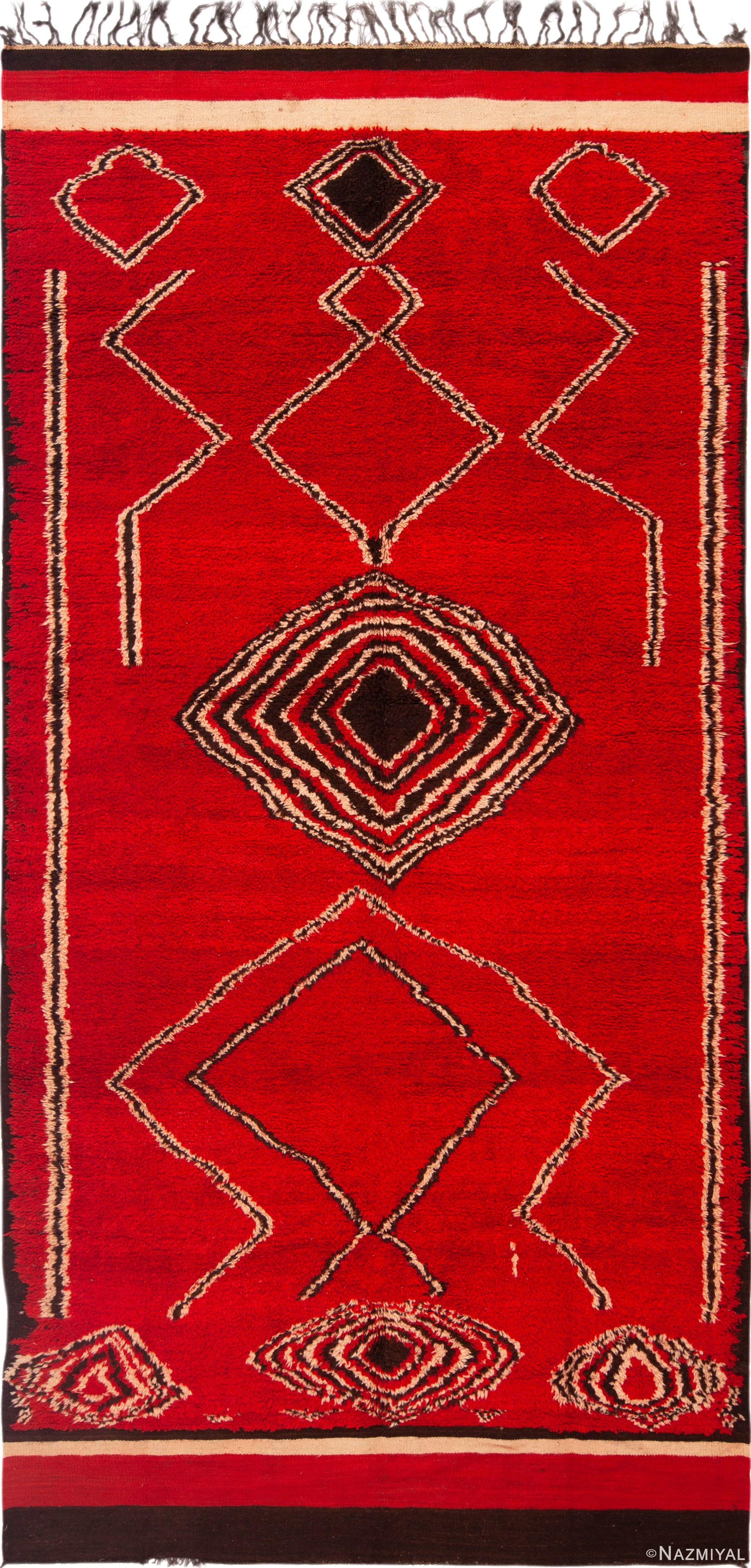
 Size: 6 ft 6 in x 13 ft 9 in (1.98 m x 4.19 m)