What Is a Gobelin Tapestry?
A Gobelin tapestry is a woven wall tapestry associated with the Manufacture des Gobelins in Paris, one of the most important tapestry workshops in French decorative art. The name comes from the Gobelin family, dyers and cloth makers whose Paris workshop site later became tied to royal tapestry production.
In a strict historical sense, a Gobelin tapestry refers to work connected to the Gobelins manufactory. In broader modern usage, “gobelin” may also describe tapestry-style woven fabric or wall hangings inspired by this French textile tradition. True Gobelins works are valued for their detailed weaving, artistic designs, rich colors and close connection to French court taste.
The Manufacture des Gobelins became especially important under King Louis XIV, when it supplied tapestries and furnishings for royal residences. Related French textile traditions, including French rugs and tapestries, tapestries and Savonnerie carpets, remain important to collectors, designers and decorative arts historians today.
Throughout the 17th century and beyond, the Manufacture des Gobelins remained the leading tapestry manufacturer in Europe. Over the years, the Manufacture hosted some of the best French designers, including Charles Le Brun (1619-1690), Jean-Baptiste Oudry (1686-1755) and François Boucher (1703-1770). Le Brun was the creative director at the royal palace, Oudry is well-known for his paintings of animals and Boucher is credited with being the first French rococo painter.
French Decorative Art Before the Gobelins Manufactory
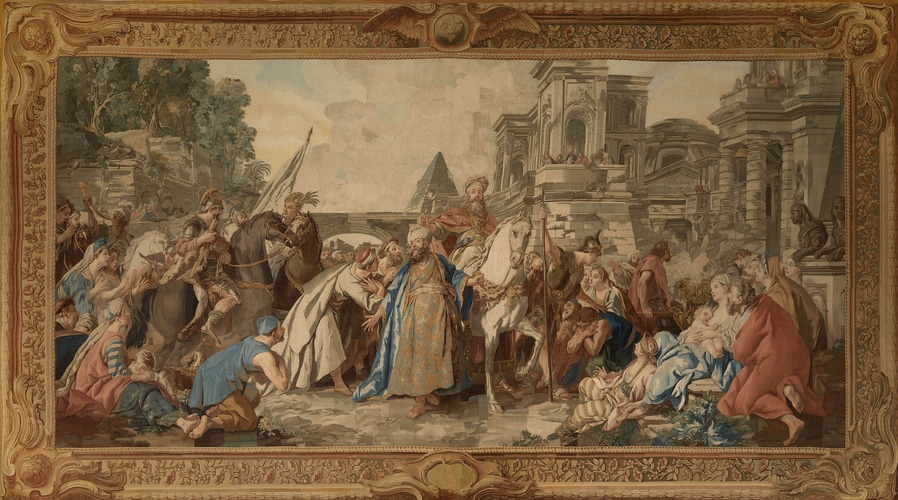
During the Renaissance, the French Fontainebleau School gained prominence as a center for fine art, architecture and tapestry design. Under the patronage of Francis I and his successors, Fontainebleau helped shape the visual language used by the French court. Between 1538 and 1550, the Fontainebleau School operated a royal tapestry works that helped prepare the ground for later French tapestry production.
The demand for French decorative art and French rugs and tapestries continued to increase steadily into the mid-1600’s and well into the late 1700’s. In 1664, two Flemish weavers established a factory in Beauvais in northern France. This site became the leading exporter of tapestries while the Gobelins site continued to be the designated supplier to the French court. The Beauvais manufactory, which specialized in low-warp weaving, received some state subsidies but continued to operate as a private business well into the 18th century.
History of the Gobelins Tapestry Factory
The Gobelins were a family of dyers and weavers who settled in the Faubourg Saint Marcel region to the southeast of Paris in the mid-1400’s. Jehan Gobelin (c. 1410-1476) founded the factory, where he discovered a scarlet dye that he actively promoted. The Gobelins made a substantial profit in the dye industry well into the 1500’s, finally abandoning the endeavor in the latter part of the 16th century.
King Henry IV (1553-1610) was seeking to establish a French tapestry industry to compete with businesses in Antwerp and Brussels. In 1601, he leased the Gobelins plant, inviting Flemish weavers to relocate to France to assist in developing a competitive enterprise. François de la Planche and Marc de Comans, the king’s Flemish tapestry weavers, ran the works until 1629. Control of operations passed to their sons Raphael de la Planche and Charles de Comans until 1650. The partnership dissolved that year, resulting in the establishment of two separate workshops.
In 1662, Louis XIV acquired the factory buildings and adjoining grounds, which he devoted to the production of general upholstery. Under the official title “Manufacture Royale des Meubles de la Couronne”, the restructured factory supplied the king with tapestries and furnishings for the royal residences. Antique carpets were not supplied by the Gobelins works but were instead produced by the Savonnerie factory. The king appointed Charles Le Brun, his official painter and creative manager, to serve as the director of the newly established Manufacture Royale.
Le Brun hired a large workforce, including goldsmiths, carpenters and furniture makers, painters and weavers whose job it was to provision the king’s palaces with tapestries and furnishings. Le Brun himself was an accomplished tapestry designer and created “Louis XIV Visits the Gobelins Manufacture” as well as several cartoons for “The Four Elements”, “The Four Seasons” and “The Months of the Year”.
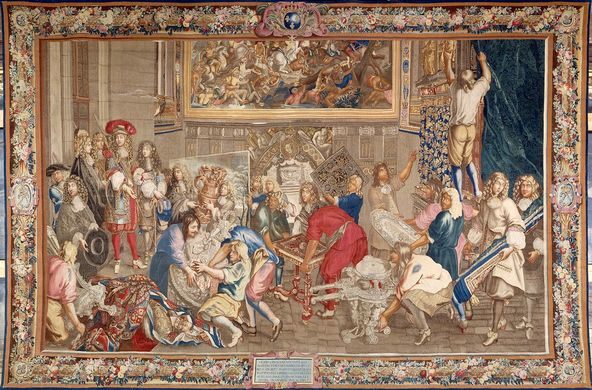
During the reign of Louis XIV, it was common for tapestries to exalt the monarch. Weavers were paid according to order type and complexity, and craftsmen who created flesh tones and human figures typically commanded the highest salaries. The ending of the reign of Louis XIV in the 18th century gave way to themes that were more casual and more visually varied, with the inclusion of new colors and innovative designs.
In 1694, Louis XIV’s financial problems resulted in the temporary closing of the factory. The works reopened three years later only to weave tapestries and remained the leading European tapestry supplier throughout most of the 18th century.
The factory was closed again during the Revolutionary period but was reopened by Napoleon and continued to evolve during the 15-year Bourbon Restoration that began in 1815. Production of Savonnerie carpets was moved to the Gobelins factory in 1826, and operations were consolidated under one roof.
The Gobelin Tapestry in the Modern Era
The Gobelins factory continued to make significant strides during the Era of Modern Art that began in 1850 and that continued for nearly a century after that. The factory suffered a setback in 1871, when supporters of the ill-fated Paris Commune burned down several of the workshops at Gobelins. In 1912, the French architect Jean-Camille Formigé (1845-1926) designed and built a replacement structure on avenue des Gobelins.
During the early 1900’s, abstract art and Surrealism began to dominate the modern art movement. The shift in aesthetic perspective was reflected in the new designs that were being created for Gobelins tapestries and Savonnerie rugs. The motifs that became part of modern French tapestries exerted a permanent influence on the designs that were later introduced by carpet workshops in other countries.
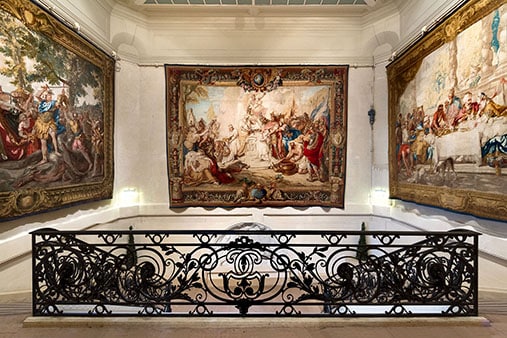
The present-day Gobelin tapestry factory is operated by the French Ministry of Culture and consists of four historic buildings that date back to the 17th century and the newer building that was built after the fire of 1871. The buildings house workshops that served as foundries for the bronze sculpture at Versailles Palace, as well as the looms where the distinctive Gobelins tapestries are still woven using techniques that were developed in the 1600’s. The tapestry works and its associated Gobelins Museum are located at 42 avenue des Gobelins in Paris.
Explore Antique French Tapestries from the Nazmiyal Collection
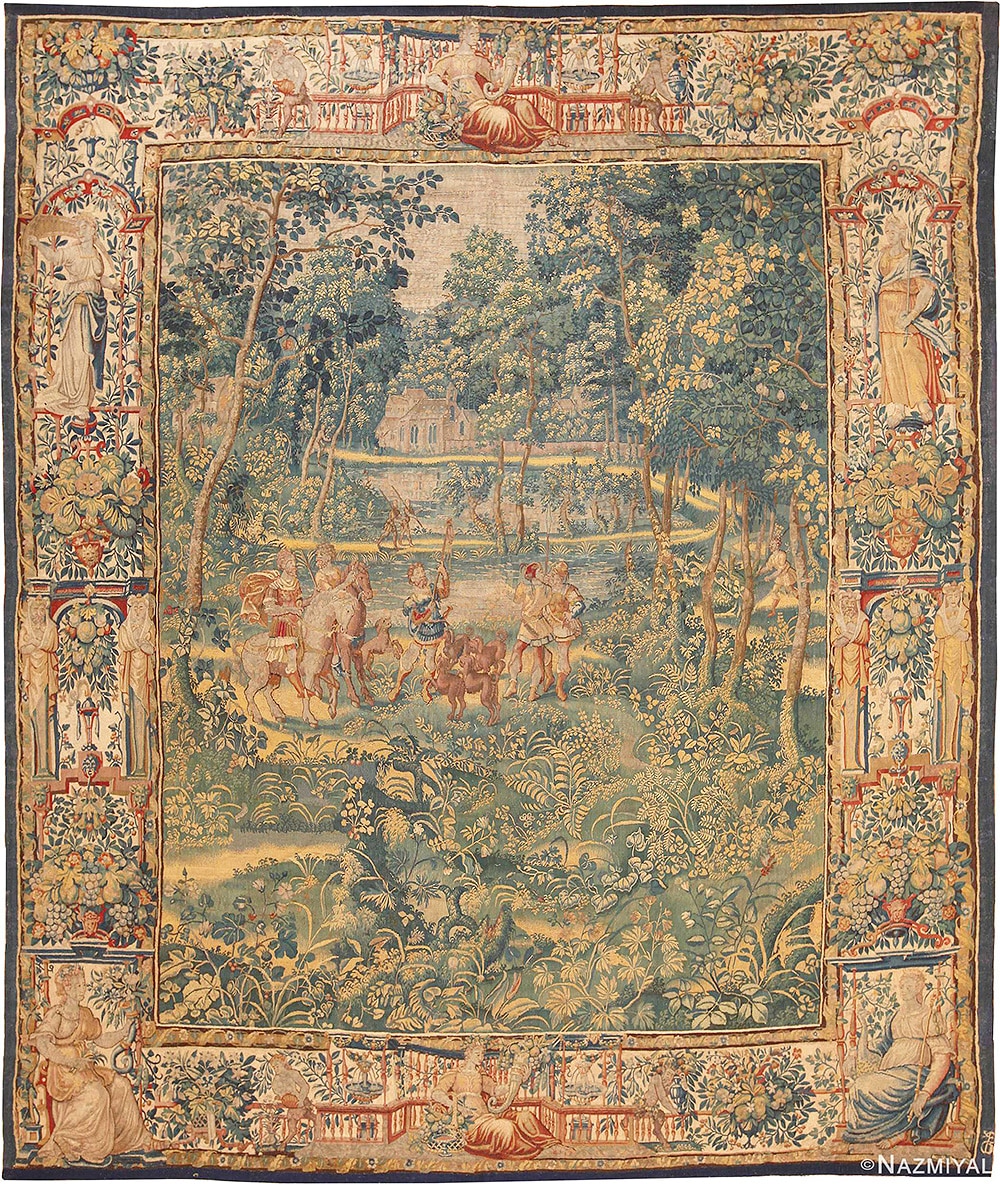
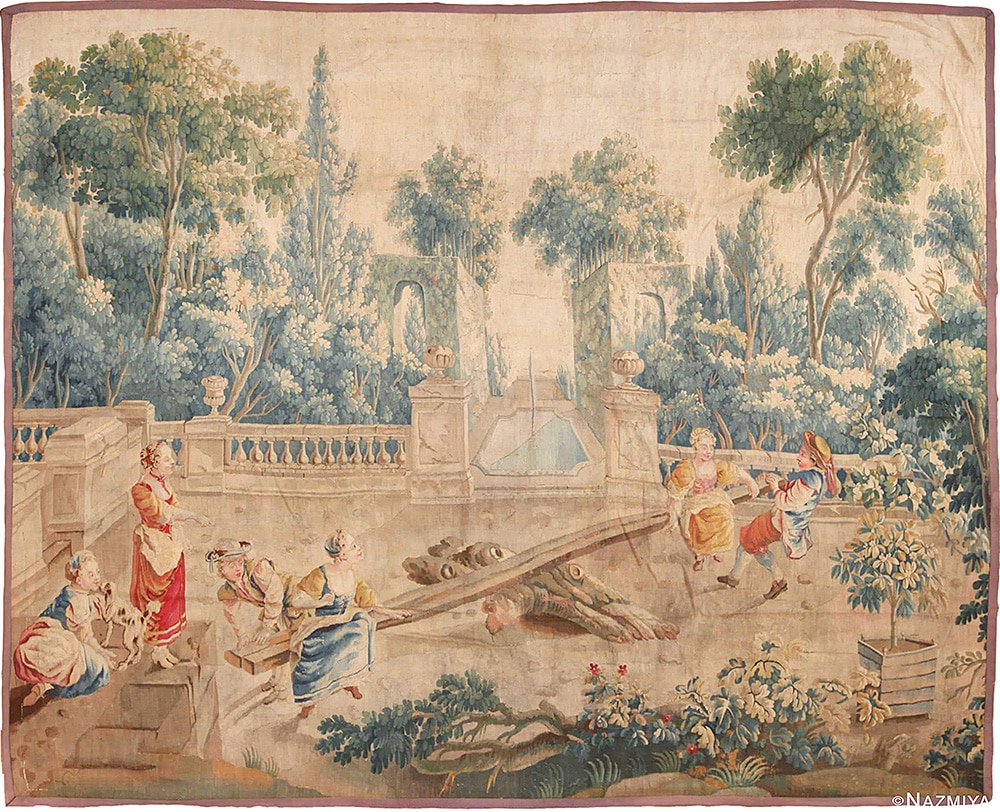
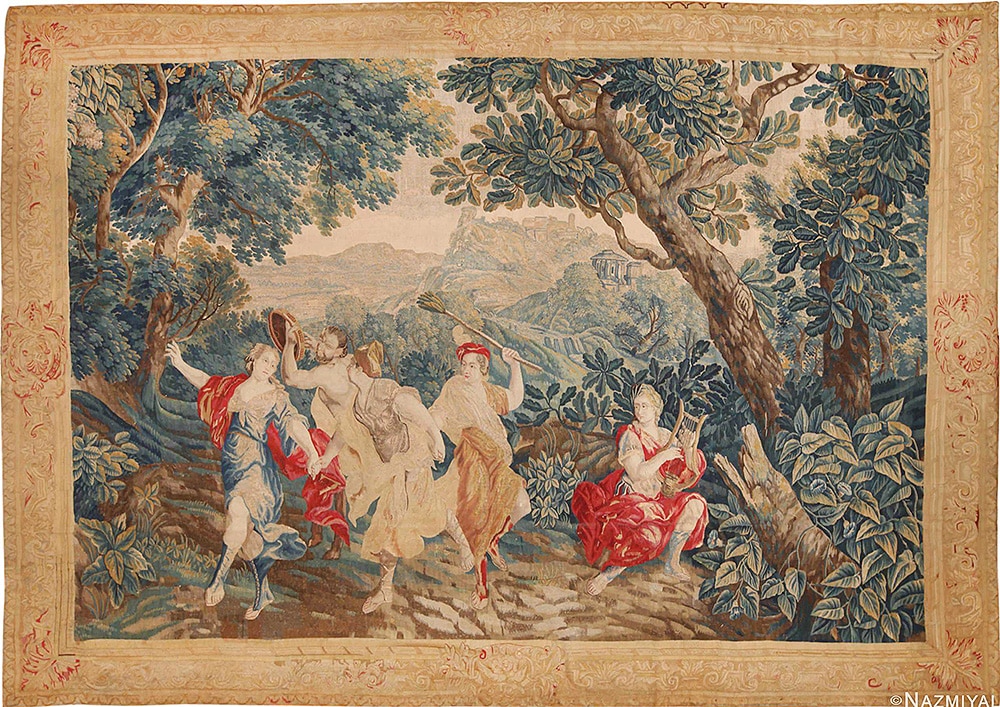
While these pieces are not Gobelin tapestries per se, they show the kind of French tapestry tradition that many readers are looking for when they research historic woven wall art. Nazmiyal’s antique tapestry collection includes rare French and European examples selected for design, age, scale, materials and decorative presence.
Related Tapestry Guides
For practical display guidance, read Nazmiyal’s guide on how to hang a tapestry or rug on the wall. For more historical context, see what historical tapestries are and the history of Beauvais tapestries.
This guide to Gobelin tapestry history was published by Nazmiyal, an antique rug gallery in NYC specializing in antique rugs, tapestries, decorative carpets and collectible woven textiles.