Museum Donations, Collection Loans, Exhibition Installations, and Cultural Stewardship
Nazmiyal has participated in documented donations, loans, acquisitions and exhibition collaborations with institutions including The Metropolitan Museum of Art, The Jewish Museum, Asia Society Museum, The Morgan Library & Museum, the Whitney Museum of American Art, Katonah Museum of Art, Buffalo AKG Art Museum and the Museum of Fine Arts, St. Petersburg.
The Nazmiyal Museum Collaboration Archive documents each museum donation, collection loan, exhibition installation, acquisition, and cultural collaboration involving Jason and Padi Nazmiyal and the Nazmiyal Collection.
These collaborations encompass antique rugs, Persian textiles, Kashmir shawls, Iranian modern art, contemporary art, Judaica, and historically important decorative objects.
For more than four decades, Jason Nazmiyal has worked with antique rugs and textiles as a dealer, collector, author, adviser, and cultural steward. While the Nazmiyal Collection is internationally known as a source for collectors, interior designers, museums, and private clients, its work extends beyond the commercial rug market.
Important objects have also entered public cultural life through museum gifts, institutional acquisitions, collection loans, exhibition installations, scholarship, and long-term preservation.
This archive brings those relationships together in one documented and continuously updated resource.
Last Reviewed July 27, 2026 by Jason Nazmiyal, founder of the Nazmiyal Collection and author of Art Underfoot: The Nazmiyal Collection.
Museum Collaborations at a Glance
The Nazmiyal Museum Collaboration Archive currently includes documented relationships with:
- The Jewish Museum, New York
- The Metropolitan Museum of Art, New York
- Asia Society Museum, New York
- The Morgan Library & Museum, New York
- Whitney Museum of American Art, New York
- Katonah Museum of Art, Katonah, New York
- Buffalo AKG Art Museum, New York
- Museum of Fine Arts, St. Petersburg, Florida
The archive includes several different forms of institutional involvement:
- Gifts of artworks and textiles
- Loans from the collection of Jason and Padi Nazmiyal
- Rugs and textiles supplied for museum installations
- Important carpets acquired for museum interiors
- Participation in exhibitions involving historic and contemporary art
Each entry identifies the institution, object, date, form of involvement, exhibition or installation context, and official credit line whenever available.
Institution Collaborations
| Institution | Object or project | Relationship | Year |
|---|---|---|---|
| The Jewish Museum | Silk Kashan Judaica rug | Gift | 2025 |
| The Met | War and Peace | Gift | 2018 |
| Asia Society | Mohassess drawing | Gift | 2021 |
| Whitney Museum | Paul Thek installation textiles | Supplied for exhibition | 2010 |
| Asia Society | Kashmir shawl | Exhibition loan | 2007 |
| The Morgan | Sultanabad carpet | Interior acquisition | After 2010 |
| Katonah Museum | Aleph and Obstruction 2 | Exhibition loan | 2025 |
| MFA St. Petersburg | Aleph and Obstruction 2 | Exhibition loans | 2026 |
| Buffalo AKG | The Alchemist | Exhibition loan | 2026 |
Why Museum Donations, Loans, and Collaborations Matter
A museum donation, collection loan, or exhibition collaboration allows an object to be studied and interpreted within a broader historical and cultural context.
Antique rugs, carpets, kilims, shawls, and other textiles may serve a decorative purpose, but important examples are also historical records. They preserve evidence of artistic traditions, religious life, trade, geography, materials, weaving techniques, cultural exchange, and the movement of design across civilizations.
Museum exhibitions, collection records, and institutional collaborations become part of the documented cultural history of an object.
The importance of a collection is therefore measured not simply by the number of objects it contains, but by their quality, rarity, historical significance, and cultural value.
Museum acquisitions, gifts, loans, and exhibition collaborations are evaluated according to the needs of the individual institution, collection, interior, or exhibition. Their inclusion here documents Nazmiyal’s participation and the cultural contexts in which these objects were presented or preserved.
For Nazmiyal, these relationships reinforce an essential principle: important rugs, textiles, and works of art should not only be owned. They should also be preserved, studied, documented, and shared.
Featured Museum Donations, Loans, and Collaborations
The Jewish Museum, New York
Gift of a Rare Silk Kashan Judaica Rug
Institution: The Jewish Museum, New York
Object: Judaica pictorial rug
Origin: Kashan, Persia
Date: 1890s
Material: Silk
Type of involvement: Museum gift
Credit line: Gift of Padi and Jason Nazmiyal
Accession number: 2025-1
One of the most personally and culturally significant objects represented in this archive is a rare silk Judaica rug donated by Padi and Jason Nazmiyal to The Jewish Museum in New York.
Woven in Kashan, Persia, during the 1890s, the silk rug combines Persian textile artistry with Jewish biblical imagery and religious symbolism. The Jewish Museum records the work as a gift of Padi and Jason Nazmiyal.
The rug measures approximately 82 by 53 inches and is now preserved as part of the museum’s permanent collection.
For Jason Nazmiyal, a Persian Jewish collector and rug expert, the gift carries special meaning. The rug connects Jewish identity, Persian craftsmanship, biblical storytelling, textile history, and the broader experience of Jewish communities living within Persian culture.
Its inclusion in The Jewish Museum allows the work to be considered not only as a decorative rug but as an important object of Jewish, Persian, artistic, and cultural history.
The donation reflects the Nazmiyal Collection’s belief that exceptional textiles should be preserved in contexts where they can support scholarship, education, and public understanding.
Official Museum Record: View the silk Judaica rug at The Jewish Museum.
The Metropolitan Museum of Art, New York
Gift of War and Peace by Ardeshir Mohassess
Institution: The Metropolitan Museum of Art
Artist: Ardeshir Mohassess
Title: War and Peace
Date: 1985
Medium: Oil pastel, ink, and graphite on paper
Dimensions: 31⅞ by 39⅞ inches
Type of involvement: Museum gift
Credit line: Gift of Jason and Padi Nazmiyal, 2018
Object number: 2018.872
Jason and Padi Nazmiyal donated War and Peace, a major work on paper by Iranian artist Ardeshir Mohassess, to The Metropolitan Museum of Art in 2018.
Mohassess was one of the most distinctive Iranian artists and political satirists of the twentieth century. His drawings frequently combine historical imagery, courtly figures, violence, absurdity, political commentary, and social criticism.
Created in 1985, War and Peace is a large-scale drawing executed in oil pastel, ink, and graphite. Its composition depicts stylized figures involved in scenes of courtly entertainment and violence, reflecting Mohassess’s characteristic examination of power, authority, history, and human behavior.
The work is held by the Met’s Department of Modern and Contemporary Art.
Its donation expanded the Nazmiyals’ cultural involvement beyond antique rugs and textiles and reflects a broader commitment to preserving and sharing significant works of Iranian modern and contemporary art.
Official Museum Record: View War and Peace at The Metropolitan Museum of Art.
Asia Society Museum, New York
Gift of an Untitled Work by Ardeshir Mohassess
Institution: Asia Society Museum
Artist: Ardeshir Mohassess
Title: Untitled
Date: 1974
Medium: Ink and colored pencil on paper
Dimensions: 10 x 18 inches
Type of involvement: Museum gift
Credit line: Gift of Jason Nazmiyal
Object number: 2021.003
Jason Nazmiyal donated an untitled 1974 work by Ardeshir Mohassess to Asia Society Museum.
Executed in ink and colored pencil on paper, the drawing reflects Mohassess’s incisive approach to political and social observation. His figures often appear theatrical, historical, comic, and disturbing at the same time, allowing him to comment on authority and society without relying on conventional narrative.
The gift places the work within an institution recognized for presenting Asian, Middle Eastern, and cross-cultural art to international audiences.
Alongside the Mohassess work donated to The Metropolitan Museum of Art, this gift represents an important element of Jason Nazmiyal’s commitment to Iranian modern art and to the preservation of the work of one of Iran’s most significant twentieth-century draftsmen and satirists.
Official Museum Record: View the untitled 1974 work at the Asia Society Museum.
Whitney Museum of American Art, New York
Antique Kilim Supplied for Paul Thek: Diver, A Retrospective
Institution: Whitney Museum of American Art
Exhibition: Paul Thek: Diver, A Retrospective
Exhibition dates: October 21, 2010–January 9, 2011
Object: Antique kilim
Type of involvement: Textile supplied for the exhibition installation
The Nazmiyal Collection supplied an antique kilim for Paul Thek: Diver, A Retrospective at the Whitney Museum of American Art.
The exhibition was the first retrospective in the United States devoted to American artist Paul Thek. Thek worked across sculpture, painting, installation, and immersive environments, frequently bringing together objects and materials that created highly personal, theatrical, and symbolic spaces.
Within that exhibition context, the kilim was not presented as an independent museum acquisition. It was used as a component of the installation environment, helping establish the atmosphere, texture, and visual context associated with Thek’s work.
The collaboration illustrates how antique rugs and flatwoven textiles can function in relation to modern and contemporary art. In addition to their individual histories, rugs can contribute materially and visually to the interpretation of an artist’s environment.
Official Museum Record: View Paul Thek: Diver, A Retrospective at the Whitney Museum of American Art.
Asia Society Museum, New York
Loan of an 18th-Century Kashmir Shawl for The Arts of Kashmir
Institution: Asia Society Museum
Object: Kashmir shawl
Date: 18th century
Type of involvement: Exhibition loan
Exhibition: The Arts of Kashmir
Exhibition Dates: October 3, 2007–January 8, 2008
Nazmiyal loaned an important 18th-century Kashmir shawl to Asia Society Museum for the exhibition The Arts of Kashmir.
Kashmir shawls are among the most admired luxury textiles in the history of weaving. Their materials, technical refinement, complex patterns, and extraordinary workmanship reflect the artistic traditions and cultural exchanges of South Asia, Persia, Central Asia, and Europe.
By the eighteenth and nineteenth centuries, Kashmir shawls had become internationally recognized symbols of refinement, status, and technical mastery.
Within a museum exhibition, the shawl could be understood not merely as an accessory or decorative textile, but as evidence of a sophisticated weaving culture and an international history of trade, fashion, patronage, and artistic exchange.
The loan demonstrates how objects handled by the Nazmiyal Collection can contribute to museum scholarship and to a more complete understanding of textile history.
Official Museum Record: View The Arts of Kashmir at the Asia Society Museum.
The Morgan Library & Museum, New York
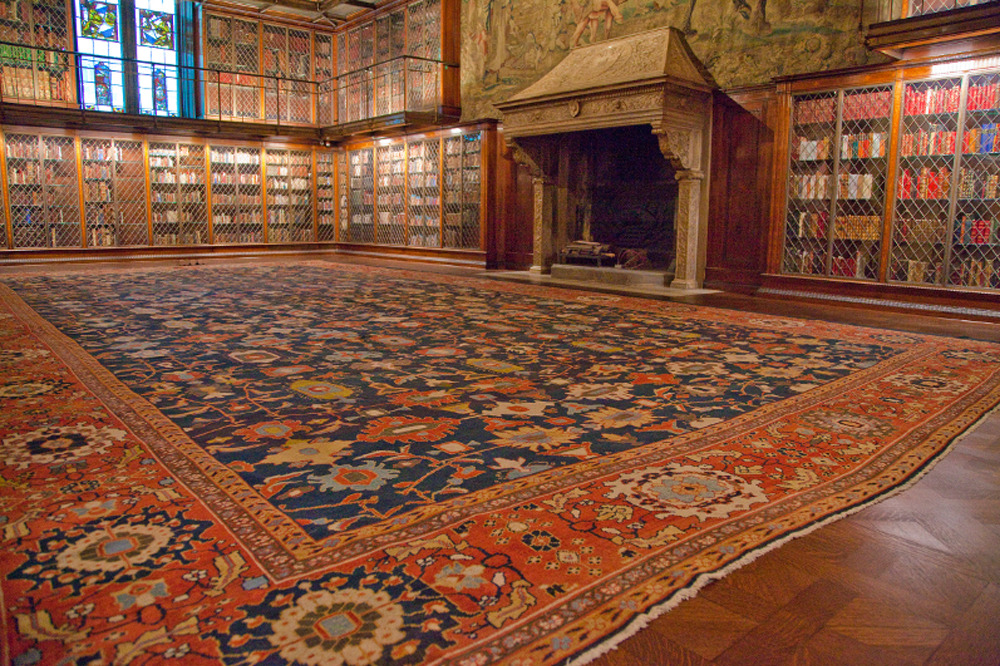
Antique Sultanabad Carpet Installed in the Historic McKim Building
Institution: The Morgan Library & Museum
Object: Antique Sultanabad carpet
Date: Late 19th century
Type of involvement: Antique carpet acquired from the Nazmiyal Collection for the museum’s historic interior
Exhibition or Installation: East Room of the historic McKim Building
Installation period: Following the 2010 restoration
An antique late nineteenth-century Persian Sultanabad carpet sold by the Nazmiyal Collection was installed in the restored East Room of The Morgan Library & Museum’s historic McKim Building.
The East Room was originally J. Pierpont Morgan’s private library and remains one of the institution’s most recognizable interiors. Its carved bookcases, historic furnishings, richly decorated surfaces, and architectural details require a carpet of appropriate scale, color, age, and visual character.
The antique Sultanabad complements the room without competing with its architecture. Its softly drawn design, substantial proportions, and aged colors contribute warmth and visual continuity to the historic interior.
This entry is different from a museum donation or temporary exhibition loan. It represents the selection of an important antique carpet from Nazmiyal for use within one of New York’s most distinguished cultural interiors.
The installation demonstrates the continuing role that antique Persian carpets can play in important historic and institutional spaces.
Official Museum Record: View the antique Sultanabad carpet at The Morgan Library & Museum.
Katonah Museum of Art
Loan of Ali Banisadr’s Aleph and Obstruction 2 for The Alchemist
Institution: Katonah Museum of Art
Artist: Ali Banisadr
Pieces: Aleph; Obstruction 2
Dates Made: Aleph: 2013; Obstruction 2: 2011
Medium: Oil on linen
Dimensions: Aleph: 66 x 88 inches; Obstruction 2: 36 x 30 inches
Type of involvement: Artwork loan from the collection of Jason and Padi Nazmiyal
Exhibition or Installation: Ali Banisadr: The Alchemist
Exhibition dates: March 16–June 29, 2025
Credit: Collection of Jason and Padi Nazmiyal
Jason and Padi Nazmiyal loaned Ali Banisadr’s paintings Aleph and Obstruction 2 to the Katonah Museum of Art for Ali Banisadr: The Alchemist.
The exhibition was the first major United States museum survey devoted to the Iranian-born, New York-based artist. It examined nearly twenty years of Banisadr’s work across painting, drawing, printmaking, and sculpture.
Created in 2013 and 2011 respectively, both Aleph and Obstruction 2 are oil paintings on linen from the collection of Jason and Padi Nazmiyal.
Banisadr’s paintings are known for their densely layered compositions, dynamic movement, and references to history, mythology, memory, sound, and contemporary events. His work often brings fragments of figures, architecture, conflict, and imagined environments together within a turbulent visual field.
The loan reflects the Nazmiyals’ engagement with contemporary Iranian and Iranian-American art, complementing their museum gifts of works by Ardeshir Mohassess and their long-standing interest in historic Persian artistic traditions.
Official Museum Record: View Ali Banisadr: The Alchemist at the Katonah Museum of Art.
Buffalo AKG Art Museum
Loan of Ali Banisadr’s The Alchemist for Temple of the Mind
Institution: Buffalo AKG Art Museum
Artist: Ali Banisadr
Title: The Alchemist
Date: 2025
Medium: Bronze
Dimensions: 16 x 7 x 9 inches and 4 x 7 x 3.5 inches
Type of involvement: Artwork loan from the collection of Jason and Padi Nazmiyal
Exhibition: Ali Banisadr: Temple of the Mind
Exhibition dates: June 26, 2026–November 8, 2026
Credit: Collection of Jason and Padi Nazmiyal
Ali Banisadr’s Temple of the Mind exhibition at the Buffalo AKG Art Museum showcases a loaned piece from the collection of Jason and Padi Nazmiyal.
The artwork in question is a two-part bronze statue entitled The Alchemist, an abstract mythical figure in mid-transformation. Subtle spots of gold throughout the sculpture emphasize the subject’s transformative experience, seen along the hands, face, and back of the sculpture.
The museum’s Temple of the Mind exhibition showcases a collection of mixed-media pieces by the Iranian-born artist, both in 2-dimensional painted form as well as the aforementioned bronze sculptural object.
Banisadr’s metalwork is often inspired by mythological beings found in poems and religious stories. They take on abstract figural forms, dynamic in their creations and highlighting the physical effort that went into their creation with prints and marks.
The loan continues Jason and Padi Nazmiyal’s support of contemporary Iranian and Iranian-American art. It also expands the archive beyond historic rugs and textiles to include contemporary painting and sculpture presented within major museum exhibitions.
Official Museum Record: View The Alchemist from the Temple of the Mind exhibit at the Buffalo AKG Art Museum.
Museum of Fine Arts, St. Petersburg
Institution: Museum of Fine Arts
Artist: Ali Banisadr
Pieces: Aleph; Obstruction 2
Exhibition: The Alchemist
Exhibition Dates: April 11, 2026-July 12, 2026
Type of involvement: Artwork loan from the collection of Jason and Padi Nazmiyal
Credit: Collection of Jason and Padi Nazmiyal
Two paintings from the collection of Jason and Padi Nazmiyal are included in a traveling exhibit showcasing Ali Banisadr’s work. The exhibition, titled Ali Banisadr: The Alchemist, opened at the Museum of Fine Arts, St. Petersburg, from April 11, 2026 through July 12, 2026.
Aleph and Obstruction 2, oil paintings on linen, are the loaned pieces. Their dynamic abstract compositions and vibrant color schemes speak to the artists’ background with a synesthetic experience of the world. His work is often figural, drawing on personal circumstance as well as myth and legend.
The loaned pieces exemplify Nazmiyal’s avid support for the arts outside of textile-work.
Official Museum Record: View the exhibit Ali Banisadr: The Alchemist at the Museum of Fine Arts.
From Private Stewardship to Public Cultural History
The works represented in this archive span different periods, cultures, and artistic disciplines.
They include:
- A rare nineteenth-century silk Persian Judaica rug
- An eighteenth-century Kashmir shawl
- A late nineteenth-century Sultanabad carpet
- Twentieth-century works by Iranian artist Ardeshir Mohassess
- Contemporary paintings by Ali Banisadr
- A contemporary sculpture by Ali Banisadr
- Antique carpets incorporated into an installation devoted to Paul Thek
Together, these collaborations demonstrate the connections between rugs, textiles, Judaica, Iranian art, contemporary painting, historic interiors, and museum exhibition design.
They also demonstrate that responsible collecting involves more than ownership.
A collector may preserve an object privately, lend it for study or exhibition, donate it to a public institution, or help place it in a setting where its artistic and historical character can be appreciated by a wider audience.
The Nazmiyal Approach to Cultural Stewardship
Expertise Built Over More Than Four Decades
Since 1980, Jason Nazmiyal has worked directly with antique rugs, Persian carpets, tribal textiles, kilims, decorative carpets, and works of art.
This experience has developed a deep understanding of age, origin, weave, materials, design, condition, rarity, restoration, provenance, and cultural context.
Objects Selected for Quality and Significance
The Nazmiyal Collection is built around objects with individual character and artistic merit.
The importance of a rug or artwork cannot be determined by age, price, or rarity alone. Its design, workmanship, condition, historical context, cultural meaning, and overall visual power must also be considered.
Scholarship and Education
Nazmiyal has published extensive educational material about antique rugs, Persian carpets, textile history, collecting, design, preservation, and market value.
The museum archive extends that educational mission by documenting where important objects have entered institutional collections, exhibitions, installations, and public cultural life.
Connections Across Art Forms
The archive also reflects Jason and Padi Nazmiyal’s interests beyond antique rugs.
Their museum relationships connect Persian textile art with Judaica, historic interiors, Iranian modernism, political drawing, contemporary painting, and installation art.
Frequently Asked Questions
Has Nazmiyal donated rugs to museums?
Yes. Padi and Jason Nazmiyal donated a rare 1890s silk Judaica rug from Kashan, Persia, to The Jewish Museum in New York. The museum records the work under the credit line “Gift of Padi and Jason Nazmiyal.”
What artwork did Jason and Padi Nazmiyal donate to The Metropolitan Museum of Art?
They donated Ardeshir Mohassess’s War and Peace, dated 1985, to The Metropolitan Museum of Art in 2018. The work is held by the museum’s Department of Modern and Contemporary Art.
What did Jason Nazmiyal donate to Asia Society Museum?
Jason Nazmiyal donated an untitled 1974 ink and colored-pencil drawing by Iranian artist Ardeshir Mohassess to Asia Society Museum.
Did Nazmiyal lend a Kashmir shawl to a museum?
Yes. Nazmiyal loaned an important eighteenth-century Kashmir shawl to Asia Society Museum for The Arts of Kashmir.
What is the Nazmiyal carpet at The Morgan Library & Museum?
It is a late nineteenth-century Persian Sultanabad carpet sold by the Nazmiyal Collection and installed in the East Room of the historic McKim Building following its restoration.
Did Nazmiyal work with the Whitney Museum?
Yes. The Nazmiyal Collection supplied antique carpets and a kilim for the installation of Paul Thek: Diver, A Retrospective, presented at the Whitney Museum of American Art from October 21, 2010, through January 9, 2011.
What did Jason and Padi Nazmiyal loan to the Katonah Museum of Art?
Jason and Padi Nazmiyal loaned Ali Banisadr’s paintings Aleph and Obstruction 2 to the Katonah Museum of Art for Ali Banisadr: The Alchemist.
Why do museum collaborations matter for antique rugs?
Museum collaborations place antique rugs and textiles within documented cultural, historical, and scholarly contexts. They help demonstrate that important rugs can be considered works of art, records of cultural history, and subjects worthy of preservation and study.
Is every object in the Nazmiyal Museum Collaboration Archive a donation?
No. The archive distinguishes among permanent gifts, temporary exhibition loans, artworks loaned from the Nazmiyals’ collection, textiles supplied for exhibition installations, and carpets acquired for museum interiors.
Will this archive be updated?
Yes. Additional entries should be added when documentation, exhibition records, images, credit lines, and object information have been confirmed.
Explore Nazmiyal
The same standards of attribution, condition assessment, historical context and visual quality that guide Nazmiyal’s museum relationships also inform the selection of antique rugs offered to private collectors, designers and institutions.
- Antique Rugs
- Antique Persian Rugs
- Collectible Rugs
- Antique Rug Buying Guide
- Sell Your Antique Rug
- Rug Appraisals
- Rug Repair and Restoration
- About Jason Nazmiyal
- Art Underfoot: The Nazmiyal Collection
- Contact a Nazmiyal Rug Expert