
An exceptional eighteenth-century Kashmir shawl from the Nazmiyal Collection was selected for inclusion in The Arts of Kashmir, a major international loan exhibition presented by Asia Society Museum in New York City.
The rare textile was displayed at Asia Society from October 3, 2007, through January 6, 2008. Its inclusion placed the shawl alongside important works loaned by museums and private collections from around the world.
Reviewed by Jason Nazmiyal, founder of Nazmiyal Antique Rugs
Museum Exhibition Details
Institution: Asia Society Museum, New York
Exhibition: The Arts of Kashmir
Exhibition dates: October 3, 2007–January 6, 2008
Object: Antique Millefleurs Kashmir shawl
Date: Eighteenth century
Origin: Kashmir, Indian subcontinent
Type of involvement: Museum exhibition loan
Lender: Nazmiyal Collection
Exhibition curator: Dr. Pratapaditya Pal
Nazmiyal’s Loan to The Arts of Kashmir
The Nazmiyal Collection loaned an important eighteenth-century Kashmir shawl to Asia Society Museum for its landmark exhibition, The Arts of Kashmir.
Organized as an international survey of Kashmir’s artistic traditions, the exhibition explored the region’s cultural achievements across nearly two millennia. It brought together Buddhist, Hindu, and Islamic works, including sculpture, painting, architecture, calligraphy, carpets, shawls, and decorative arts.
The exhibition was curated by Dr. Pratapaditya Pal, a respected scholar of South Asian and Himalayan art. It was conceived to demonstrate Kashmir’s importance as a center of intellectual exchange and artistic production connecting the Indian subcontinent with Central Asia, Tibet, Persia, and other neighboring cultures.
The inclusion of the Nazmiyal shawl recognized both its artistic quality and its significance within the history of Kashmir textile production.
About the Eighteenth-Century Kashmir Shawl
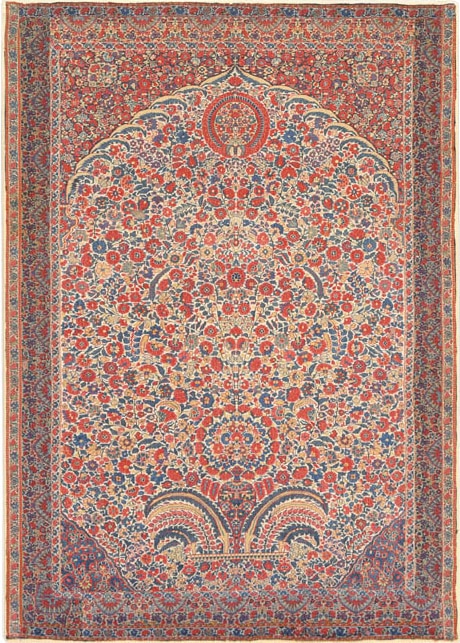
The textile loaned by Nazmiyal is a refined example of an eighteenth-century Millefleurs Kashmir shawl.
“Millefleurs” is a French term meaning “a thousand flowers.” In textile scholarship, it describes compositions filled with densely arranged blossoms, flowering plants, leaves, and delicate stems. These designs create a continuous garden-like surface in which individual floral forms merge into an exceptionally intricate overall pattern.
The Nazmiyal shawl is distinguished by its:
- Exceptionally fine textile construction
- Closely arranged floral ornamentation
- Subtle and carefully balanced coloring
- Precise drawing of individual flowers and leaves
- Sophisticated relationship between pattern and open space
- Remarkable technical refinement
Although visually abundant, the composition remains controlled and harmonious. Its restrained palette and finely articulated flowers create an effect that is both luxurious and remarkably delicate.
Why Kashmir Shawls Are Important
Historic Kashmir shawls are among the most technically accomplished luxury textiles produced in South Asia.
Kashmir became celebrated for shawls woven from exceptionally fine animal fibers, particularly pashmina. The softness, warmth, light weight, and complex design of these textiles made them highly prized among Mughal rulers, aristocratic courts, wealthy merchants, and international collectors.
The finest examples could require extraordinary patience and technical skill to produce. Rather than being printed or simply embroidered onto a finished surface, many historic Kashmir shawl designs were constructed through labor-intensive weaving methods that allowed weavers to build intricate patterns directly into the textile.
These shawls served several functions. They could be worn as luxurious garments, presented as diplomatic or courtly gifts, used as symbols of rank, or preserved as valuable family possessions.
By the late eighteenth and nineteenth centuries, Kashmir shawls had also become highly desirable in Europe. Their popularity helped introduce the curved floral boteh, later widely known as the paisley motif, to European fashion and textile design.
The Millefleurs Tradition
Millefleurs Kashmir shawls are admired for the density and naturalism of their floral decoration.
The design tradition reflects the importance of flowering plants in Mughal and Indian court art. Artists and textile designers drew inspiration from garden imagery, botanical studies, Persian floral ornament, and the visual culture of the Mughal court.
In the finest examples, flowers are not merely repeated as generic decorative motifs. Individual blossoms, stems, and leaves may be carefully varied, creating the impression of an imagined garden rather than a mechanically repeated pattern.
The complexity of these designs made Millefleurs shawls especially demanding to produce. Their fine scale required close coordination between the designer’s original plan and the weavers responsible for translating that plan into textile form.
The Cultural Importance of Kashmir
Kashmir occupies a distinctive geographic and cultural position between South Asia, Central Asia, Persia, and the Himalayan world.
Over centuries, the region became a meeting place for Hindu, Buddhist, Islamic, Persianate, and local Kashmiri traditions. This cultural exchange is visible in Kashmir’s religious art, architecture, manuscripts, metalwork, carpets, and textiles.
The Arts of Kashmir exhibition sought to present this broader history rather than treating Kashmir solely as the source of luxury shawls. The exhibition included artistic traditions extending from antiquity into the modern period and demonstrated the region’s role as a major center of cultural and intellectual production.
Asia Society described the exhibition as the first major museum presentation devoted comprehensively to the arts of Kashmir across different periods and artistic media.
Why the Museum Loan Matters
The selection of the Nazmiyal shawl for a major international museum exhibition demonstrates the object’s importance beyond the commercial marketplace.
Museums evaluate prospective loans according to factors such as:
- Historical relevance
- Authenticity
- Rarity
- Artistic quality
- Physical condition
- Exhibition context
- Educational value
Its inclusion in The Arts of Kashmir established the shawl as a significant example of historic Kashmir textile art suitable for public exhibition and scholarly interpretation.
Museum loans also help place privately held works into a broader historical context. When displayed beside related paintings, sculptures, manuscripts, carpets, and decorative objects, an individual textile can reveal connections that may not be apparent when it is viewed in isolation.
Nazmiyal and the Preservation of Historic Textiles
Since 1980, Nazmiyal has specialized in historically important antique rugs, carpets, kilims, tapestries, shawls, and other woven works of art.
The collection has included textiles representing major weaving cultures across Persia, the Caucasus, Anatolia, Central Asia, India, Europe, and North Africa. Each object is evaluated according to its age, origin, construction, materials, design, condition, rarity, and cultural importance.
Nazmiyal’s participation in museum exhibitions reflects a broader commitment to scholarship, preservation, and public access. By lending important works to cultural institutions, Nazmiyal helps place antique textiles within the wider history of art rather than presenting them only as decorative objects.
The eighteenth-century Millefleurs Kashmir shawl displayed at Asia Society Museum is one example of that commitment.
Frequently Asked Questions
What textile did Nazmiyal lend to Asia Society Museum?
Nazmiyal loaned a rare eighteenth-century Millefleurs Kashmir shawl to Asia Society Museum in New York.
What exhibition included the Nazmiyal Kashmir shawl?
The shawl appeared in The Arts of Kashmir, a major international exhibition devoted to Kashmir’s artistic and cultural history.
When was The Arts of Kashmir held?
The exhibition was presented at Asia Society Museum from October 3, 2007, through January 6, 2008.
Who curated The Arts of Kashmir?
The exhibition was curated by Dr. Pratapaditya Pal, a prominent scholar of South Asian and Himalayan art.
What does Millefleurs mean?
Millefleurs is French for “a thousand flowers.” The term describes decorative compositions densely filled with small flowers, plants, leaves, and stems.
When was the Nazmiyal shawl made?
The Kashmir shawl dates to the eighteenth century.
Where were Kashmir shawls made?
Historic Kashmir shawls were produced in Kashmir, a region located in the northern Indian subcontinent and connected culturally with South Asia, Central Asia, Persia, and the Himalayan world.
What were historic Kashmir shawls made from?
Many of the finest Kashmir shawls were woven using pashmina, an exceptionally soft and fine fiber associated with Himalayan goats. The precise material of an individual shawl should be determined through specialist examination and documentation.
Why are antique Kashmir shawls valuable?
Their value may derive from their age, rare materials, extremely fine workmanship, complex designs, condition, provenance, and historical importance. Museum-quality examples represent some of the most accomplished textile production associated with South Asia.
Why was the Nazmiyal shawl selected for a museum exhibition?
Its eighteenth-century date, refined Millefleurs design, exceptional craftsmanship, and relevance to the history of Kashmir made it appropriate for inclusion in a major scholarly exhibition.
Explore More
Learn more about antique Kashmir textiles, Millefleurs designs, museum collaborations, and historically important woven works of art in the Nazmiyal Collection.