
The Museum of Fine Arts St. Petersburg was the first art museum built in St. Petersburg. The institution seeks to make artwork publicly accessible, both historic and contemporary. It is an encyclopedic art museum, exhibiting work from across the globe, representing the full breadth of human creativity.
Jason and Padi Nazmiyal loaned two of Ali Banisadr’s paintings to be included in their 2026 exhibit Ali Banisadr: The Alchemist. The exhibit focuses on Banisadr’s work over nearly two decades in multiple mediums, exploring philosophy, personal experiences, history, and myth.
Reviewed by Jason Nazmiyal, Founder of the Nazmiyal Collection
Exhibition Donation Information
Institution: Museum of Fine Arts
Artist: Ali Banisadr
Pieces: Aleph; Obstruction 2
Dates Made: Aleph: 2013; Obstruction 2: 2011
Medium: Oil on linen
Dimensions: Aleph: 66 x 88 inches; Obstruction 2: 36 x 30 inches
Exhibition: Ali Banisadr: The Alchemist
Exhibition Dates: April 11, 2026–July 12, 2026
Credit: Collection of Jason and Padi Nazmiyal
Ali Banisadr: The Alchemist
The exhibition Ali Banisadr: The Alchemist encompasses nearly twenty years of work from contemporary artist Ali Banisadr. His work spans across mediums, both in two dimensions and in three. Banisadr draws from his childhood experiences of the Iran-Iraq war to create fragmented and expressive works of art. The gestural nature of his work transcends medium, evident in his sculptural work in addition to his paintings and printmaking.
His paintings are dynamic, utilizing vibrant colors and complex compositions to capture abstract movement in a two-dimensional format. Banisadr’s personal experiences with synesthesia similarly inform his paintings, as do themes of history, philosophy, and myth.
The exhibition’s title is a reference to the ancient practice of alchemy. It was a pseudo-science influenced in part by medicinal practices and magic. Alchemy was a transmutative artform that sought to discover a cure to all illness as well as the secret to eternal youth. Banisadr’s work focuses on the nuance of alchemy and how it relates to the transformative aspect of the human experience.
Aleph
Aleph is one of Banisadr’s pieces loaned out to the exhibit from Jason and Padi Nazmiyal’s private collection. It is a large-scale painting made with oil on linen and named after the first letter of several Semitic alphabets.
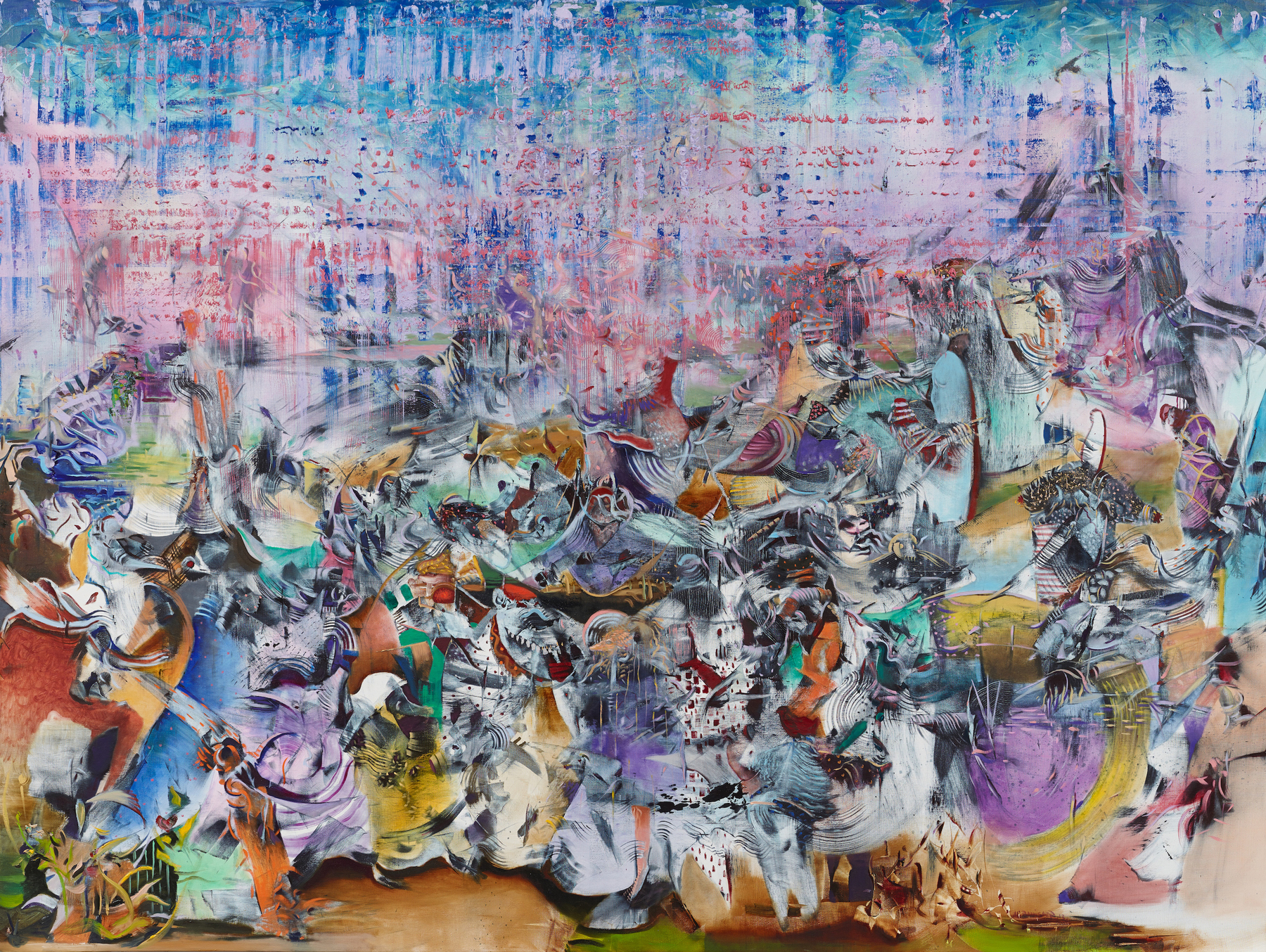
The painting is in Banisadr’s usual style, fragmented and chaotic, with gestural brushstrokes that give the impression of movement. The dynamic nature of the piece is aided by bright hues of blues, pinks, oranges, and whites. Depicted are abstracted figures grouped together in frenzy. Both angular and rounded sweeping strokes of paint give it a cubist-like quality.
Obstruction 2
Obstruction 2 is another of Nazmiyal’s loaned works by Ali Banisadr. The painting is older than Aleph, created in oil on linen just a few years before. Though smaller, it is equally captivating in its technical execution.
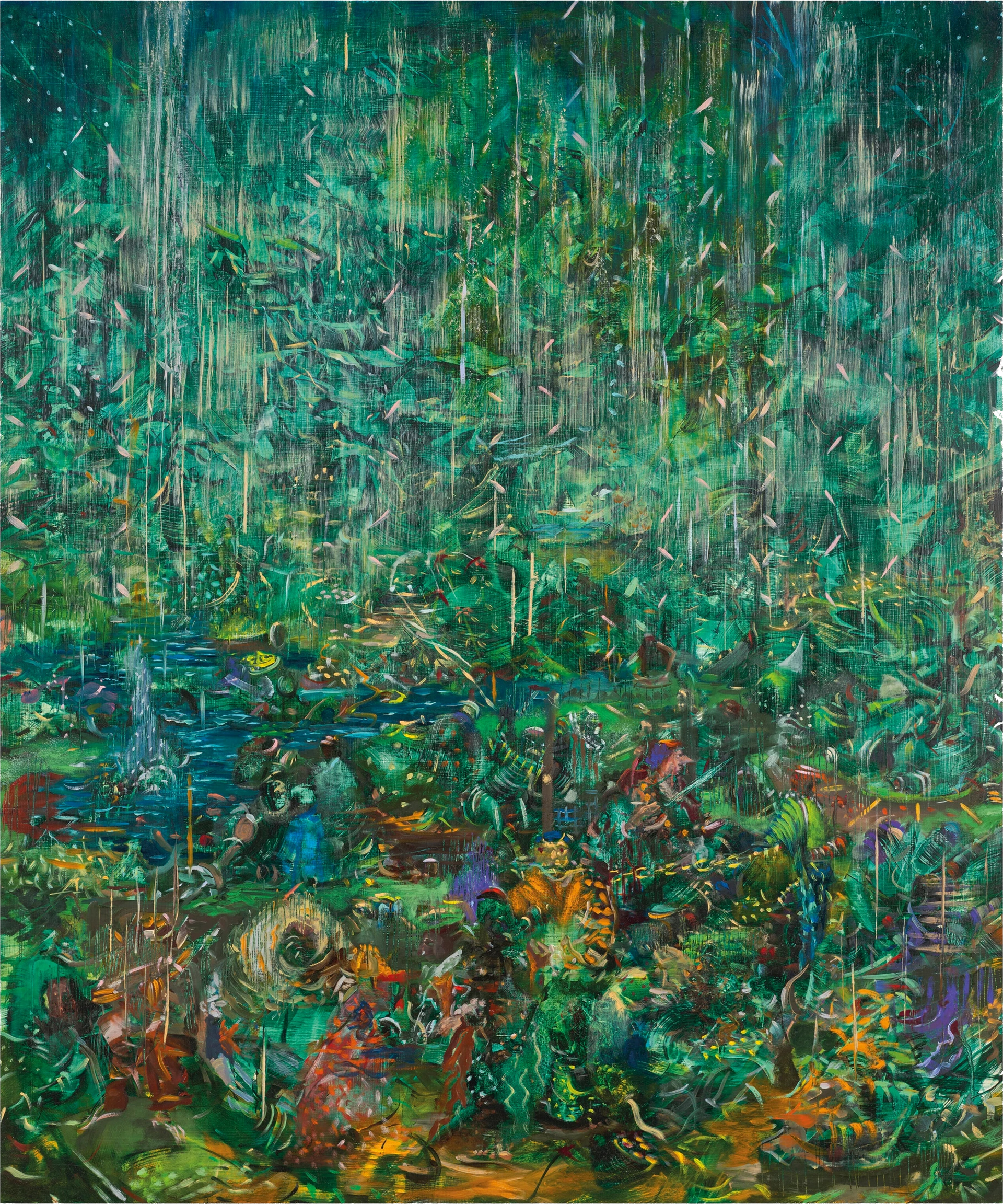
This piece is dominated by vibrant greens used in crafting a lively jungle-like scene. The painting is layered with complex details throughout, using gestural brushstrokes to communicate energy and vitality. Abstracted mythological figures make up the bottom half of the painting, interacting with their environment in a way that mixes magic with reality. Moreover, the dense composition of Obstruction 2 makes the piece a worthwhile sight, leading the eye to discover new elements at every glance.
More About Nazmiyal and the Continued Support for Art
Jason Nazmiyal is the founder of the Nazmiyal Collection, one of the largest inventories of antique rugs in the world. Since the 1980’s he has worked to build his extensive catalog, including antique Persian rugs, Turkish rugs, tribal rugs, Caucasian carpets, and other Oriental textiles. His interest in the preservation and study of rugs have led to several important collaborative exploits with cultural institutions, as well as legitimizing his place as a collector of historic and artistic works.
Though his specialty lies in rugs and antiques, Nazmiyal appreciates art in all its forms, collecting fine art as well as textiles. His collaboration with an encyclopedic institution such as the MFA St. Petersburg exemplifies his continued interest in the preservation of culture through artwork. This donation made to the Ali Banisadr: The Alchemist exhibit is just one of many examples of Nazmiyal’s continued support for the arts. The donations hold personal relevance as well, due to the shared heritage and relevant subject matter explored in Banisadr’s work.
Frequently Asked Questions
What paintings from Jason and Padi Nazmiyal’s private collection are included in the exhibition Ali Banisadr: The Alchemist?
The paintings Aleph and Obstruction 2 are both included in the exhibition.
When was the exhibition on display?
The exhibition was on display starting April 11–July 12, 2026.
Were the pieces exhibited donated to the Museum of Fine Arts St. Petersburg?
No. Both paintings included in the exhibition were loaned to the Museum of Fine Arts St. Petersburg by Jason and Padi Nazmiyal.
Does Jason Nazmiyal collect anything aside from paintings?
Yes. Jason Nazmiyal is known primarily as an antique rug collector. His collection includes over 4,000 textiles spanning cultures from around the world.
Has Jason Nazmiyal collaborated with any other museums and exhibitions?
Yes. Jason Nazmiyal has previously donated, loaned, and collaborated with several other museum and institutions. This includes institutions such as The Katonah Museum of Art, the Asia Society Museum, and The Metropolitan Museum of Art.
Explore More
Jason Nazmiyal’s contributions to cultural institutions extends beyond the Museum of Fine Art St. Petersburg. His private collection has been involved in donations, loans, and other institutional collaborations throughout the years, including The Metropolitan Museum of Art, The Whitney Museum of Art, The Morgan Library & Museum, and more. Learn more in the Nazmiyal Museum Collaboration Archive.