
The Jewish Museum in New York City is one of the world’s leading institutions devoted to Jewish art and culture. Through its exhibitions, educational programs, and permanent collection, the Museum explores Jewish history, identity, tradition, and artistic expression across cultures and time periods.
Founded in 1904, The Jewish Museum was the first institution of its kind established in the United States and is among the oldest Jewish museums in the world. Its collection contains nearly 30,000 works of art, ceremonial objects, archaeological artifacts, photographs, and other materials reflecting more than 4,000 years of Jewish culture.
Reviewed by Jason Nazmiyal, founder of the Nazmiyal Collection
Museum Gift Details
Institution: The Jewish Museum
Object: Pictorial Judaica Rug
Origin: Kashan, Persia
Date: 1890s
Material: Silk
Size Specifications: 82 x 53 inches
Type of Involvement: Museum Gift
Credit Line: Gift of Padi and Jason Nazmiyal
Accession Number: 2025-1
Current Status: On view at The Jewish Museum
Padi and Jason Nazmiyal’s Gift to The Jewish Museum
Padi and Jason Nazmiyal donated this historically important Persian Jewish silk rug to The Jewish Museum in 2025.
Woven in Kashan, Persia, during the closing decade of the nineteenth century, the rug combines exceptional silk weaving with an unusually ambitious program of Jewish biblical imagery and Hebrew inscriptions. Its imagery reflects the artistic interaction of Persian, Jewish, Qajar, and European visual traditions.
The gift ensures that this rare textile will be preserved in a major public collection, where it can be studied and appreciated as both a work of art and an important document of Persian Jewish cultural history.
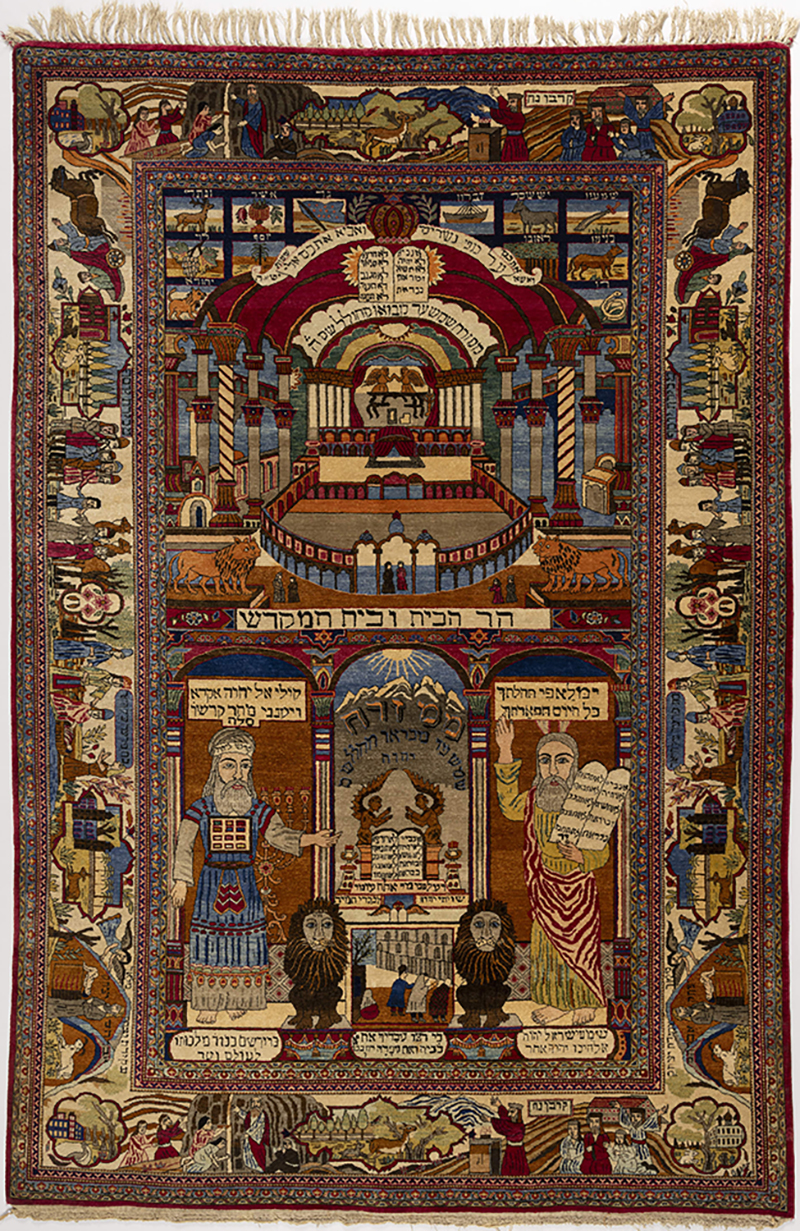
History of the Persian Judaica Rug
This pictorial rug belongs to a small and important group of Jewish silk carpets woven in Kashan during the late nineteenth and early twentieth centuries.
According to literary and oral traditions recorded within the Iranian Jewish community, this carpet type was commissioned during the reign of Naser al-Din Shah of Persia for his Jewish court physician, Hakim Nour Mahmood. The traditional account states that the Shah presented the carpet in gratitude after Mahmood survived an assassination attempt reportedly organized by jealous colleagues at court.
Because this history comes from community tradition and published scholarship, it is best understood as an important historical account associated with the carpet type rather than as conclusively documented royal provenance for this individual rug.
From a technical perspective, the rug demonstrates the extraordinary craftsmanship of the silk-weaving workshops of Kashan. Its sophisticated drawing, detailed figures, Hebrew inscriptions, architectural imagery, and intricate floral ornamentation reflect the high level of skill associated with Kashan’s finest pictorial carpets.
Biblical Imagery and Hebrew Inscriptions
The rug presents an elaborate vertical arrangement of Jewish biblical and religious imagery.
The central composition includes representations of Aaron the High Priest, Moses holding the Tablets of the Law, the Menorah, the Holy of Holies, and an architectural vision of the Temple. The upper portion incorporates symbols associated with the Twelve Tribes of Israel.
Narrative scenes appearing within the rug and its surrounding border include episodes traditionally identified as:
- Noah and his sons before the Ark
- The Binding of Isaac
- Joseph being sold into slavery
- The discovery of the infant Moses among the reeds
- Elijah’s ascent to heaven
- Traditional sacred sites associated with biblical figures
Hebrew inscriptions accompany many of these scenes and help connect the visual narrative to Jewish scripture and religious tradition.
The composition is distinctly Persian in its materials, floral ornamentation, color, and workmanship, while its subject matter is unmistakably Jewish. It therefore represents an exceptional visual record of Jewish artistic life within Qajar-era Persia.
Nazmiyal’s Commitment to Art and Historical Preservation
For more than four decades, Jason Nazmiyal has worked with historically important antique rugs and textiles from Persia and other major weaving cultures, collecting work and founding the Nazmiyal Collection.
The donation of this rare Kashan Judaica rug reflects Padi and Jason Nazmiyal’s commitment to preserving culturally meaningful works and making them accessible to the public, scholars, students, and future generations.
The gift also holds personal significance for Jason Nazmiyal as a Persian Jewish collector. The rug brings together Persian craftsmanship and Jewish religious history, reflecting an interconnected heritage that has existed for centuries.
By placing the rug in the permanent collection of The Jewish Museum, Padi and Jason Nazmiyal have helped preserve an important work of Persian Jewish art within a major public institution.
Frequently Asked Questions
Where is the Persian Judaica rug now?
The rug is in the permanent collection of The Jewish Museum in New York City. The Museum’s collection record identifies it as accession number 2025-1 and states that it is currently on view.
Who donated the rug to The Jewish Museum?
The rug was donated by Padi and Jason Nazmiyal. Its official museum credit line is “Gift of Padi and Jason Nazmiyal.”
When and where was the rug made?
The rug was woven in Kashan, Persia, during the 1890s.
What material was used to make the rug?
The rug is woven from silk.
What are the dimensions of the rug?
The rug measures 82 × 53 × 1/4 inches, or approximately 208.3 × 134.6 × 0.6 centimeters.
Why is this rug historically significant?
The rug is a rare example of Persian Jewish textile art. It combines Kashan silk-weaving techniques, Qajar-period artistic influences, Hebrew inscriptions, and detailed depictions of Jewish biblical subjects.
Was the rug commissioned by Naser al-Din Shah?
A historical tradition associated with this carpet type states that Naser al-Din Shah commissioned it for his Jewish court physician, Hakim Nour Mahmood. This account was preserved within the Iranian Jewish community and repeated in published scholarship. It should be described as a traditional historical account rather than as conclusively documented provenance for this specific rug.
What Jewish subjects appear on the rug?
The rug includes Moses, Aaron, the Tablets of the Law, the Menorah, the Temple, and narrative scenes from the Hebrew Bible.
Why did Padi and Jason Nazmiyal donate the rug?
The donation helps preserve an important example of Persian Jewish art and makes it available for public viewing, education, and scholarly research at The Jewish Museum.