
A Late-19th-Century Persian Carpet Chosen for J. Pierpont Morgan’s Historic Library
In 2010, The Morgan Library & Museum selected an antique Persian Sultanabad rug from Nazmiyal Collection for the restoration of J. Pierpont Morgan’s historic library in New York City.
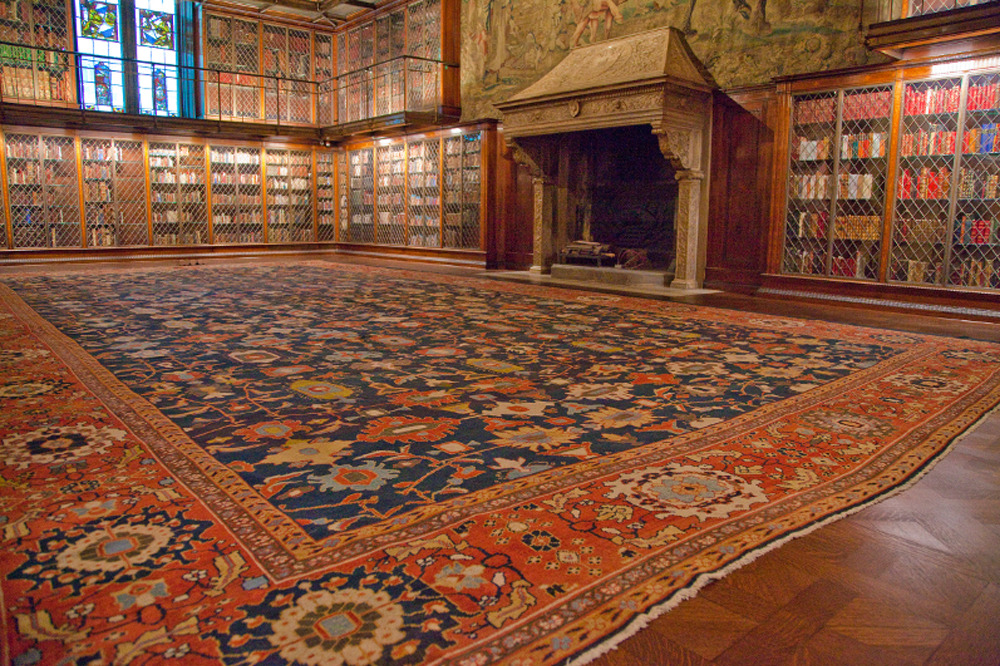
The late-19th-century carpet was installed in the grand East Room of the original McKim building as part of the most extensive restoration of its interiors since the library was completed in 1906.
The project brought together architecture, historic furnishings, decorative arts, books, manuscripts and fine art to revive one of New York City’s most celebrated Gilded Age interiors.
For Nazmiyal Collection, the selection represented an important recognition of the enduring artistic and decorative importance of antique Persian rugs.
Reviewed by Jason Nazmiyal, Founder of the Nazmiyal Collection
Project Details
Institution: The Morgan Library & Museum
Location: New York, New York
Historic Building: J. Pierpont Morgan’s Library, also known as the McKim building
Object: Antique room-size Persian carpet
Rug Type: Sultanabad rug
Origin: Persia
Date: Late 19th century
Nazmiyal’s Involvement: The antique Sultanabad rug was selected from Nazmiyal Collection for installation in the restored East Room
Installation Date: 2010
Public Reopening: October 30, 2010
Restoring the Historic McKim Library
J. Pierpont Morgan commissioned architect Charles Follen McKim of McKim, Mead & White to design a private library beside his Madison Avenue residence.
Constructed between 1902 and 1906, the building was conceived as an intimate Renaissance-inspired palazzo in which Morgan could preserve and display his growing collection of rare books, manuscripts, drawings and works of art.
More than a century later, The Morgan Library & Museum undertook a major restoration of the building’s historic interiors. The project included new lighting, the cleaning of marble and architectural ornament, the restoration of period furnishings and fixtures, and the installation of new exhibition cases.
The North Room, originally used as an office, was also opened to museum visitors for the first time.
The restored library reopened to the public on October 30, 2010.
The Antique Sultanabad Rug in the East Room
An important part of the restoration was the placement of a late-19th-century Persian rug in the East Room, the monumental central library lined with richly carved bookcases and illuminated by an ornate painted ceiling.
The carpet selected from Nazmiyal Collection was chosen to complement the architectural character, proportions and historic atmosphere of the room.
The Morgan has described the carpet as similar to the Persian rug that originally occupied the library. Its softly aged colors, expansive scale and classical Persian design help visually anchor the room while harmonizing with its dark wood, Renaissance-inspired ornament and historic furnishings.
Rather than functioning simply as a floor covering, the Sultanabad contributes to the total decorative composition of the interior.
Why a Sultanabad Rug was Appropriate for the Library
Sultanabad carpets were woven in western Persia beginning in the late 19th century, often in large dimensions suitable for the substantial rooms of European and American residences.
They are admired for their generous scale, balanced floral compositions, softly modulated colors and ability to complement formal architectural interiors without overwhelming them.
These qualities made an antique Sultanabad especially appropriate for J. Pierpont Morgan’s library.
The carpet provides warmth and visual continuity beneath the richly ornamented room while preserving the dignity and historic character of the architecture.
During the Gilded Age, Persian carpets were widely collected by prominent American patrons and were frequently incorporated into libraries, galleries, drawing rooms and private studies. Their use reflected both an appreciation for Persian textile artistry and the period’s interest in creating richly layered interiors.
A Carpet Connected to the History of the Room
The selection of a period-appropriate Persian rug was more than a decorative decision.
It helped restore an essential element of how the library would have been experienced during Pierpont Morgan’s lifetime. Historic interiors are defined not only by their architecture but also by the relationship among furniture, lighting, textiles, objects and works of art.
The Sultanabad rug helps unite these elements while creating a more historically resonant environment for visitors.
The Morgan’s restoration demonstrates the important role antique carpets can play in the interpretation and preservation of historic interiors.
William M. Griswold on the McKim Building
During the restoration project, William M. Griswold, then director of The Morgan Library & Museum, described the McKim building as the “heart and soul” of the institution.
He emphasized that the building embodied the taste and vision of the museum’s founder and that its rooms had become synonymous with the character of the Morgan itself.
The restoration was intended to preserve that legacy while allowing the museum to display more works from its collections in the setting for which the building was originally created.
Nazmiyal Collection and The Morgan Library & Museum
Nazmiyal Collection was honored to provide the antique Sultanabad rug selected for this important New York cultural institution.
The project reflects Nazmiyal’s longstanding work with collectors, curators, designers, architects and museums seeking antique rugs of appropriate quality, scale, history and visual character.
Selecting a rug for a historic museum interior requires more than finding an attractive carpet. The piece must relate convincingly to the building’s period, architecture, furnishings, lighting and proportions.
The Sultanabad selected for the Morgan met those requirements while bringing the artistry of Persian weaving into dialogue with one of America’s most distinguished historic libraries.
Why This Project Matters
The installation at The Morgan Library & Museum demonstrates how antique rugs contribute to architecture, historic preservation and the museum experience.
It also illustrates several important principles:
- Antique rugs can serve as historically appropriate elements within landmark interiors.
- Persian carpets should be understood as works of decorative art as well as functional furnishings.
- The correct carpet can strengthen the relationship between architecture, furniture and works of art.
- Experienced rug specialists can help museums and designers identify pieces with the appropriate age, scale, palette and cultural context.
The project remains an important example of Nazmiyal Collection’s involvement with leading cultural institutions.
About Antique Sultanabad Rugs
Antique Sultanabad rugs were produced in the region surrounding present-day Arak in western Iran. The area is historically known for creating decorative carpets for both domestic and international markets.
Typical Sultanabad carpets feature:
- Large-scale floral or arabesque patterns
- Spacious, well-balanced compositions
- Softly contrasting natural colors
- Supple wool construction
- Generous room-size proportions
- Designs that work especially well in both historic and contemporary interiors
Their relaxed drawing and monumental scale have made antique Sultanabad rugs particularly desirable among collectors, decorators and interior designers.
Each genuine antique Sultanabad is individually woven and reflects variations in design, color, wool and craftsmanship.
About The Morgan Library & Museum
The Morgan Library & Museum began as the private library of financier and collector Pierpont Morgan.
Today, the institution preserves and presents important collections of manuscripts, rare books, drawings, prints, music manuscripts, literary archives and works of art.
The original McKim library remains the historic center of the museum and one of New York City’s most significant architectural interiors.
About Nazmiyal Collection
Founded by Jason Nazmiyal in 1980, Nazmiyal Collection is a New York gallery specializing in antique Persian rugs, rare Oriental carpets, vintage rugs, collectible textiles and exceptional decorative carpets.
For more than four decades, Nazmiyal has worked with private collectors, museums, designers, architects and institutions throughout the United States and internationally.
Every antique rug is evaluated for age, origin, construction, condition, design and artistic merit. This combination of inventory depth, authentication standards and expert guidance has established Nazmiyal as a trusted resource for important historic and decorative rugs.
Frequently Asked Questions
What rug was selected for The Morgan Library & Museum?
The Morgan selected a late-19th-century Persian Sultanabad rug from Nazmiyal Collection for the East Room of J. Pierpont Morgan’s restored library.
Where is the Sultanabad rug installed?
The carpet was installed in the East Room of the historic McKim building, the original private library commissioned by Pierpont Morgan.
Was the rug added during the 2010 restoration?
Yes. The rug was installed as part of the restoration and reinstallation of J. Pierpont Morgan’s Library, which reopened to the public on October 30, 2010.
Why was an antique Persian rug chosen?
A late-19th-century Persian carpet was appropriate to the period and decorative character of the historic library. The Morgan notes that it is similar to the rug originally used in the room.
What is an antique Sultanabad rug?
An antique Sultanabad is a Persian carpet generally woven in or near the Sultanabad region of western Iran. These rugs are known for their large scale, floral designs, softly aged colors, and suitability for substantial architectural interiors.
Did the rug enter the Morgan’s permanent art collection?
Available public information confirms that the rug was installed in the restored historic library. Unless separate accession documentation is available, it is more accurate to describe the carpet as having been selected or acquired for the interior rather than as an accessioned work in the museum’s permanent collection.
Does Nazmiyal work with museums and cultural institutions?
Yes. Nazmiyal Collection has supplied, loaned, or donated rugs, carpets, and works of art for museum exhibitions, institutional collections and historic interiors.
Explore More
Discover additional stories about Nazmiyal Collection’s museum loans, donations, institutional projects and collaborations, including work connected with The Jewish Museum, The Metropolitan Museum of Art, the Whitney Museum of American Art, Asia Society Museum and other cultural institutions.