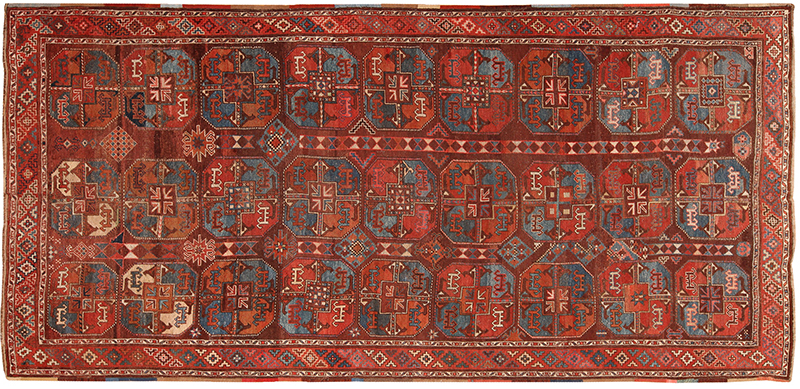
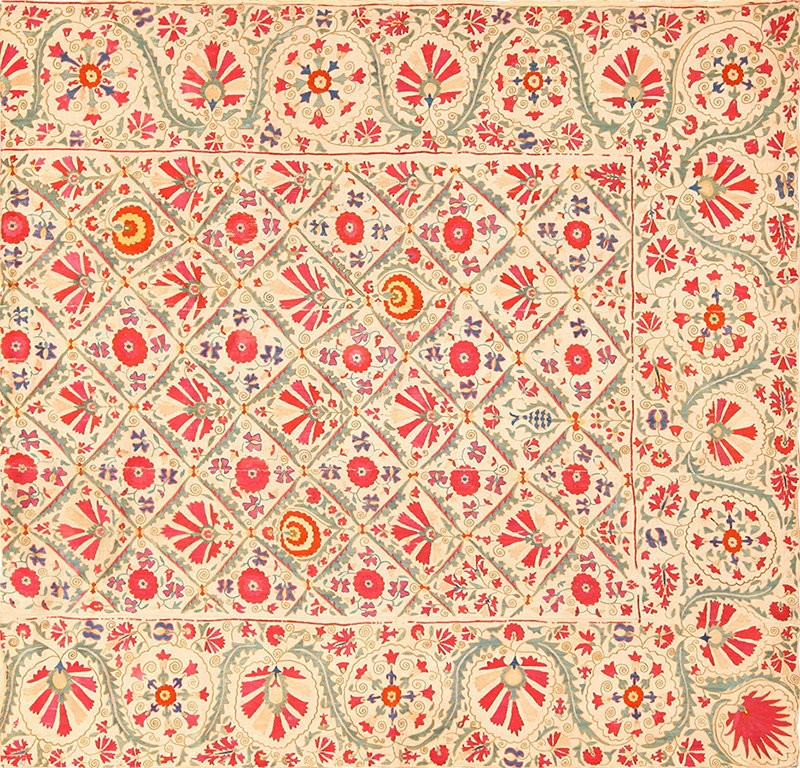
Tribal Uzbek Textiles from the Silk Road, Including Suzani Embroideries and Ikat Cloth
Uzbekistan textiles are best known for bold, symbolic embroidery and luminous silk cloth shaped by centuries of Silk Road exchange. On this page, “Uzbekistan textiles” includes suzani embroideries, abr (ikat) fabrics, and related tribal weavings that carry regional color and unmistakable handwork. If you’re deciding between a wall statement, a collected textile, or an accent piece for a room, start with motif clarity, dye character, and condition integrity. For current availability and tailored guidance, visit Nazmiyal, and explore regional context in Rug Origins.
Uzbekistan textiles are hand-made Central Asian weavings—especially suzani embroidery and silk ikat cloth—recognized for symbolic motifs, saturated color, and Silk Road-influenced design vocabulary.
Why Shop With Us? 3 Pillars of Nazmiyal Collection
Curated authenticity: we prioritize true technique (embroidery and resist-dye) and strong, honest condition.
Design-forward guidance: practical help choosing scale, placement, and color harmony for real rooms.
Collector care: transparent support for evaluating rarity, restoration, and long-term stewardship.
How to Identify Uzbekistan Textiles
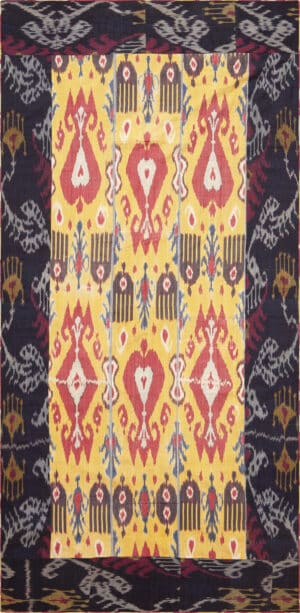
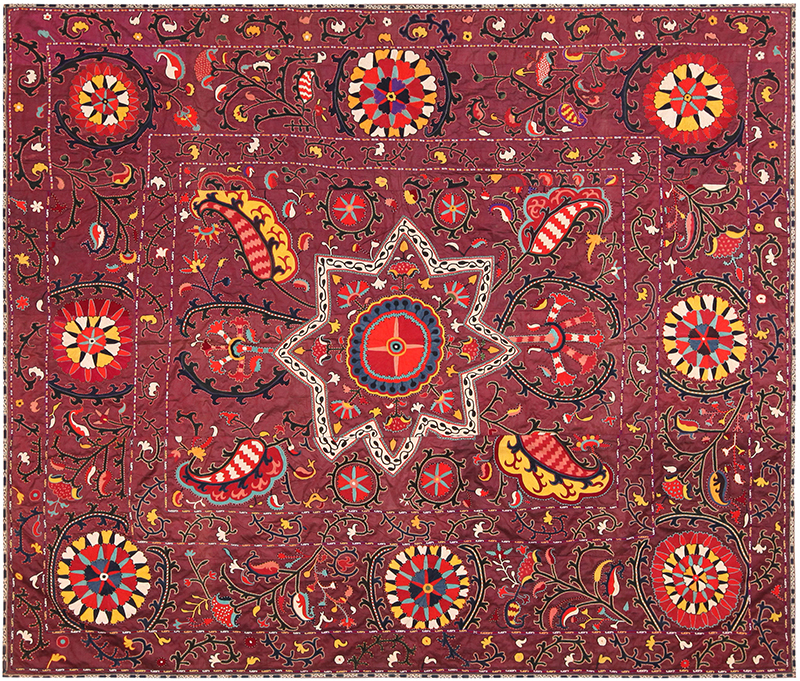
Uzbek textiles are often recognizable at a glance: suzani pieces feature bold, hand-embroidered motifs on a cloth ground, while ikat (abr) cloth shows feathered, “bound cloud” color transitions created before weaving. Look for the telltale signs of hand production—irregularities that feel alive rather than mechanically perfect. Regional symbolism can appear through repeated medallion-like rounds, solar forms, flowering vines, and fruit motifs used to convey abundance and celebration.
Materials and Construction
Traditional Uzbekistan textiles commonly combine cotton foundations with silk embroidery (suzani) or rely on silk cloth produced through resist-dye methods (ikat). What to check when evaluating a piece:
Technique authenticity: embroidery should show hand tension changes; ikat should show characteristic feathering, not surface printing.
Thread and ground integrity: inspect for thinning, splits along folds, and stress around corners and edges.
Dye character: older textiles often show layered color and mellow transitions that reward natural light viewing.
Metallic elements: when present, confirm stability and note any oxidation or loss in high-contact areas.
Decorating With Uzbek Textiles
Uzbek textiles can work as wall art, a dramatic headboard panel, or a layered accent over seating. In eclectic interiors, a single suzani can become the focal point while you keep surrounding patterns quieter; in more tailored rooms, use the textile’s palette to guide paint, trim, and art choices. If you’re balancing eras, pair a statement textile with an antique rug foundation, echo color notes through adjacent vintage rugs, or sharpen the contrast with clean-lined modern rugs in nearby zones.
Placement tip: keep direct sunlight modest and avoid high-friction areas unless the textile is being used as a decorative overlay rather than a daily-wear surface.
Value and Collecting
Collector interest typically follows technique and rarity: authentic, finely worked suzani and true silk ikat cloth are valued for hand labor, cultural continuity, and visual impact. Condition matters—especially stitch loss, dye bleed, or structural weakness along folds. When comparing pieces, prioritize authenticity of method (resist-dye versus printing), clarity of motif, and the “settled” harmony of the palette. Provenance and region-specific character can add meaning and value, especially for textiles with strong symbolic language and well-preserved surfaces.
Related Rugs
If you like Uzbekistan textiles for their Central Asian character and Silk Road lineage, the closest cousin category to explore is Suzani textiles.
Category
What it’s known for
Best use
Uzbekistan textiles
Suzani embroidery and ikat cloth with symbolic motifs and saturated color
Most are textiles rather than pile rugs—commonly used as wall art, bed panels, or layered décor—though they can be adapted for upholstery and decorative overlays.
What is the difference between suzani and ikat?
Suzani is embroidery stitched onto a cloth ground, while ikat is a woven cloth made from resist-dyed yarns that create characteristic blurred edges.
How can I tell authentic ikat from printed fabric?
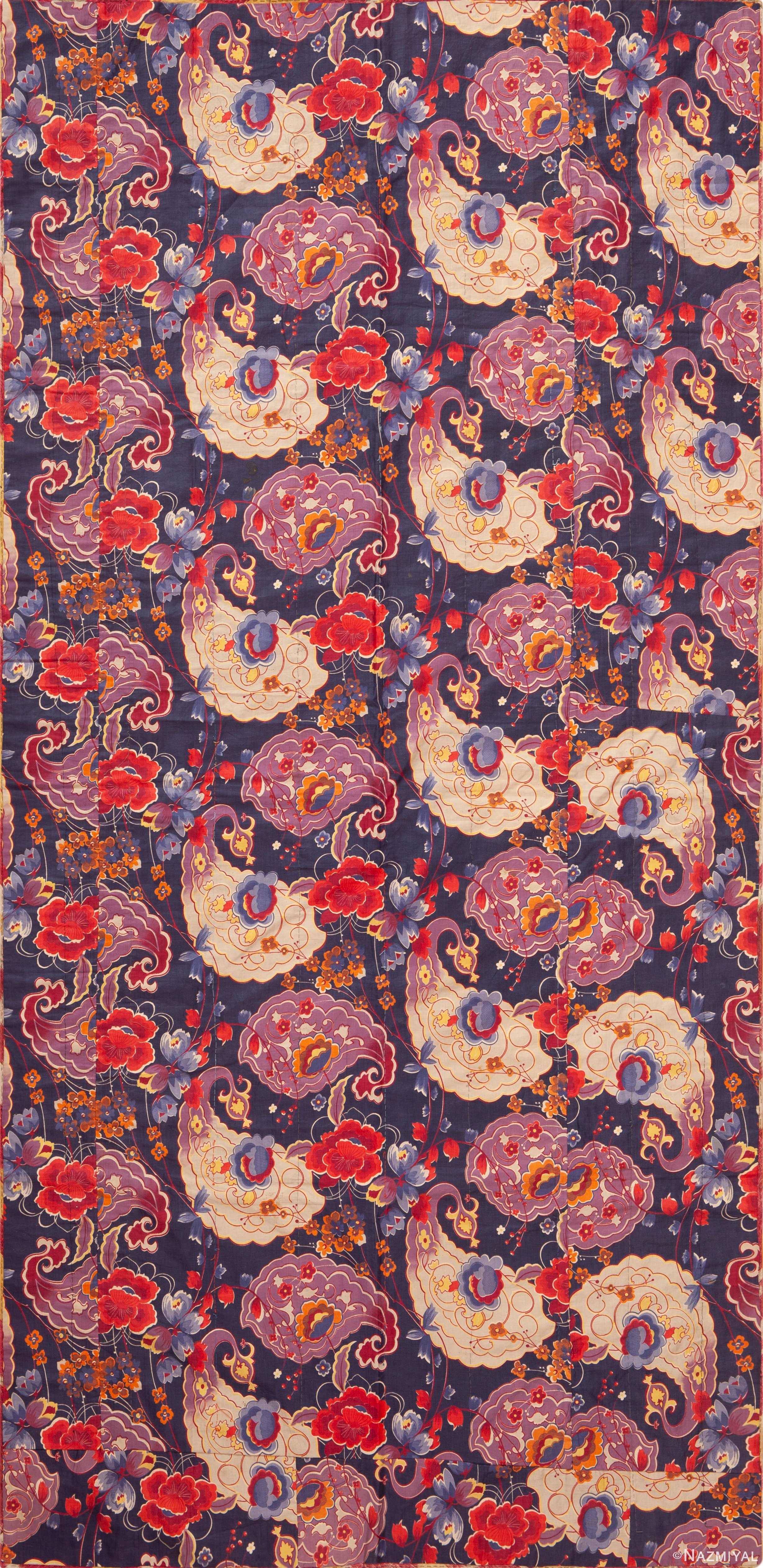
Authentic ikat shows feathered transitions and structure-driven patterning; printed fabrics often look flat, overly sharp, or identical on every repeat.
Do suzani textiles have symbolic meaning?
Many designs use motifs associated with celebration, abundance, and protection—often expressed through florals, circular forms, and fruit imagery.
How should I care for an antique Uzbekistan textile?
Limit direct sunlight, avoid moisture, and handle gently at folds and edges. For cleaning and stabilization, consult a qualified textile conservator.
Do you ship Uzbekistan textiles internationally?
Yes—options vary by destination and item type, and we can help coordinate the best approach for your project.
Nazmiyal White-Glove Service
We make it easy to shop with confidence—whether you’re choosing a single statement piece or curating a full room.
Nazmiyal Collection has been a trusted source for antique rugs and vintage carpets for over 45 years. Our NYC gallery curates one-of-a-kind pieces with an emphasis on authenticity, provenance, and lasting decorative value.
Need help? Call us at (212) 545-8029 or visit our New York City showroom to work with a rug expert.
             Posted on Google        Clay Pendergrast     Trustindex verifies that the original source of the review is Google. My wife and I are so pleased with the antique Uzbek Bokhara Rug purchased from the Nazmiyal Collection. Not only does the rug have a spectacular design, it also was very reasonably priced. The way it transforms our living room, reconciling the classic modern furniture with the 1913 Craftsman interior is remarkable.         Posted on Google        Terence Hayes     Trustindex verifies that the original source of the review is Google. I have purchased multiple rugs at multiple Nazmiyal auctions and I am extremely pleased with the quality, price, and experience.  Highly recommended!         Posted on Google        Victor Florintsev     Trustindex verifies that the original source of the review is Google. The only ones I'd ever buy rugs from. The best.         Posted on Google        Jeffrey NeumanB     Trustindex verifies that the original source of the review is Google. I bought two gorgeous Serapi rugs from Farhad at Nazmiyal Rugs!  Beautiful carpets, fair prices and great service.  Very happy customer.  Farhad (the sales person) was very patient and gave us great service.         Posted on Google        john haid     Trustindex verifies that the original source of the review is Google. Alen is a gentleman and an expert.  Really great to work with.         Posted on Google        Edward Yasuna     Trustindex verifies that the original source of the review is Google. I recently purchased a modern Kandinsky rug from Nazmiyal Auctions.  It was just as described, and the director (Farhad) of the auctions had it sent to me quickly and safely.  Payment was easy, the rug was reasonably priced, and I highly recommend Nazmiyal Auctions and Antique Rugs.  Quality merchandise and first-class service.         Posted on Google        Nicholas Carr     Trustindex verifies that the original source of the review is Google. Had a excellent experience buying a rug in Nazmiyal's 1/18/26 online auction.  First, prior to the auction, viewing a number of lots at the 32nd St showroom (I had prepared a list from the online catalog). The staff were great to work with: helpful, knowledgable, honest, and flexible.  Second, after placing an online bid and winning the desired item, arranging payment and pickup was simple and straightforward. Everything went seamlessly and the overall experience was educational and fun. Many thanks to Jason and his team.         Posted on Google        Andrea Gared     Trustindex verifies that the original source of the review is Google. Everyone at Naziyal is proffessional, especially Jason and Farhad.
They are knowledgeable, truthful, and true gentlemen. I have sold several rugs through them and will always go to them first, to buy or sell. The best in the business!
Frequently Asked Questions
Its location as a hub of the Silk Road allowed Uzbekistan to be exposed to the arts and culture of all that passed through. This inspired the local population to develop a highly sophisticated art and cultural heritage. In their artwork, you can see the influences of Chinese, Persian, Turkish, Mongolian, and Indian culture. Beginning in the 19th century, you also begin to see the Russian influence in the artwork and textiles, too.
The suzani textiles are heavily embroidered pieces. The word “suzani” in Farsi means embroidery. Each piece of suzani is individual and has a unique story behind the work. The embroidery begins when a daughter is born. The fabric is added to by the family and is meant to adorn the young woman’s marital bed when she is wed. It is a unique gift that is part of her dowry. It is a work that takes years to complete and meant to mark the crowning movement in her life.
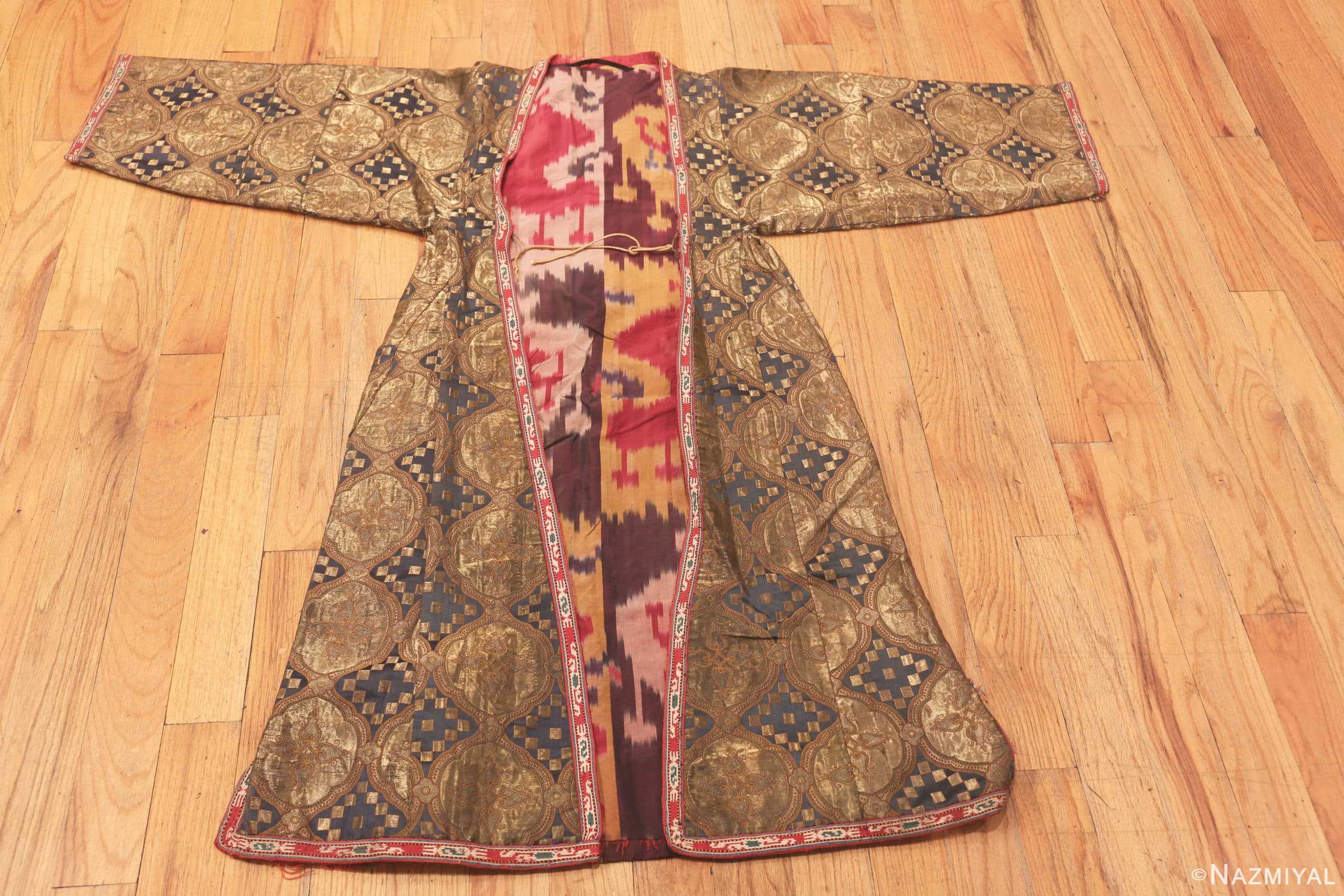
Ikat weaving began in the Fergana Valley in the 12th century. These fabrics were an important part of the culture, and when someone received an award, they were presented with ikat robes to mark the occasion. However, this ended when the Soviet Union took over the area. The weavers were forced to produce standardized patterns and the traditional ikat weaving patterns almost all but died out.
The colors are created using cochineal and madder root for reds. Dried pomegranate rind is used for gold. Walnut husk creates browns, and indigo is the traditional material for blues. Nothing beats the beauty of an authentic ikat textile. Many modern reproductions do not use the traditional technique and are printed after the cloth is made. A trained eye can distinguish these from the real Uzbekistan ikat cloth.
THE NAZMIYAL NEWSLETTER
Discover Your Next Favorite Rug
Get new arrivals, rug inspiration, educational blogs, and collection highlights delivered to your inbox.
By subscribing, you agree to receive marketing emails from Nazmiyal. Unsubscribe anytime. View our Privacy Policy.