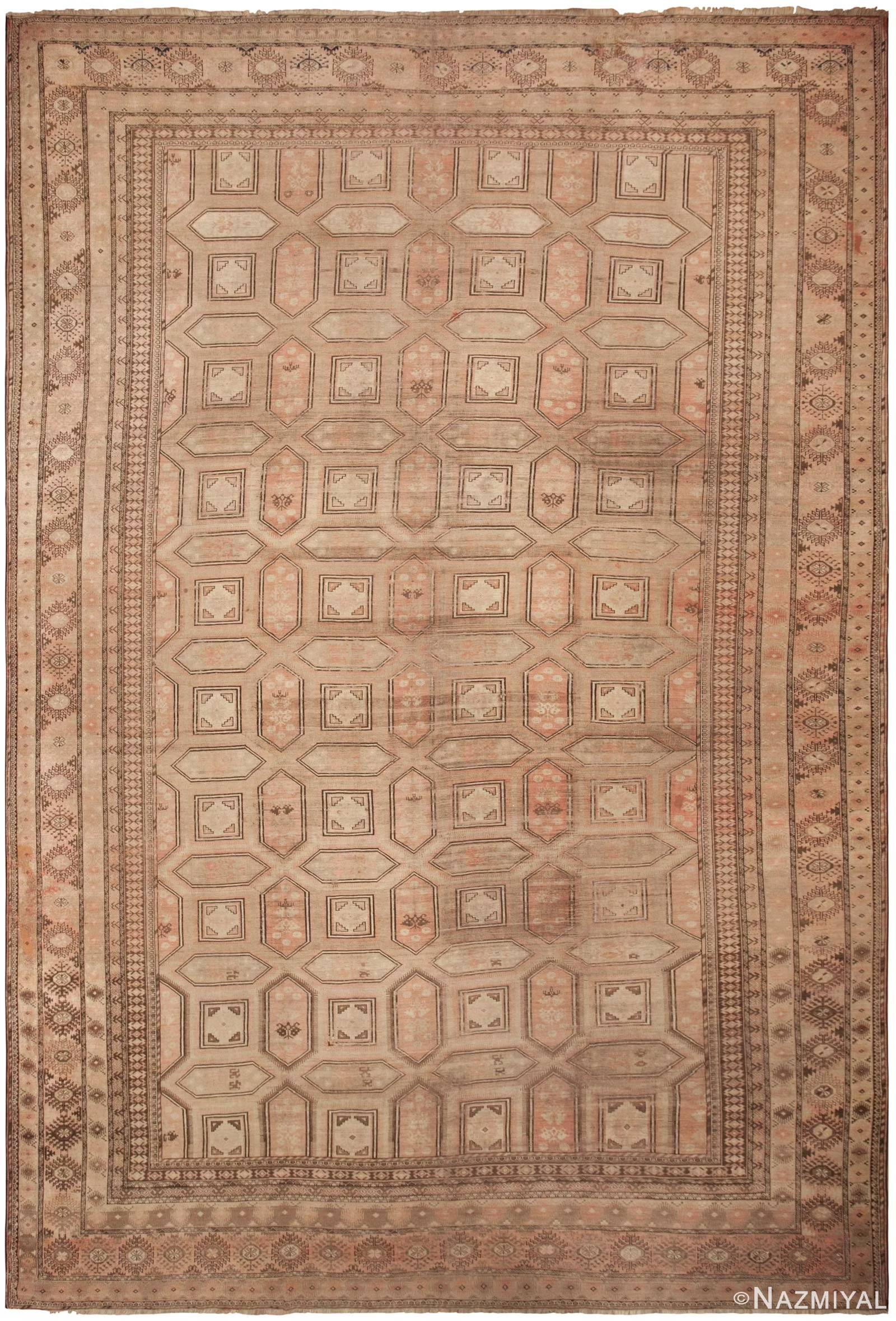
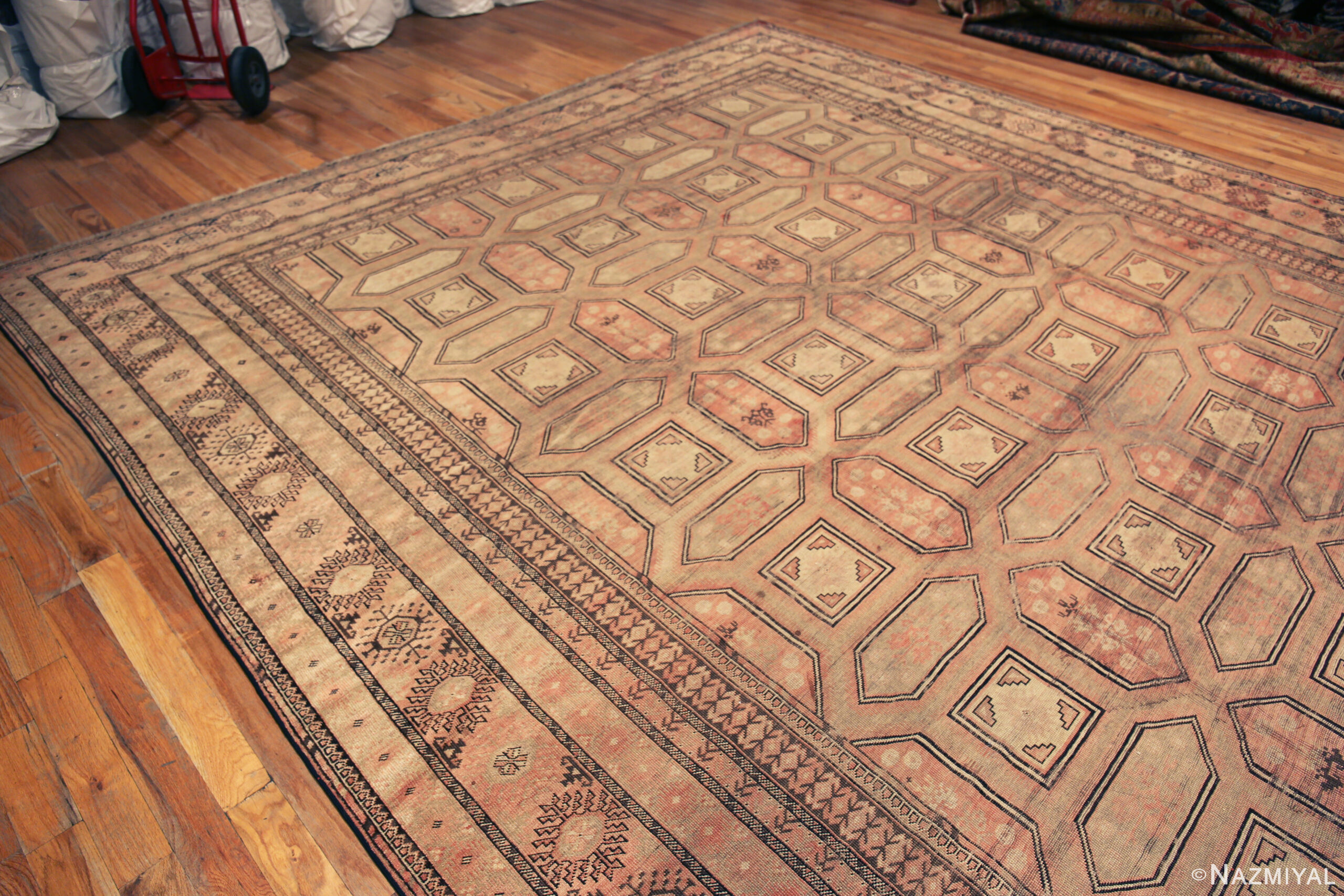
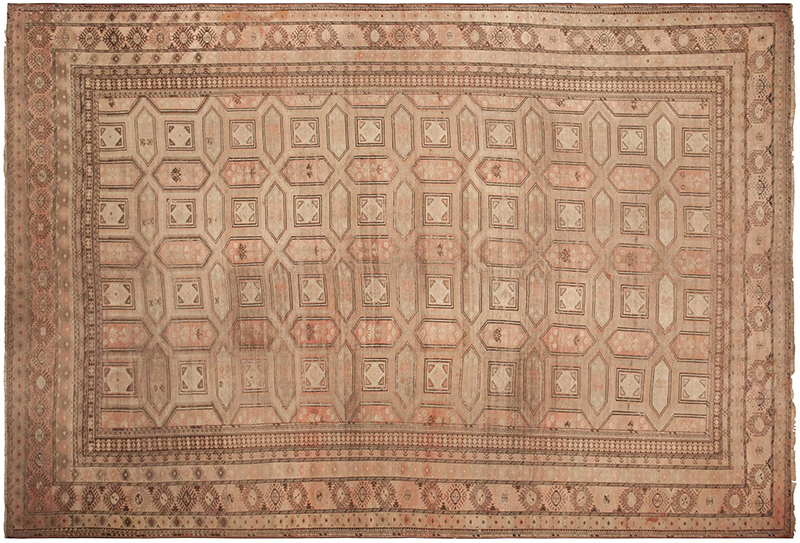
Beshir rugs are hand-knotted tribal carpets commonly attributed to a Beshir subgroup within the Ersari Turkoman weaving family, known for refined lattice-and-floral patterning and repeating “compartmental” layouts.
At Nazmiyal Collection, we look at Beshir rugs as a sweet spot between tribal character and refined patterning. Often associated with the Amu Darya corridor (and linked to the wider Turkoman weaving world), antique Beshir carpets are prized for compartmental and lattice-based layouts, stylized florals, and a color sensibility that can feel brighter and more decorative than many classic gul rugs. If you are comparing weaving families across the region, start with our Central Asian rugs collection and then narrow your search by design, size, and the specific look you want in the room.
Updated January 28, 2026 • Reviewed by Jason Nazmiyal
Many Beshir rugs are associated with weaving communities in and around northern Afghanistan and the broader Central Asian corridor. Visually, they are often “pattern-forward”: dense repeats, compartmental grids, and floral geometry that can feel more refined than many purely emblem-based tribal designs. For a wider country-and-region overview, browse the Rug Origins hub.
Lattice and compartment fields: repeating grids divided into small “cells,” sometimes with barber-pole style separators.
Floral-influenced ornament: rosettes, vines, and stylized blossoms; these influences can feel closer to Persian rugs than many other Turkmen tribal formats.
Less reliance on large guls: compared with some Turkoman types, Beshir compositions often prioritize allover patterning over repeating emblem fields.
Build and handle: hand-knotted pile rugs, typically wool pile with a sturdy foundation; many examples present tight, even knotting and crisp drawing of small motifs.
What Are Beshir Rugs?
Beshir rugs are Turkoman tribal carpets associated with the Beshir group within the broader Ersari weaving world. In the market, “Beshir” often signals a more refined surface and a more organized decorative rhythm than many purely emblem-driven Turkoman rugs—frequently expressed through repeating lattice structures and stylized floral systems.
Where Do Beshir Rugs Come From?
Beshir weaving is linked to the broader Amu Darya region and the historic trade networks that connected Central Asia to Persia and beyond. Because borders and naming conventions shifted over time, many examples are described as Afghan in the trade, while the weaving identity remains rooted in Turkoman/Ersari traditions. The most reliable approach is to confirm attribution through structure, design logic, and period coherence—not the label alone.
Design Language, Motifs & Layouts
Lattice and allover frameworks: repeating networks that read as orderly and architectural.
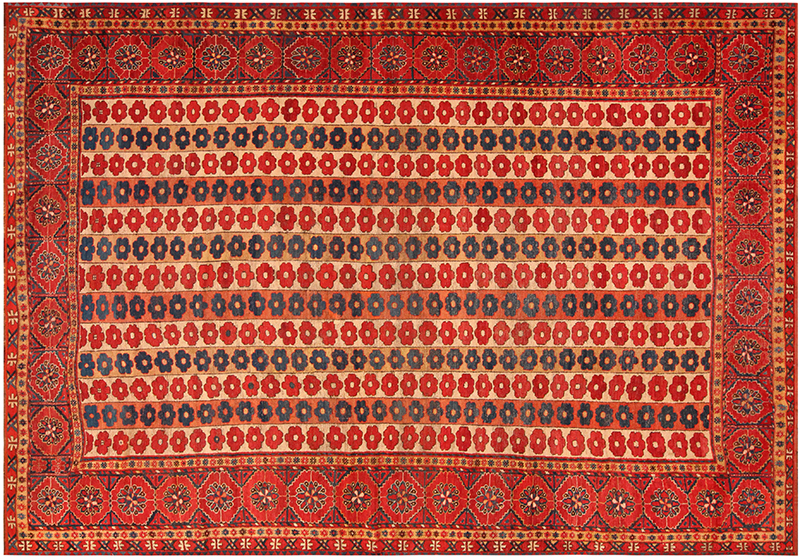
Stylized florals: floral influence expressed with tribal simplification (more “system” than bouquet).
Miniaturized ornament: small-scale fills and compartments that create texture and depth without clutter.
Border hierarchy: calm framing that supports the field rather than competing with it.
Materials & Construction
Weave type: typically hand-knotted pile carpets.
Pile: usually wool, valued for luster and character when well preserved.
Structure: varies by piece; evaluate foundation stability, edge security, and end finishes.
Surface reading: stronger examples show crisp drawing with a balanced “handle” (neither overly rigid nor overly loose).
How to Identify an Authentic Beshir Rug
No single detail “proves” a Beshir attribution. We look for alignment across multiple indicators:
Design coherence: lattice/allover logic that feels intentional, not improvised.
Drawing clarity: motifs should read cleanly at normal viewing distance.
Palette integrity: saturated tones with believable age behavior (avoid harsh, flat-looking recolor).
Structural condition first: foundation, edges, and ends matter more than “cosmetic” surface issues.
Repair honesty: good conservation supports structure and blends visually; heavy-handed work can reduce desirability.
Beshir vs. Ersari (and Other Turkoman Weavings)
Beshir: often more refined repeating systems (frequent lattice/allover organization), with a “polished tribal” look.
Ersari: broader umbrella with wide stylistic range; attribution depends heavily on structure and design language.
Other Turkoman groups: can emphasize emblematic gul systems more strongly (selection should be category-aware, not name-driven).
If you love the Beshir look but want to compare within the closest family, explore Ersari rugs.
Value, Collecting & Investment Considerations
Value in antique Beshir rugs typically reflects a combination of decoration and scholarship: how well the rug works in a room, plus how confidently it presents its identity and quality.
Color: saturated palettes with usable balance (and believable age behavior).
Size: room-size carpets and long galleries tend to remain in steady designer demand.
Condition: structural stability (edges/ends/foundation) is the first filter.
Buying correctly: within any category, price paid is a major driver of long-term satisfaction.
Beshir Rugs in Interior Design
Beshir rugs are especially strong when you want pattern and structure without visual chaos. Their repeating systems can read “architectural,” making them excellent anchors in both traditional rooms and clean contemporary spaces.
Gallery formats: hallways, long dining rooms, and libraries.
Room-size carpets: living rooms where you want depth and a grounded center.
Pairing rule: let the rug’s repeat do the work—keep surrounding textiles quieter.
In the rug trade, both spellings are commonly used to describe the same general weaving identity.
Are Beshir rugs Afghan or Turkoman?
Many are described as Afghan due to geography and trade usage, while the weaving identity is tied to Turkoman/Ersari traditions. Confirm by structure and design logic.
What designs are most associated with Beshir rugs?
Repeating lattice and allover systems, stylized florals, and disciplined small-scale ornament are common signals.
What should I prioritize when buying an antique Beshir rug?
Design clarity, palette coherence, and structural condition (especially edges/ends and foundation) are the most dependable filters.
Nazmiyal White-Glove Service
We make it easy to shop with confidence—whether you’re choosing a single statement piece or curating a full room.
Nazmiyal Collection has been a trusted source for antique rugs and vintage carpets for over 45 years. Our NYC gallery curates one-of-a-kind pieces with an emphasis on authenticity, provenance, and lasting decorative value.
Need help? Call us at (212) 545-8029 or visit our New York City showroom to work with a rug expert.
             Posted on Google        Clay Pendergrast     Trustindex verifies that the original source of the review is Google. My wife and I are so pleased with the antique Uzbek Bokhara Rug purchased from the Nazmiyal Collection. Not only does the rug have a spectacular design, it also was very reasonably priced. The way it transforms our living room, reconciling the classic modern furniture with the 1913 Craftsman interior is remarkable.         Posted on Google        Terence Hayes     Trustindex verifies that the original source of the review is Google. I have purchased multiple rugs at multiple Nazmiyal auctions and I am extremely pleased with the quality, price, and experience.  Highly recommended!         Posted on Google        Victor Florintsev     Trustindex verifies that the original source of the review is Google. The only ones I'd ever buy rugs from. The best.         Posted on Google        Jeffrey NeumanB     Trustindex verifies that the original source of the review is Google. I bought two gorgeous Serapi rugs from Farhad at Nazmiyal Rugs!  Beautiful carpets, fair prices and great service.  Very happy customer.  Farhad (the sales person) was very patient and gave us great service.         Posted on Google        john haid     Trustindex verifies that the original source of the review is Google. Alen is a gentleman and an expert.  Really great to work with.         Posted on Google        Edward Yasuna     Trustindex verifies that the original source of the review is Google. I recently purchased a modern Kandinsky rug from Nazmiyal Auctions.  It was just as described, and the director (Farhad) of the auctions had it sent to me quickly and safely.  Payment was easy, the rug was reasonably priced, and I highly recommend Nazmiyal Auctions and Antique Rugs.  Quality merchandise and first-class service.         Posted on Google        Nicholas Carr     Trustindex verifies that the original source of the review is Google. Had a excellent experience buying a rug in Nazmiyal's 1/18/26 online auction.  First, prior to the auction, viewing a number of lots at the 32nd St showroom (I had prepared a list from the online catalog). The staff were great to work with: helpful, knowledgable, honest, and flexible.  Second, after placing an online bid and winning the desired item, arranging payment and pickup was simple and straightforward. Everything went seamlessly and the overall experience was educational and fun. Many thanks to Jason and his team.         Posted on Google        Andrea Gared     Trustindex verifies that the original source of the review is Google. Everyone at Naziyal is proffessional, especially Jason and Farhad.
They are knowledgeable, truthful, and true gentlemen. I have sold several rugs through them and will always go to them first, to buy or sell. The best in the business!
THE NAZMIYAL NEWSLETTER
Discover Your Next Favorite Rug
Get new arrivals, rug inspiration, educational blogs, and collection highlights delivered to your inbox.
By subscribing, you agree to receive marketing emails from Nazmiyal. Unsubscribe anytime. View our Privacy Policy.