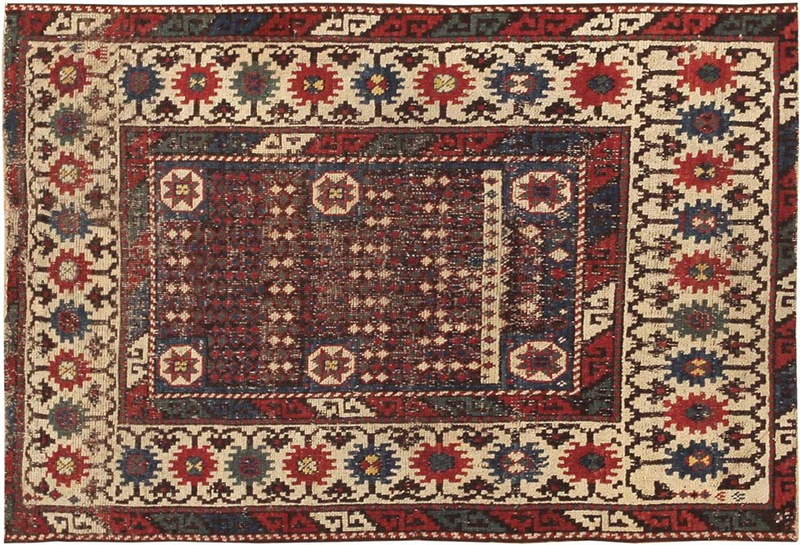
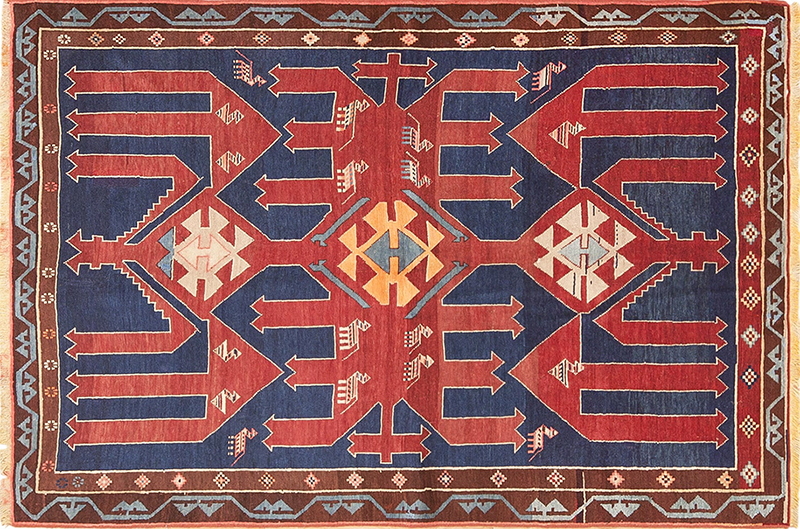
Avar rugs are antique tribal carpets associated with Avar weaving communities in Dagestan (eastern Caucasus). If you are browsing Caucasian rugs, Avar pieces stand out for stepped polygon repeats, energetic borders, and bold color contrasts that read beautifully in both traditional and modern rooms. At Nazmiyal Collection, we curate collectible examples and help you choose the right size, palette, and condition for your space.
An Avar rug is a Caucasian tribal rug type known for bold geometric design—often repeating stepped polygons—woven in the Dagestan region and prized for graphic presence and saturated color.
Antique Avar rugs are admired for a distinctly tribal visual language: repeating rows of stepped polygons that create a powerful rhythm across the field. Borders are often bold and diagonal in feel, reinforcing the rug’s graphic architecture and making the pattern read clearly from across a room.
As part of the broader family of traditional Oriental rugs, Avar pieces are celebrated for their confident geometry and saturated color contrasts. Many examples show a warm, earthy cast in the foundation yarns, which can appear as light brown tones in the structure and edges.
How to Identify an Antique Avar Rug
When you are evaluating an Avar rug, focus on what the weaving communicates at a glance: clear geometric intent, coherent spacing, and borders that frame the composition without feeling crowded. Avar rugs typically emphasize strong pattern logic over delicate curvilinear drawing.
Motif structure: stepped polygons and repeated geometric compartments that feel deliberate.
Border discipline: crisp border sequence with strong contrast and clean corner turns.
Color behavior: rich, saturated hues that hold depth (even when mellowed by age).
Condition clues: even wear, stable edges, and repairs that do not interrupt the geometry.
Decorating With Avar Rugs
Avar rugs excel where you want bold structure: hallways, studies, entryways, and layered living rooms. Their geometry pairs well with clean-lined furniture and also grounds eclectic spaces when you keep surrounding patterns quieter.
If you want a close stylistic comparison, look at Shirvan rugs. Both live within the Caucasian tribal design universe, but they often differ in pattern density and the way motifs are “drawn” across the field.
Feature
Avar Rugs
Shirvan Rugs
Field design
Bold stepped polygons and repeating compartments with strong rhythm
Often finer patterning with more intricate small-scale geometry
Visual impact
Graphic and highly legible from a distance
Detail-rich texture that rewards closer viewing
Best room use
Spaces that benefit from a strong geometric anchor
Spaces where you want tribal character with more pattern nuance
Closest Cousins
Shirvan rugs (closest cousin for comparing Caucasian design density and drawing style)
Dagestan rugs (regional comparison within eastern Caucasus traditions)
Kazak rugs (another major Caucasian tribal category with bold geometry)
Nazmiyal Collection has been a trusted source for antique rugs and vintage carpets for over 45 years. Our NYC gallery curates one-of-a-kind pieces with an emphasis on authenticity, provenance, and lasting decorative value.
Need help? Call us at (212) 545-8029 or visit our New York City showroom to work with a rug expert.
Updated January 22, 2026 • Reviewed by Jason Nazmiyal
             Posted on Google        Clay Pendergrast     Trustindex verifies that the original source of the review is Google. My wife and I are so pleased with the antique Uzbek Bokhara Rug purchased from the Nazmiyal Collection. Not only does the rug have a spectacular design, it also was very reasonably priced. The way it transforms our living room, reconciling the classic modern furniture with the 1913 Craftsman interior is remarkable.         Posted on Google        Terence Hayes     Trustindex verifies that the original source of the review is Google. I have purchased multiple rugs at multiple Nazmiyal auctions and I am extremely pleased with the quality, price, and experience.  Highly recommended!         Posted on Google        Victor Florintsev     Trustindex verifies that the original source of the review is Google. The only ones I'd ever buy rugs from. The best.         Posted on Google        Jeffrey NeumanB     Trustindex verifies that the original source of the review is Google. I bought two gorgeous Serapi rugs from Farhad at Nazmiyal Rugs!  Beautiful carpets, fair prices and great service.  Very happy customer.  Farhad (the sales person) was very patient and gave us great service.         Posted on Google        john haid     Trustindex verifies that the original source of the review is Google. Alen is a gentleman and an expert.  Really great to work with.         Posted on Google        Edward Yasuna     Trustindex verifies that the original source of the review is Google. I recently purchased a modern Kandinsky rug from Nazmiyal Auctions.  It was just as described, and the director (Farhad) of the auctions had it sent to me quickly and safely.  Payment was easy, the rug was reasonably priced, and I highly recommend Nazmiyal Auctions and Antique Rugs.  Quality merchandise and first-class service.         Posted on Google        Nicholas Carr     Trustindex verifies that the original source of the review is Google. Had a excellent experience buying a rug in Nazmiyal's 1/18/26 online auction.  First, prior to the auction, viewing a number of lots at the 32nd St showroom (I had prepared a list from the online catalog). The staff were great to work with: helpful, knowledgable, honest, and flexible.  Second, after placing an online bid and winning the desired item, arranging payment and pickup was simple and straightforward. Everything went seamlessly and the overall experience was educational and fun. Many thanks to Jason and his team.         Posted on Google        Andrea Gared     Trustindex verifies that the original source of the review is Google. Everyone at Naziyal is proffessional, especially Jason and Farhad.
They are knowledgeable, truthful, and true gentlemen. I have sold several rugs through them and will always go to them first, to buy or sell. The best in the business!
Frequently Asked Questions
Antique Avar rugs originate from the northeastern Caucasus and are known for their sharp geometric designs, fine knotting, and strong tribal character. They often feature star motifs, stepped medallions, and carefully articulated borders.
Collectors appreciate Avar rugs for their precision, saturated natural dyes, and balanced compositions. Their technical quality places them among the more refined weavings of the Caucasus, appealing to both scholars and designers.
Identification involves finely rendered geometric motifs, star-and-cross patterns, and compact structure. Avar rugs often use deep blues, reds, and ivory, with crisp outlines and highly structured borders.
Yes. Avar rugs were woven with resilient mountain wool and firm knotting, providing excellent durability. They perform well in living rooms, hallways, studies, and other high-use spaces.
Value is determined by age, condition, dye quality, and the clarity of geometric drawing. Early Avar rugs with precise motifs, strong colors, and minimal restoration are especially desirable among collectors.
THE NAZMIYAL NEWSLETTER
Discover Your Next Favorite Rug
Get new arrivals, rug inspiration, educational blogs, and collection highlights delivered to your inbox.
By subscribing, you agree to receive marketing emails from Nazmiyal. Unsubscribe anytime. View our Privacy Policy.