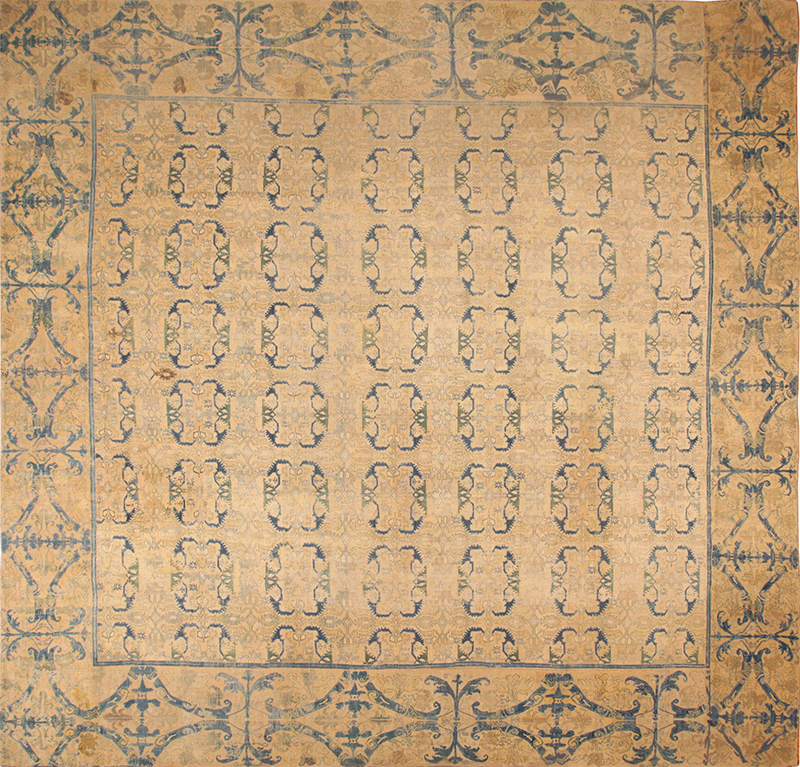
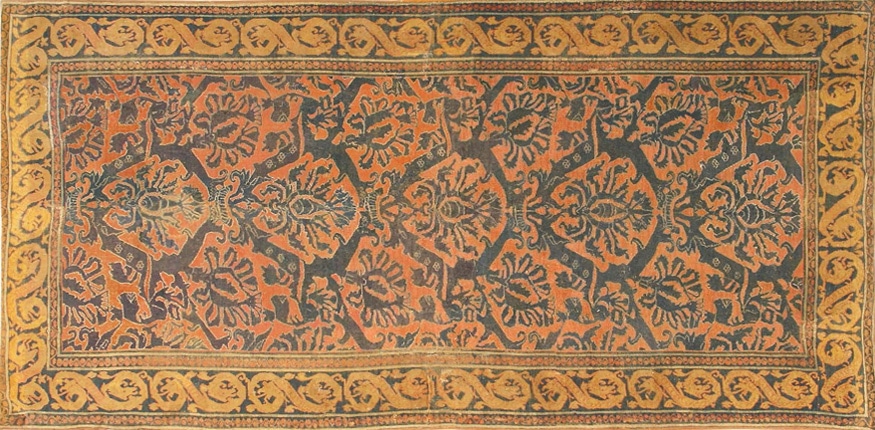
Alcaraz rugs are rare early Spanish carpets—often associated with post-Reconquista Renaissance-era design—recognized for bold allover ornament, acanthus scroll vocabulary, and distinctive Spanish weaving structure.
Alcaraz rugs are among the rarest early Spanish carpets, valued for their Renaissance-era ornament, Iberian color sensibility, and the shift from Moorish-influenced patterning toward a more classically derived European vocabulary. At Nazmiyal Collection, you can explore antique Alcaraz carpets selected for collectors and decorators who want historic Spanish weaving with room-ready presence—muted golds, greens, and blues, scrolling acanthus forms, and confident allover geometry. For broader context on Spain’s weaving centers and how Alcaraz relates to other regional traditions, visit our antique rugs from Spain hub.
Updated February 6, 2026 • Reviewed by Jason Nazmiyal
Antique Alcaraz carpets are prized for early Spanish rarity and historically important design vocabulary.
Look for allover organization, acanthus-and-palmette ornament, and a restrained Iberian palette (often golds, greens, blues, and ivories).
Structure can differ from many “Oriental” traditions—collectors often note the Spanish knotting/handle and period construction traits.
At-a-Glance Specs
Origin: Spain (Alcaraz tradition; early Spanish workshop output)
Common eras: 16th–17th century examples are most celebrated; later Spanish rugs may reference the vocabulary
Weave / structure: hand-knotted pile; period Spanish construction traits can include staggered knot alignment (often discussed as “Spanish knot” structure)
Materials: typically wool pile with wool foundation; natural-dye palettes may mellow beautifully with age
Typical sizes: room-size rugs and large statement carpets; some rare survivals appear as fragments
Palette: gold and butterscotch grounds • sage/green ornament • indigo/blue accents • warm ivories and sepias
What to look for: confident drawing • balanced allover spacing • authentic age character • readable pattern even with honest wear
Browse the Alcaraz selection on this page to compare pattern density, palette (gold-forward vs blue-forward), and scale—from room-size carpets to important collector-level pieces.
Why Nazmiyal Collection? 3 Pillars of Nazmiyal Collection
When you’re shopping a rare category like Alcaraz, the difference is clarity, accuracy, and real guidance—before you commit.
Unmatched Inventory Depth — breadth across eras and regions, including scarce European and Spanish traditions.
Rigorous Authenticity Standards (expert-vetted & accurately represented) — origin, era, structure, and condition are presented plainly for confident decision-making.
Expert Advisory (real guidance on size/placement/value) — help selecting the right scale, placement strategy, and complementary styles for your space.
Identification & Construction
A practical way to recognize antique Alcaraz carpets is by their design “grammar”: disciplined allover organization, scrolling acanthus and palmette-derived ornament, and a European ornamental vocabulary that feels closer to Renaissance textiles than to later workshop standardization. Many examples favor warm gold grounds with contrasting greens or blues, and the drawing often reads as bold and architectural even at a distance.
Structurally, early Spanish carpets are frequently discussed in terms of their distinctive knotting alignment and handle—traits that can look and feel different from many Near Eastern traditions. If you are comparing European weaving structure to broader “Oriental” categories, it can help to contrast Spanish construction with major traditions like Persian rugs. For a wider map of how origin shapes materials and structure across regions, start with Rug origins.
Decorating & Placement Guidance
Decorators often treat Alcaraz carpets as “foundation artwork”: give the pattern breathing room, repeat one or two tones in upholstery or art, and let the allover rhythm do the heavy lifting. In dining rooms and formal living rooms, larger Alcaraz pieces can anchor the layout with historic gravitas; in libraries or studies, a room-size rug adds warmth while keeping the palette restrained.
For a collected interior, pair an Alcaraz carpet with complementary Antique rugs, clean-lined Vintage rugs, and graphic Modern rugs—especially when you echo one accent color (sage, indigo, or warm gold) across smaller textiles in the room.
Alcaraz Carpets vs Cuenca Rugs
Both are important Spanish traditions, but they tend to deliver a different look and historical emphasis. Use this quick comparison to choose faster.
Acanthus scroll: A classical leaf-and-vine motif used widely in Renaissance ornament and European decorative arts.
Allover design: A pattern system that repeats across the entire field without relying on a single dominant medallion.
Spanish knot (collector term): A way collectors describe the distinctive knot alignment/structure seen in many early Spanish carpets.
Patina: The visual character that develops over time through age, wear, and natural dye mellowing.
For more terminology (materials, dyes, motifs, and condition language), see the Rug glossary.
FAQ
What makes Alcaraz carpets so rare? Surviving early Spanish carpets are scarce, and fewer still retain strong pattern readability and presentable condition at room size.
Are Alcaraz rugs always 16th or 17th century? The most celebrated examples are early (often 16th–17th century), but Spanish rugs from later periods can reference related design vocabulary or regional aesthetics.
What designs are most associated with Alcaraz carpets? Collectors often note allover organization, scrolling ornament, and Renaissance-influenced decorative language that can resemble historic European textiles.
Do Alcaraz carpets work in modern interiors? Yes—because many examples have disciplined geometry and restrained palettes, they can feel architectural and surprisingly contemporary when paired with clean-lined furnishings.
How should I choose the right size? Start with the furniture plan: for living rooms, aim to place at least the front legs of major seating on the rug; for dining rooms, ensure chairs stay on the rug when pulled out.
How should I care for an antique Spanish carpet? Vacuum gently, rotate periodically, avoid prolonged direct sunlight, and use professional rug care for deep cleaning or any restoration decisions.
Nazmiyal White-Glove Service
We make it easy to shop with confidence—whether you’re choosing a single statement piece or curating a full room.
Nazmiyal Collection has been a trusted source for antique rugs and vintage carpets for over 45 years. Our NYC gallery curates one-of-a-kind pieces with an emphasis on authenticity, provenance, and lasting decorative value.
Need help? Call us at (212) 545-8029 or visit our New York City showroom to work with a rug expert.
             Posted on Google        Clay Pendergrast     Trustindex verifies that the original source of the review is Google. My wife and I are so pleased with the antique Uzbek Bokhara Rug purchased from the Nazmiyal Collection. Not only does the rug have a spectacular design, it also was very reasonably priced. The way it transforms our living room, reconciling the classic modern furniture with the 1913 Craftsman interior is remarkable.         Posted on Google        Terence Hayes     Trustindex verifies that the original source of the review is Google. I have purchased multiple rugs at multiple Nazmiyal auctions and I am extremely pleased with the quality, price, and experience.  Highly recommended!         Posted on Google        Victor Florintsev     Trustindex verifies that the original source of the review is Google. The only ones I'd ever buy rugs from. The best.         Posted on Google        Jeffrey NeumanB     Trustindex verifies that the original source of the review is Google. I bought two gorgeous Serapi rugs from Farhad at Nazmiyal Rugs!  Beautiful carpets, fair prices and great service.  Very happy customer.  Farhad (the sales person) was very patient and gave us great service.         Posted on Google        john haid     Trustindex verifies that the original source of the review is Google. Alen is a gentleman and an expert.  Really great to work with.         Posted on Google        Edward Yasuna     Trustindex verifies that the original source of the review is Google. I recently purchased a modern Kandinsky rug from Nazmiyal Auctions.  It was just as described, and the director (Farhad) of the auctions had it sent to me quickly and safely.  Payment was easy, the rug was reasonably priced, and I highly recommend Nazmiyal Auctions and Antique Rugs.  Quality merchandise and first-class service.         Posted on Google        Nicholas Carr     Trustindex verifies that the original source of the review is Google. Had a excellent experience buying a rug in Nazmiyal's 1/18/26 online auction.  First, prior to the auction, viewing a number of lots at the 32nd St showroom (I had prepared a list from the online catalog). The staff were great to work with: helpful, knowledgable, honest, and flexible.  Second, after placing an online bid and winning the desired item, arranging payment and pickup was simple and straightforward. Everything went seamlessly and the overall experience was educational and fun. Many thanks to Jason and his team.         Posted on Google        Andrea Gared     Trustindex verifies that the original source of the review is Google. Everyone at Naziyal is proffessional, especially Jason and Farhad.
They are knowledgeable, truthful, and true gentlemen. I have sold several rugs through them and will always go to them first, to buy or sell. The best in the business!
THE NAZMIYAL NEWSLETTER
Discover Your Next Favorite Rug
Get new arrivals, rug inspiration, educational blogs, and collection highlights delivered to your inbox.
By subscribing, you agree to receive marketing emails from Nazmiyal. Unsubscribe anytime. View our Privacy Policy.