Perpedil Rugs Unknown Until the 19th Century
Even though rugs in this area were being produced for thousands of years, it was only in the latter part of the 19th century that they became a part of the world heritage. Until that time, this area of the world was remote and inaccessible. This means that the tribes had little or no contact with the outside world. They were living largely as they had for thousands of years.
This would all change in the late 1870’s when the Trans Caucasian Railway was built that allowed access to the area. It was then that the world was introduced to these beautiful creations that were like nothing they had ever seen before. This opened access to an art form that had not been seen in Europe until that time, and it opened up new economic opportunities for the weavers and tribes of the region. However, it also meant exposure to European culture, and this would change the social fabric of the tribes forever. The rugs of this region were destined to become world treasures that represent a type of cultural archaeology and a glimpse into the past.
Influencing the Turkish Empire On Perpedil Rugs
The tribes of the Caucasus Mountains were people who had been driven out of more hospitable areas of the world. At one time, there were approximately 350 different tribes in the area that spoke over 150 distinct languages. They were from many different religions including Jewish people, Christians, Buddhists, Norsemen and Germans. The people of the mountains were known for their spirit of independence and their longevity.
At one point, Turks from the Ottoman Empire became enamored with the beauty of the tribal women. They began kidnapping them and taking them as wives. In this way, people with olive skin and striking eyes made their way into the Turkish people. This practice was especially prevalent among the ruling class, which had an influence over the development of art within the empire.
As these women became integrated into Turkish culture, the geometric and stylized designs of their Oriental rugs also became indoctrinated into Turkish culture. In this way, the nomadic tribal people had an influence on the development of artistic design in the Ottoman Empire. This can be seen through the geometric designs that are common in Ottoman rugs.
Changing Traditions of Perpedil Rugs
One the qualities of Perpedil rugs that makes them still highly collectible today is their tribal and primitive quality. They often have a high knot count that allowed the weavers to render designs in fine detail. They are often trimmed short to highlight the design. This allows the design to remain crisp and avoid becoming muddied as one would see with a higher pile rug.
The carpets of Perpedil stand out among the tribal rugs of the Caucasus mountains because they are heavier pile than those produced throughout the rest of the region. They often used bright jewels tones in emerald green, sapphire, fuchsia and brilliant reds. The designs often feature large geometric patterns that are simple yet striking.
Perpedil rugs are often smaller in size, which makes them suitable for wall hangings, table coverings, and as accent pieces in the home. The designs produced prior to the 1890s in Perpedil have unique qualities that would soon disappear with the exposure to European culture. The high demand for the rugs caused them to change their traditional rug production methods.
Rugs produced prior to the 1890’s used only natural dye stuffs that could be found in the local area, which gives the rugs a subdued and pastoral feel. However, in the 1890’s, the demand was high, and the rug producers turned to the use of imported commercial dyes from Europe.
This changed the vital artistic characteristics of the rugs, making those that were produced prior to the 1890’s a rare and collectible piece that represents a culture that is no longer in existence in its original form.
Caucasian and Perpedil Rug Patterns
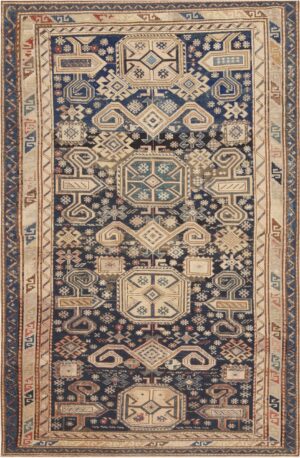
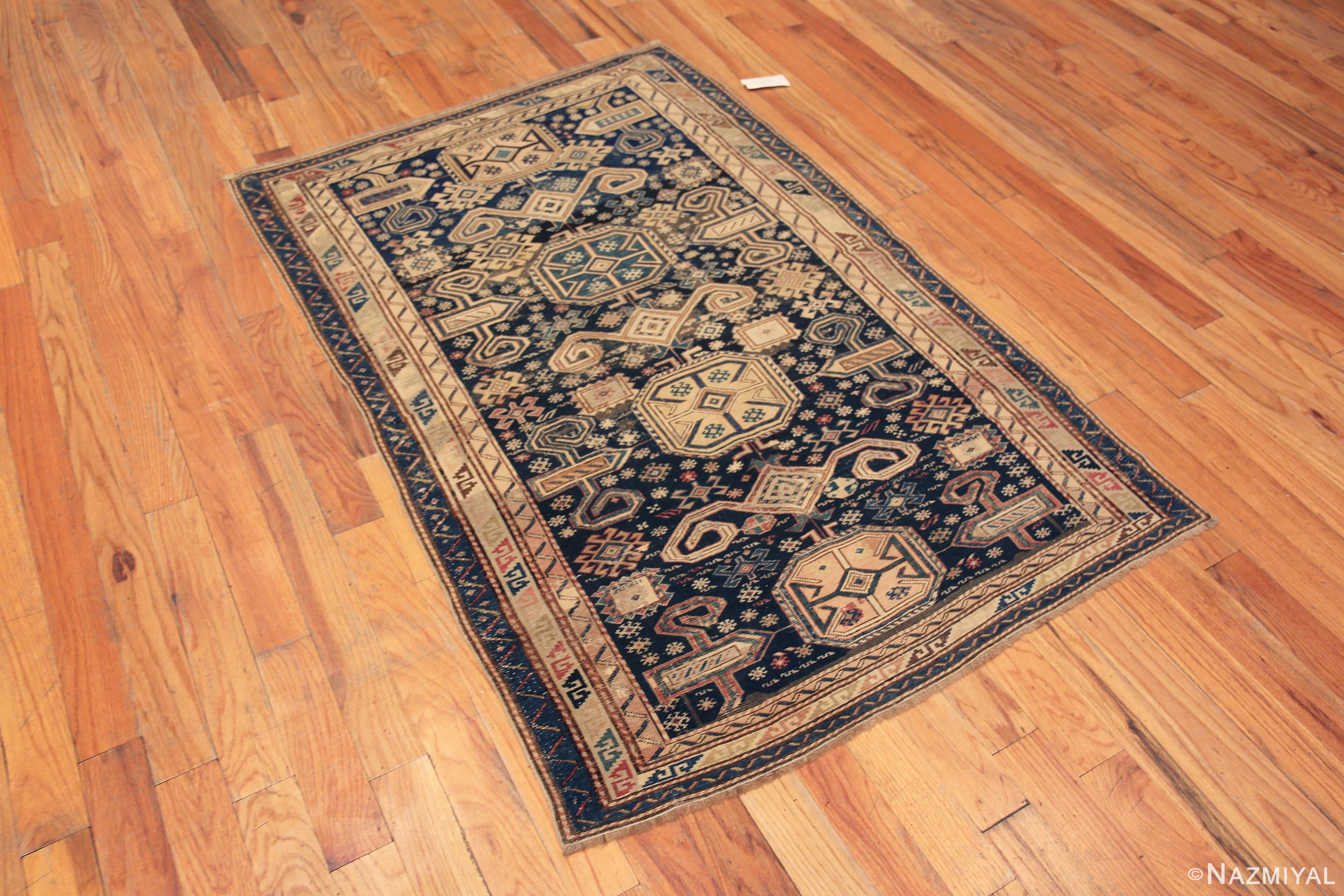
One of the most fascinating features of Caucasian carpets is the use of traditional symbols to convey meaning. Perpedil rugs are distinctive in that they use a stylized ram’s horn motif that is a symbol of strength, fertility and vitality. The colors and designs found in the tribal rugs of Perpedil have a distinctive artistic quality that is achieved through the use of brilliant colors and the inclusion of ancient tribal symbols in the design.
Another feature that distinguishes older tribal Perpedil carpets from newer ones is that the older carpets were produced using all wool. Both the warp and weft were made from sheep or goat hair. Sometimes one would also find exotic fibers such as camel. The warp threads are made of undyed lighter colored yarn in one area of the rug that is mixed with dark or mixed colored wool in another area of the same rug. Goat was sometimes used for the warp because of his strength, but it was never used as the weft because it imparted a rough texture to the carpets. They used what was locally available to them.
As the demand for the carpets grew, cotton began to be used as the warp. This was often dyed blue. One way to distinguish various tribal rugs from the Caucasus Mountain tribes is to look at the selvages. They often used different numbers of threads for the selvages in distinctive colors.
Traditional Perpedil rugs used the materials found in the local area until the introduction of the railroad in the 1870’s. The plants used to produce the dyes have an effect on how well the rug retains its colors over the years. Some of the dye stuffs are fugitive and will fade with time. However, this is not true with all of them and it is possible to find an older tribal rug that was produced using natural dyes that still has colors as bright as the day it was produced.
Perpedil Rugs Feature Individual Artistic Expression
One of the reasons why these antique Caucasian rugs became an important part of European interior design is that the individual artistic expression of the weaver can be seen in the design. Unlike the designs produced in the weaving centers of the world, these designs were less standardized. Many times, the designs have flaws in them, and sometimes it appears as if the weaver suddenly changed their mind and went in a different direction.
The nomads of the Caucasian mountains lived in a world where they moved their sheep to graze in the high mountain meadows during the summer and then escaped to the deep valleys to wait out the winter. They often lived in a small tent or a dimly lit sod hut that was dug out of a hillside. Yet, in this harsh existence, they developed a love of life and an appreciation for the beauty of the world around them.
The rugs that they produced are an expression of deep joy that comes from living close to the earth. The symbols used in the rugs represent the unity of the people, their tragedies and their triumphs. They are known for their daring and bold use of high contrast colors, yet they blend together beautifully. For the nomadic tribes, the now antique rugs are utilitarian and important in the ability to keep warm during the harsh winters, but as one can see from the carefully executed designs, they are also an expression of the individuality of the artist.
The designs of the Perpedil people are spontaneous and fresh, as well as a reflection of the beauty in the world around them. We encourage you to look around the explore our collection of Perpedil carpets. Now that you understand a bit more about them, we are sure that you will fall in love with them and come to appreciate them as much as the rest of the world.