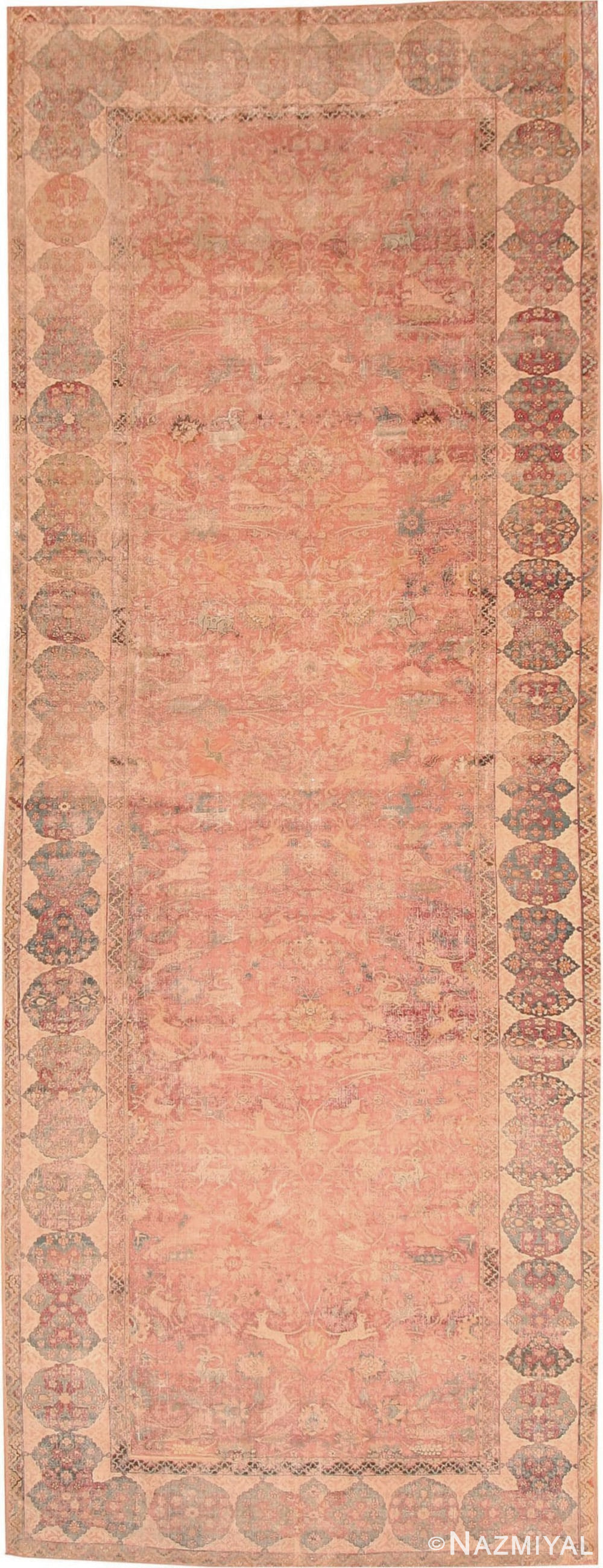


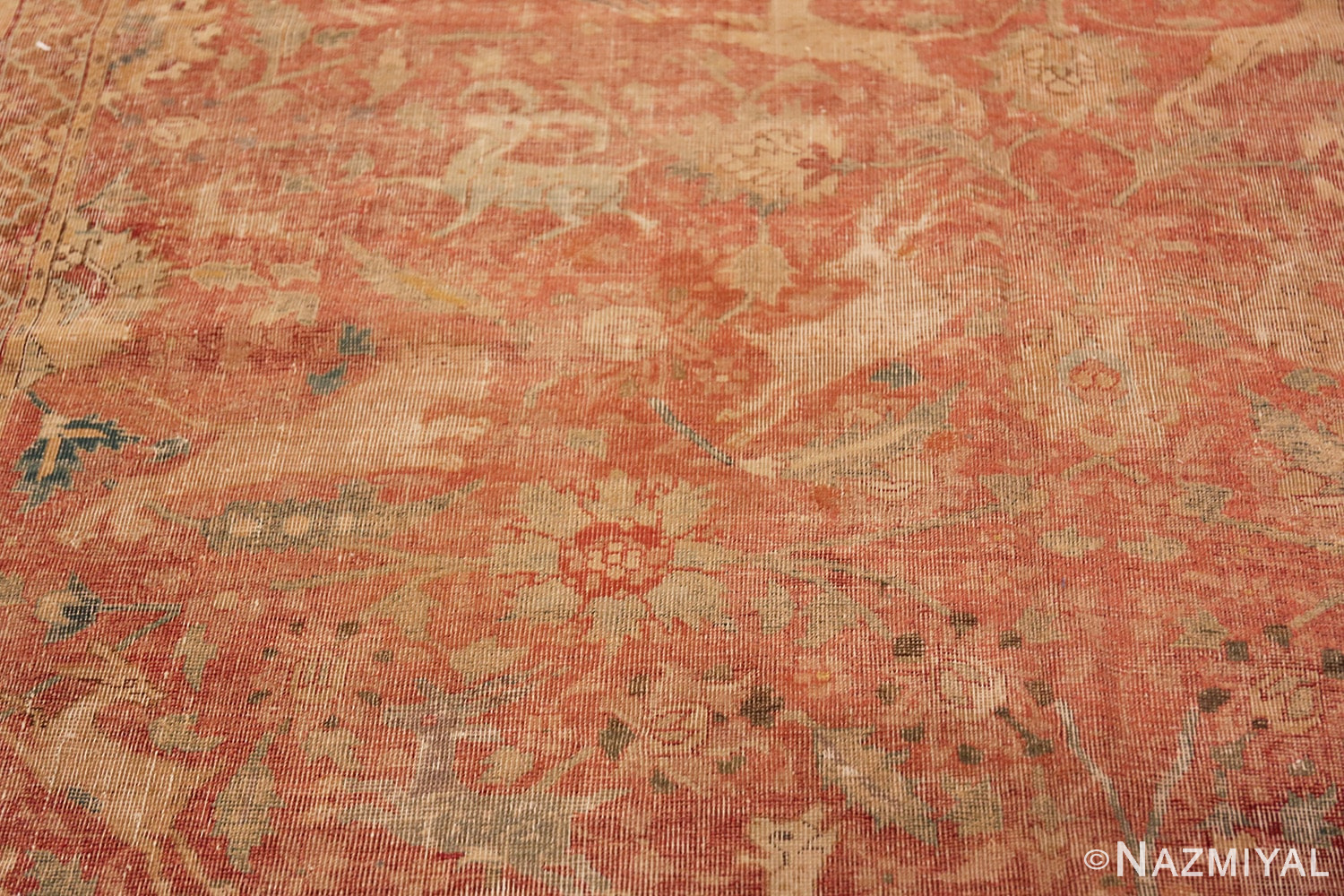



A gorgeous important 17th Century Indian Mughal animal and palmette design gallery carpet, Country of origin: India, Circa date: 17th Century – Distinguished by its elongated proportions, animated animal imagery, and unusually elaborate floral cartouche border, this seventeenth-century Indian carpet belongs to the artistic tradition through which Mughal weavers transformed Persian garden compositions into a distinctive Indian decorative language. Its importance lies in the relationship between these elements: an expansive botanical field inhabited by animals, enclosed within a measured succession of ornamental compartments.
The composition develops along the carpet’s length through branching vines, substantial palmettes, and smaller flowering forms. Animals appear within this vegetation, bringing movement and narrative interest to the underlying floral order. The absence of a dominant central medallion allows the garden imagery to extend through the field, giving the design a continuity particularly suited to its gallery proportions.
The Mughal Garden Tradition
Imperial patronage under Akbar (r. 1556–1605) established the foundations for the great flowering of Mughal carpet weaving. Persian craftsmen and artistic models contributed to this development, but Indian workshops progressively interpreted that inheritance through their own treatment of plants, animals, scale, and surface pattern.
Consider the present carpet within this exchange. Its vocabulary recalls the animal-and-palmette compositions associated with early Mughal production, in which creatures occupy a richly articulated landscape of blossoms and scrolling foliage. The Persian influence provides the historical framework; the arrangement and interpretation of the ornament give the carpet its individual character.
Scholars often discuss such compositions under the related headings of “hunting” and “paradise garden” carpets. The distinction matters. Animal imagery need not describe a literal hunt: it can also evoke an ideal landscape of abundance, vitality, and ordered nature. Here, the interweaving of fauna and vegetation invites consideration within that broader garden tradition, without requiring each animal or flower to carry a fixed symbolic meaning.
A Distinctive Cartouche Border
The main border is among the carpet’s most compelling features. Rounded, lobed floral compartments alternate with more elongated, pointed forms, creating a deliberate rhythm around the field. Their densely worked interiors contrast with the garden’s more flowing arrangement, establishing a formal architectural enclosure.
This treatment has significant parallels within the classical Mughal repertoire. A useful comparison is the animal-and-palmette carpet from the Vojtech Blau estate, offered at Sotheby’s New York on December 14, 2006, lot 54, whose border similarly alternates lobed cartouches and roundels. Related compartment borders occur in the Widener carpet in the National Gallery of Art, Washington, and the Sackville animal-and-tree carpet in the Metropolitan Museum of Art, New York.
These comparisons establish a meaningful design context for the present border. They do not, by themselves, establish a common workshop, but they demonstrate its relationship to a distinguished tradition of Mughal ornamental design.
Comparison with the Yerkes–Remarque Carpet
The celebrated Yerkes–Remarque Mughal Hunting Carpet offers a further comparison for the combination of animals, large floral forms, and an extended rectangular format. Its field contains explicit scenes of pursuit and combat, while its main border develops through scrolling vegetation and animal imagery.
The Nazmiyal carpet presents a different ornamental balance. Its compartmental border emphasizes repetition and enclosure, framing the field’s movement within a sequence of self-contained floral units. The comparison helps define the individuality of No. 3338 within the wider Mughal animal-carpet tradition.
Attribution and Significance
Lahore has been proposed as the production center for several related early Mughal animal-and-palmette carpets. For No. 3338, an Indian Mughal attribution provides the appropriate catalog framework; a more specific workshop attribution or narrower date would benefit from a documented examination of its weave, materials, and dyes.
The carpet’s significance rests on its surviving design: the sustained relationship between animal life and botanical ornament, the distinctive articulation of its border, and the impressive scale of its elongated composition. Its softened surface permits these elements to emerge gradually, rewarding close study as well as appreciation from a distance.
Comparative References
Daniel Walker, Flowers Underfoot: Indian Carpets of the Mughal Era, Metropolitan Museum of Art, New York, 1997.
Friedrich Spuhler, The Thyssen-Bornemisza Collection: Carpets and Textiles, London, 1998, pp. 178–181, pl. 46, illustrating the Yerkes–Remarque carpet.
Sotheby’s New York, Carpets from the Estate of Vojtech Blau, December 14, 2006, lot 54.