
Your Cart
Frequently Asked Questions
Let’s talk a bit about what the term “fine rugs” means and how coarse and commercial carpets compare. When you begin your research into the type of rug that you wish to purchase, you will probably hear the word “fine” mentioned frequently. Even if you shop for commercial carpets, the salesperson will probably use the term “fine”. In the world of commercial carpets and the world of hand-knotted carpets, this term means something different.
Finer woven quality carpets take longer to weave. A carpet that measures 9-foot by 12-foot and has a knot count of 500 kpsi takes over 12 months to complete. This is with four or five rug weavers working 8 hours a day and six days a week. The average weaver can tie between 4,000 and 8,000 knots in a day.
As noted above, fine / good quality rugs take longer to weave so a modern rug that is fine will cost more than a similar size modern rug with a courser weave.
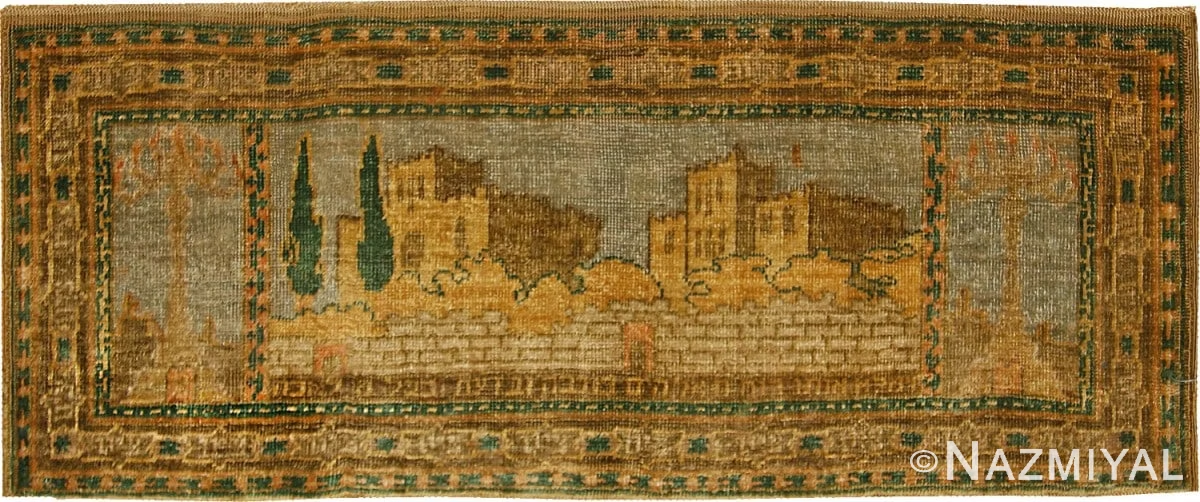
Just for the record, it is believed that the highest knot count / finest rug ever woven was a small 12-inch by 24-inch silk rug from China. It has a knot count of close to 5,000 kpsi. Among larger carpets, there are several that claim to have the highest not counts in the world. Currently, it is thought that a Hereke , which also happens to be a prayer rug, housed in the Metropolitan Museum of Art holds the record with a knot count of 4,360 kpsi. The carpet took over 14 years to produce.
Now that you understand a little bit about how quality rugs and handmade carpets compare to each other, let’s take a look at some commercial carpets. By commercial carpets, we are referring to those that are made entirely by high speed machines. Commercial carpets are measured using the “face weight”, also known as the “pile weight”. This measurement reflects the ounces of yarn is used to make a square yard of carpet. Typical commercially made carpets range between 16 and 40 oz per yard.
A quality area rug is a rug that was woven with more knots per square inch than most other area rugs. In the world of carpets and rugs, those with a fine weave are a pleasure to behold. Finer rug weaves allow for the creation of awe inspiring detail. Fine rugs have a suppleness that coarse weaves lack. They also allow for the threads to be packed tightly, which creates more durable carpets. Fine rugs are a real treasure to find, as they require considerably more time and skill from the rug weaver. They set themselves apart and have much more to offer than their high kpsi (knots per square inch) counterparts.
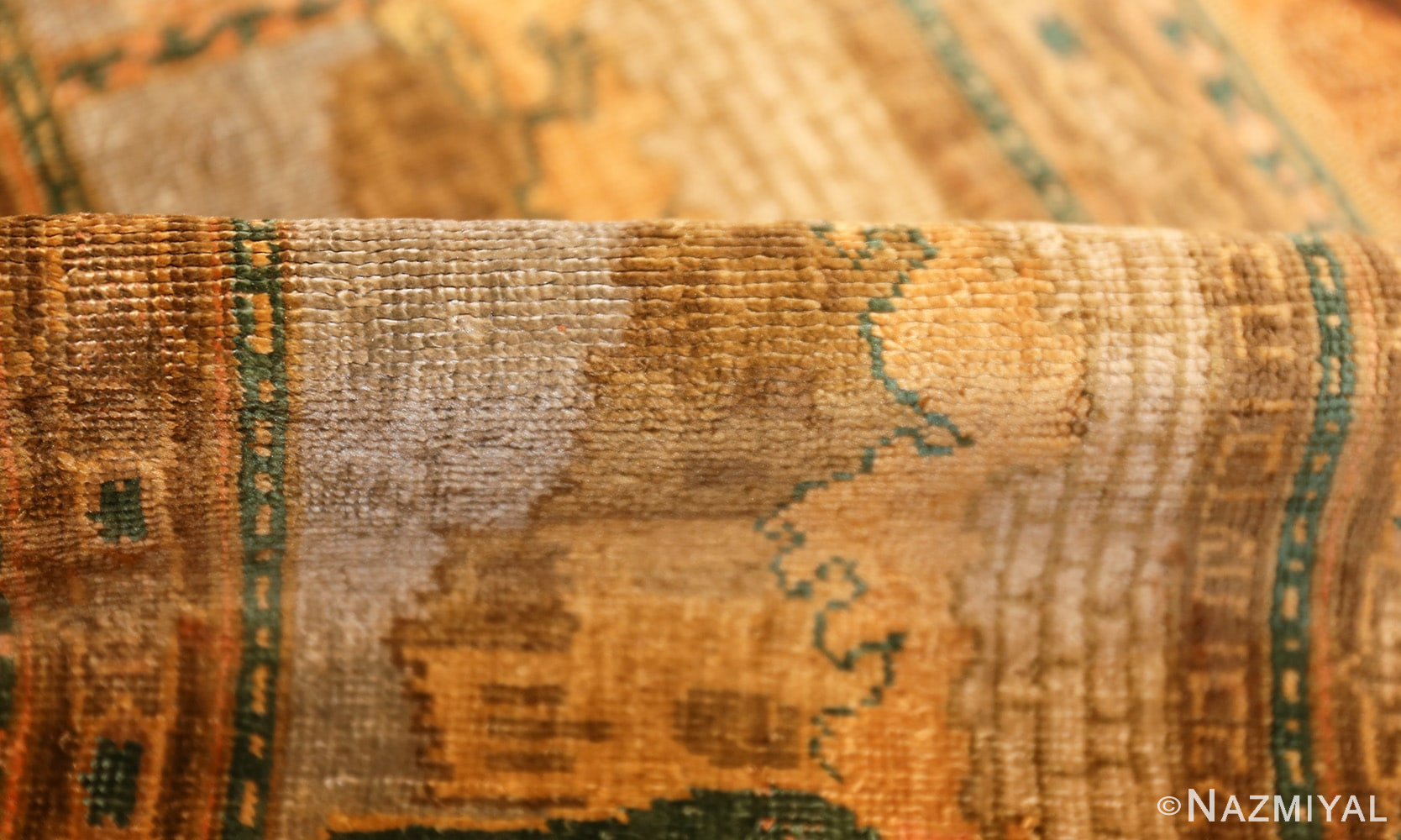
A fine weave / good quality rug is one that has a high knot count. The density of the knots is what determines whether a rug is considered to be coarse or fine. The simplest definition of knot density is determined by counting the number of knots in a square inch of weaving. It is possible that the knot counts can be different in the horizontal and vertical direction. The knot density typically can range from anywhere from 25 to over 1,000 knots per square inch (KPSI). Sometimes this measurement is translated into centimeters (knots per square centimeter – KPSC), or another measurement according to country or region. For instance, the knots per “dihari” is used in India.
There are several factors that serve to limit how fine a weave can be produced. One of them is the type of material that is available. Silk is prized for its ability to be spun into threads as fine as a spider web but still retain their strength. Silk allows for the finest rugs to be woven, particularly those that use both a silk pile and foundation.
Aside from the density of knots, there are many reasons why fine or high knot density rugs are special. If one were to compare two different rugs of the same design, age, and condition, the kpsi would be the determining factor in which one was the more valuable of the two. However, it is possible for a carpet of lower knot density to be more valuable than one of higher density, depending on other factors such as age, condition, design, and the region where it was produced.