About This Ottoman Prayer Rug
Country of Origin: Turkey
Circa: 17th Century
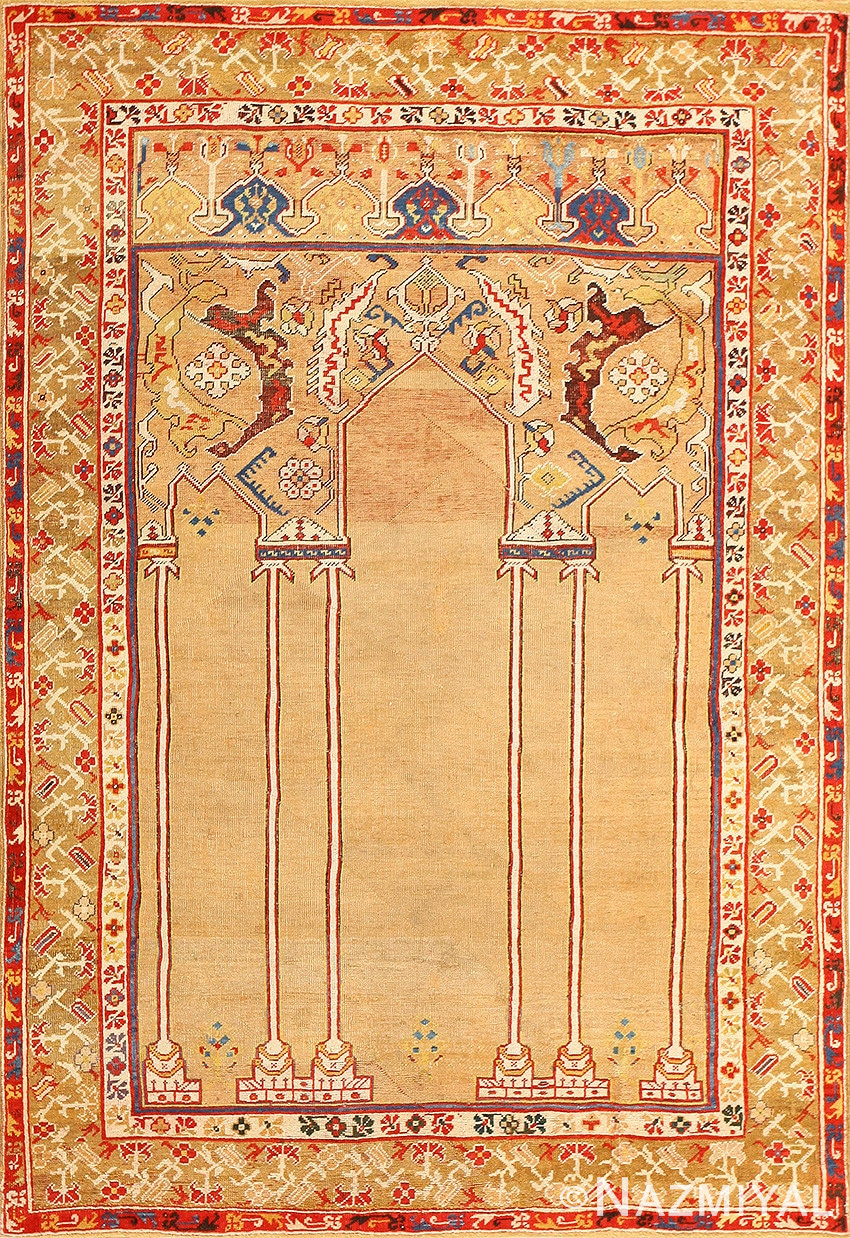
Style and color come together in this regal prayer rug from the 17th century, which showcases the best of Ottoman designs. A vibrant papyrus background defines this Turkish rug, while elegant reds, gentle blues, and vivacious yellows create movement in the foreground. Several frames of varying sizes surround each other, leading the viewer to the center of the antique rug, where a royal scene awaits them. Long pillars descend from the top of the rug’s core, ending in pleasantly grounded foundations. Above the pillars is a bright collection of leaves and flowers, glowing motifs that draw attention to the unity between the natural world and the man-made structuring below.
Condition Report
Woven upside down. Pile generally low to knot heads with areas in border and in blues closely shorn 1/8 in. Dark browns oxidized showing foundation. Lazy lines also lower and visible in the field. Small scattered reweaves in field; not extensive. Partially rewoven side guard stripes, rewoven end guard borders in approx. 1/2 in. into upper end border; well executed. Scattered spot stains in field. Velcro hanging tape sewn on reverse at upper end. Supple handle and good condition.
Provenance
- Stefano Bardini collection, Florence (by repute)
- Collection of Cavaliere Raoul Tolentino, sold American Art Galleries, New York, April 22–26, 1924, lot 786
- H. Kevorkian Collection, sold Anderson Art Gallery, New York, January 8–9, 1926, lot 316
- The Persian Carpet Galleries, London, May 26, 1972, lot 1
- Sotheby’s London, March 7, 1990, lot 70
- Eberhart Herrmann, Munich
- The Textile Gallery, London
Literature
- Eberhart Herrmann, Asiatische Teppich-und Textilkunst, v. 3, Munich, 1991, pl. 3, pp. 14–15
- Hali, June 1990, “Auction Price Guide,” p. 180
Technical Details
- Warp: Wool, Z2S, yellow
- Weft: Wool, Z spun, 2 shoots, madder red, yellow, and ivory
- Pile: Wool, symmetrical knot
- Density: 9–10 horizontal, 10 vertical
- Sides: Not original
- Ends: Not original
History of the Ottoman Double Niche Prayer Rug
The coupled-column “Double Niche Prayer Rug” group represents provincial Turkish Anatolian interpretations of sixteenth- and seventeenth-century Ottoman court prayer rugs with triple-niche and coupled-column designs, such as the renowned Ballard prayer rug now in the Metropolitan Museum of Art. See M. S. Dimand, Rugs in the Metropolitan Museum of Art, New York, 1973, p. 158, fig. 188.
Origins and Attribution
Although previously attributed to Turkish Ladik production, May Beattie’s 1968 article “Coupled-Column Prayer Rugs” identifies distinct origins based on structure. These pieces are now generally attributed to Western Anatolia, most likely Oushak. Similar examples appear in seventeenth-century European paintings such as Nicolaas van Gelder’s 1664 still life (Bailey, op. cit., pp. 24–25, fig. 8).
Design and Coloration
This prayer rug differs from most coupled-column examples in its coloration: whereas most feature dominant madder reds, this example is rendered entirely in golden straw yellow. The border’s butterscotch tone and the limited palette make the piece appear especially delicate and refined.
Comparable Examples
Similar double-niche prayer rugs where the field and border share closely related hues appear in the Museum of Applied Arts, Budapest, and the Dumbarton Oaks Collection, Washington, D.C. (see Bátari, Ottoman Turkish Rugs, 1994, and Ettinghausen et al., Prayer Rugs, 1974).
Unique Features
An unusual feature of this rug is the use of secondary design elements within the arches. The side arches display stylized floral motifs while the central arch remains open—a reversal of the typical arrangement. The small-patterned tulip, carnation, and vine border also distinguishes this rug from most coupled-column prayer rugs, which typically use medallion or large-scale floral borders.