Quick Navigation
Key Takeaways
- Mazandaran kilims are prized for a minimalist, abstract look that layers easily into modern, transitional, and collected interiors.
- Many pieces are made on narrow looms and joined in panels—a construction detail that can add character and authenticity.
- Because these are flatweaves, they tend to feel lighter, cleaner, and more graphic than pile rugs—ideal when you want impact without visual heaviness.
At-a-Glance Specs
- Origin: Northern Iran (Mazandaran Province region)
- Construction: flatwoven kilim / panel-joined layouts (piece-dependent)
- Materials: typically wool (often wool-forward, utilitarian-grade yet design-forward)
- Typical looks: stripes • tonal fields • gradients • plaid/ikat-like movement • primitive “sofrehs” (spreads)
- Best rooms: living rooms • bedrooms • studios • libraries • minimalist dining spaces
- What to look for: stable edges • honest wear • clean joins between panels • balanced color movement • a scale that matches your furniture layout
Popular Searches
Large rugs | Rug size guide | Kilim rugs | Shop Persian rugs
Featured Mazandaran Kilims from the Collection
Inventory changes frequently. These featured pieces are examples of Mazandaran kilims with the minimalist, stripe-and-tone character collectors look for in this category.
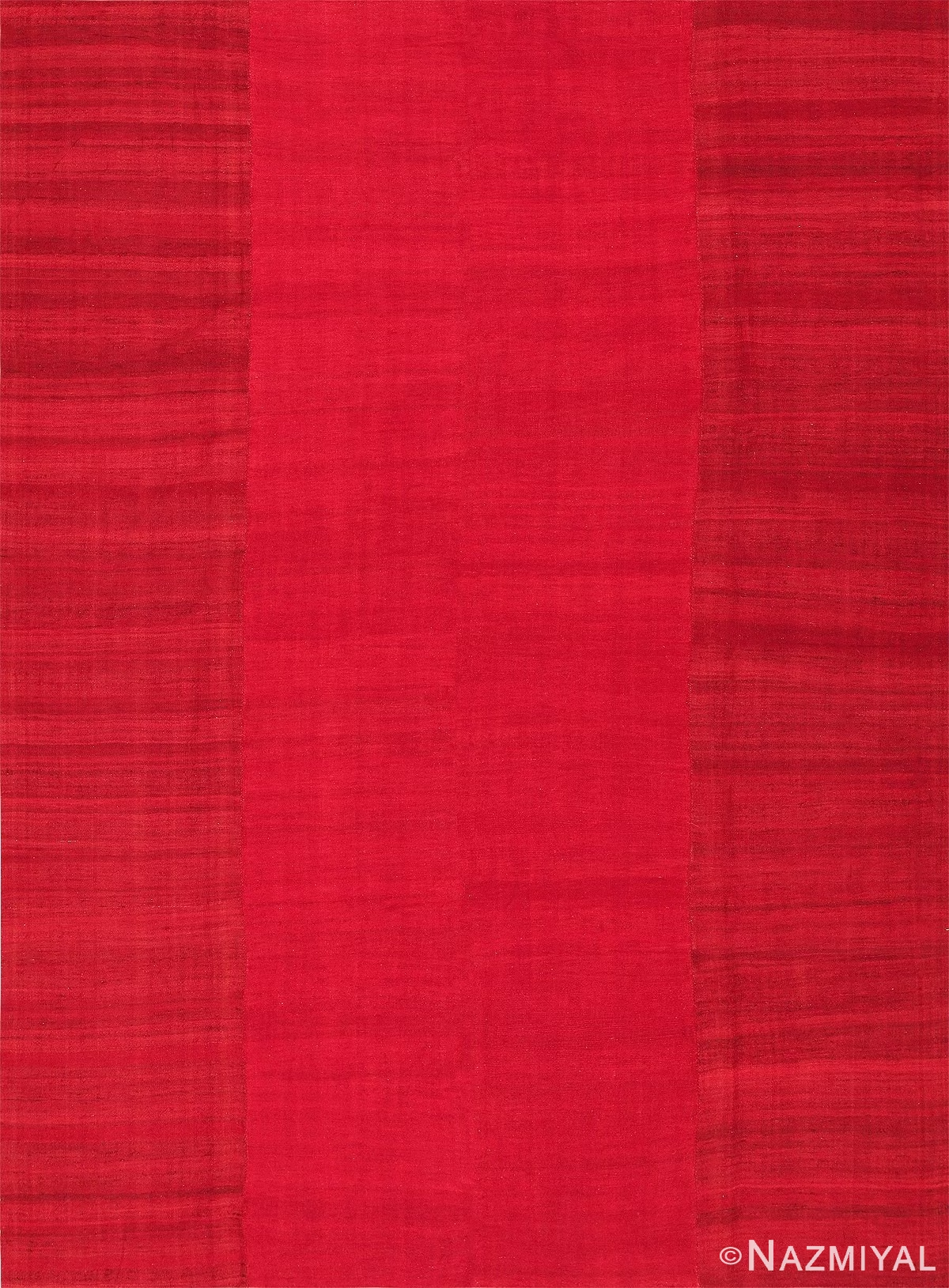
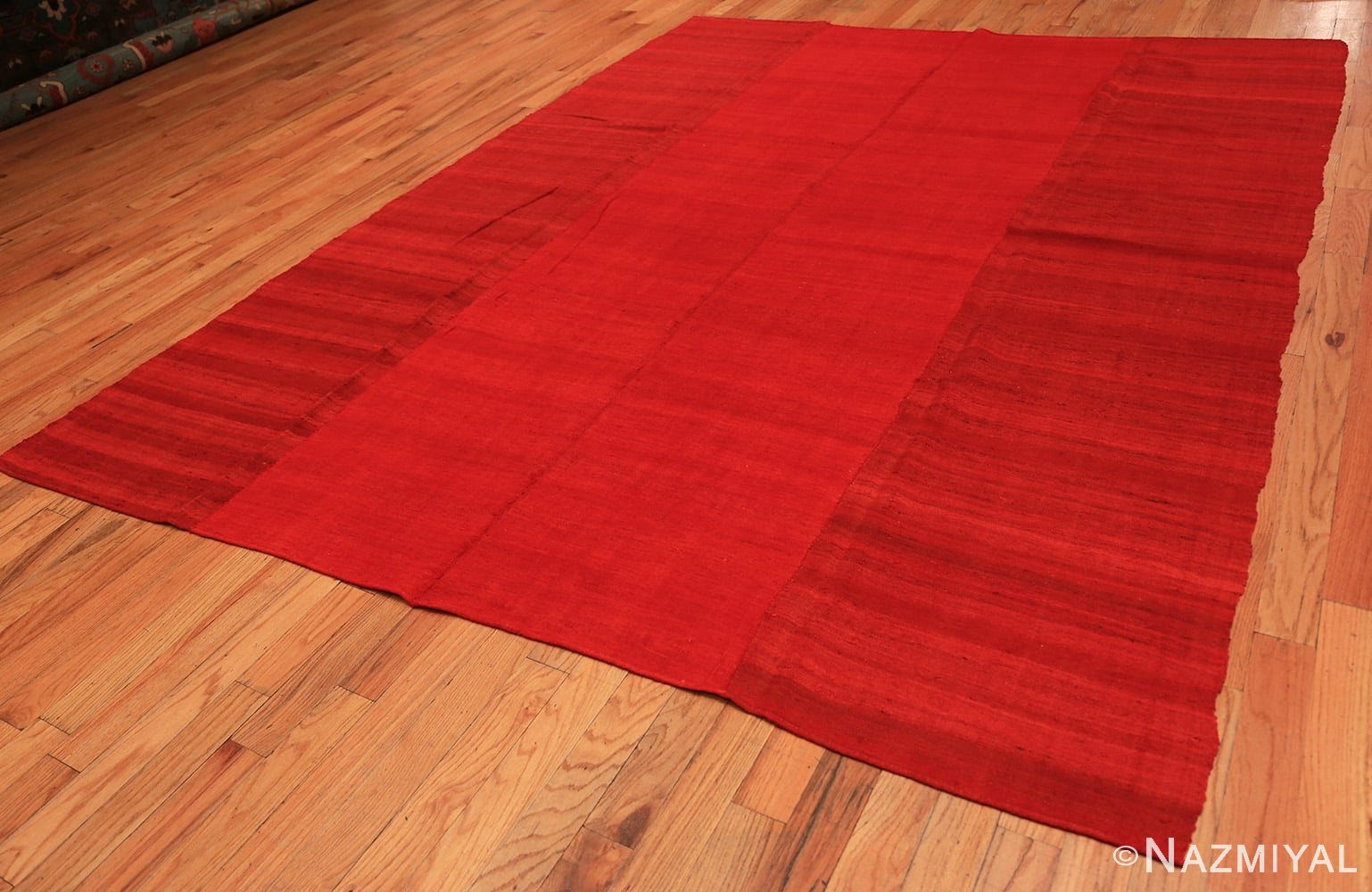
Antique Red Abstract Persian Mazandaran Kilim Rug 47334
Circa: Early 20th Century
Size: 8 ft x 11 ft (2.44 m x 3.35 m)
Origin/Type: Persia (Iran) • Mazandaran flatwoven kilim
Identification & Construction
What makes a Mazandaran kilim recognizable?
Many Mazandaran kilims rely on tone, stripe, and proportion rather than dense ornament. The “design” is often the disciplined placement of fields and bands, plus natural variation in dyed yarns that reads like brushwork. Some subtypes are famously black-and-ivory striped; others lean warmer and more saturated, with gradients and plaid-like movement.
Panel-joined weaving and why it matters
A traditional Mazandaran kilim is often woven on a narrow loom, then assembled from two (or more) panels to create a larger floor piece. When evaluating a rug, look for joins that feel stable and visually intentional. A clean join is not a flaw—it’s often part of what gives these pieces their honest, utilitarian character.
Materials and surface feel
Mazandaran kilims are typically wool-forward flatweaves. With no pile, they sit closer to the floor and tend to read more graphic than hand-knotted rugs. This makes them especially appealing for interiors that want “structure” and character without a heavy, plush surface.
Decorating & Placement Guidance
Use a Mazandaran kilim like a “foundation artwork”
Because the pattern language is restrained, Mazandaran kilims can anchor a room without competing with art, lighting, or sculptural furniture. Let the kilim set the room’s rhythm, then repeat one or two tones elsewhere (wood finish, ceramics, or a single textile accent) to keep the space cohesive.
Balance the minimalism with texture
Flatweaves feel visually crisp. If your room is very minimal, add tactile contrast—linen, bouclé, worn leather, or natural woods—so the space feels warm rather than stark.
Match the era to how you live
For collected authenticity and time-earned character, start with an antique rug. If you want a more relaxed blend with mixed furnishings, explore vintage rugs. For cleaner lines and a quieter presence, a modern rug can echo the same calm “field” feeling with less patina.
Mazandaran Kilims vs Persian Jajims
If you love Persian flatweaves and want the closest parallel category, compare Mazandaran kilims with flat-woven Persian jajims—another family of Persian textiles admired for stripe logic, utility roots, and décor-friendly abstraction.
| Feature | Mazandaran Kilims | Persian Jajims |
|---|
| Overall look | Minimalist fields, stripes, gradients; “floor art” feel | Stripe-based flatweaves and textile-like surfaces; often more “coverlet” energy |
| How it reads in a room | Graphic, calm, modern-friendly | Textile-forward, layered, warmly utilitarian |
| Best for | Minimal interiors, studios, curated living spaces | Layered rooms, collected decor, textile-driven palettes |
| Buying focus | Panel joins, color movement, edge stability | Condition, consistency of weaving, how it layers with other textiles |
Closest Cousins
Glossary
Flatweave: A rug woven without knotted pile; the surface is created by interlacing warp and weft threads.
Abrash: Natural tonal variation in dyed yarns that creates depth and movement across stripes or fields.
Panel-joined construction: A larger textile made by stitching together two or more narrow loom-woven panels.
Sofreh: A traditional “spread” or utilitarian textile that can function as a mat, cover, or floor piece.
For more definitions, see the rug glossary.
FAQ
Are Mazandaran kilims Persian rugs?
Yes. Mazandaran kilims are Persian flatwoven textiles from northern Iran. They’re often grouped with Persian kilims and other regional flatweaves.
Why do Mazandaran kilims look so modern?
Many rely on stripes, tonal fields, and natural color movement instead of dense ornament—so the effect can feel abstract and minimalist in contemporary interiors.
Do Mazandaran kilims need a rug pad?
In most homes, yes. A rug pad improves grip, reduces shifting, and adds comfort—especially important for thin flatweaves on smooth floors.
Can I use a Mazandaran kilim in a high-traffic area?
Flatweaves can work well in active spaces, but prioritize stable edges, honest condition, and a pad underneath. Rotate periodically for even wear.
How should I decorate around a Mazandaran kilim?
Treat it as a calm foundation: keep the room’s palette restrained, then repeat one or two tones from the rug in textiles, art, or a single accent piece.
Three Pillars of the Nazmiyal Collection
- Curated authenticity: We focus on collectible rugs and textiles selected for artistry, integrity, and long-term value.
- Real expertise: Guidance from specialists who understand weaving structure, regional design language, and condition nuance.
- Confidence in the buy: Clear policies and service designed to make sourcing easier—locally and worldwide.
Nazmiyal White-Glove Service
We make it easy to shop with confidence—whether you’re choosing a single statement piece or curating a full room.
Nazmiyal Collection has been a trusted source for antique rugs and vintage carpets for over 45 years. Our NYC gallery curates one-of-a-kind pieces with an emphasis on authenticity, provenance, and lasting decorative value.
Need help? Call us at (212) 545-8029 or visit our New York City showroom to work with a rug expert.