
Timurid Rugs: A Scholarly Debate, a Mystery, and the Design DNA that Shaped Later Persian Carpets
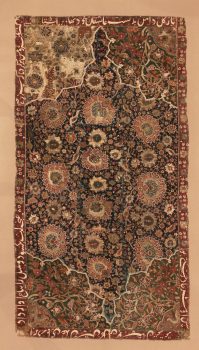
Timurid “rugs” describe the early design vocabulary that emerged under the Timurid cultural sphere in the late 14th-15th century. The Timurid motifs and compositional logic likely fed into later classical Persian carpet design. However, surviving Timurid carpets are extraordinarily scarce.
If you’ve ever wondered how the famous classical Persian carpet designs came to be, look toward the Timurid period. The Timurids transformed taste across Iran and Central Asia, helping set the stage for refined systems of the 16th-17th centuries. Yet, when it comes to actual Timurid carpets, we’re left with a problem collectors know well: the objects didn’t survive the way the ideas did.
At Nazmiyal, we treat this topic honestly. We offer clear facts, clear uncertainty, and a practical path to collecting the lineage through later rugs that preserve the conventions of the era. If you’re browsing broadly, start with Antique Rugs. Compare to Vintage Rugs and Modern Rugs. You can also use our Worldwide hub to explore by geography.
Featured From the Nazmiyal Collection
Who Were the Timurids?
The Timurids were a Turco-Mongol Dynasty founded in the late 14th century by Timur, also known as Tamerlane. His courts helped fuel major flowering of art, architecture, and scholarship across Persia and Central Asia. The most important collector takeaway is simple: Timurid court taste helped organize design systems that were later dubbed “classically Persian”.
Why Timurid Design Matters for Persian Carpets
Timurid culture works like a high level design workshop. Court patronage made it so design tastes were elevated and standardized, as specifically commissioned pieces meant for royalty were common. Trade along the Silk Road facilitated a fascinating cultural and artistic exchange between Eastern and Western cultures. Compositional elements also matured, with borders, field systems, and repeating units becoming more coherent. These were exactly the factors later carpet design needed to develop its classical system.
The Mystery: Where Are the Timurid Carpets?
Carpets are working textiles, beautiful displays but utilitarian at their core. The unfortunate truth is that survival rates collapse the further back in time you go. Scholars instead rely on rare fragment evidence and limited written references. Illustrated manuscripts and miniatures can controversially serve as evidence as well.
Can We Trust Painted Carpets in Miniatures?
There are plenty of instances in which antique carpets make appearances in the backgrounds of painted miniatures. Miniatures are especially useful for understanding motif families and layouts, but they aren’t photographs. Artists stylize, borrow, and repeat conventions. The general consensus around miniatures is to treat them as directional evidence, not courtroom evidence.
A painted rug can reflect:
- An actual textile in the room
- A studio design convention
- An imported rug
- An “idealized” pattern design
The “Holbein” Debate – Timurid Echo or Anatolian Reality?
Many Oriental antique textiles are referred to as “Holbein” rugs, nicknamed after the Renaissance painter Hans Holbein the Younger. While Holbein himself was German, the increasing popularity of Eastern carpets in wealthy European homes resulted in carpets used as motifs within paintings. Holbein’s commissioned portraits and European scenes often featured a carpet in the background to indicate the patron’s wealth and status. Thus, the title of “Holbein” was bestowed upon certain antique carpets.
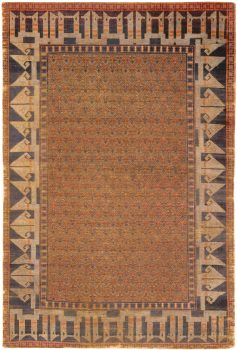
Some scholars have suggested that certain early geometric “Holbein” carpet types may preserve something close to a Timurid era design. This includes disciplined geometry, complex borders, and a fusion-like feel. However other scholars argue that many “Persian-looking” rugs from the era are instead Anatolian, complicating claims of Timurid attribution. While Timurid design certainly influenced a broader region, attribution of specific early geometric carpets remains contested.
What to Collect Today
There’s a smart approach for those who love the Timurid era but struggle finding any of these rare pieces.
- Collect from the following era where aspects of the previous still survive. Safavid Persian carpets (16-17 century) often include the classical system that required earlier development. Explore:
- Use Anatolian geometry as a comparative lens. Certain early Anatolian traditions can help determine geometric ancestry. This is especially true when comparing borders and repeat systems. Explore:
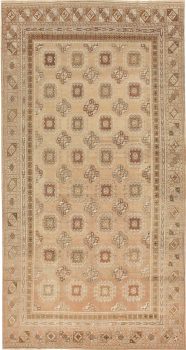
- Study Silk Road hybrids to understand motif travel. The blending of culture was a byproduct of the expansive trade system, and it affected design as well as culture. Khotan, East Turkestan, and Chinese rugs can help you identify where certain motifs and designs begin appearing. Explore:
Explore Related Chapters
Why Trust Nazmiyal?
The Nazmiyal approach is built on three foundational pillars that guide every decision, from acquisition to expertise to client trust: deep scholarly knowledge developed through decades of hands-on experience, rigorous standards of authenticity and transparent valuation, and a globally curated collection shaped by historical depth, cultural understanding, and market insight.
Your questions answered
Frequently Asked Questions
Are there any surviving Timurid carpets?
Very few survive, and attribution is debated. Much of what we know comes from fragments and indirect evidence like manuscripts.
Why do scholars argue about Timurid rugs?
Because surviving objects are scarce, and visual evidence like paintings can be stylized, borrowed, or represent imported textiles.
Are "Holbein carpets" Timurid?
Some see Holbeins as the closest visual cousin to a Timurid-era aesthetic; others argue their surviving parallels are Anatolian.
What should I buy if I want Timurid influence in my collection?
Start with early classical Persian rugs (Safavid-era) and add comparative pieces (Anatolian geometry, Silk Road hybrids) to understand the lineage.
Can Nazmiyal help me curate "history-forward" options?
Yes! Tell us your preferred size, palette, and the era-feel you want, and we’ll shortlist pieces that fit your goal.