
How Carpets Are Made: Spinning the Wool
When you think about how Persian carpets and other hand-knotted carpets are made, the first thing that you think about is the hand-knotting and weaving process. This is the part of the process that is most often demonstrated. However, long before the weaver sits down at the loom, the wool must be processed into spun yarn or thread. In several other articles the earlier processes of raising and shearing the sheep, washing the wool and carding or combing it were discussed. Spinning wool is the next part of the process after the wool has been carded or combed.
What does spinning wool mean?
Spinning wool refers to the process of converting raw wool fibers into yarn by twisting and drawing the fibers together to form a continuous strand. This age-old craft has been practiced for thousands of years and is an essential step in creating textiles and fabrics from wool. The yarn produced through spinning can then be used for knitting, crocheting, weaving, or other textile-related projects.
The spinning process typically involves the following steps:
- Shearing: The first step is to shear the wool from the sheep. This is done by using special tools to carefully remove the fleece, which is the coat of wool covering the sheep’s body.
- Cleaning and Washing: After shearing, the wool needs to be cleaned to remove impurities, such as dirt, grease (known as lanolin), and other contaminants. Washing the wool ensures that it is clean and ready for further processing.
- Carding: The cleaned wool is then carded to align the fibers and remove any remaining tangles. Carding can be done using handheld carding brushes or mechanical carding machines.
- Drafting: During drafting, the fibers are pulled and elongated to create an even thickness throughout the strand. This step helps to ensure consistency in the final yarn.
- Spinning: The drafting process is followed by spinning, where the drafted fibers are twisted together to form a continuous yarn. This can be done using a spinning wheel or a drop spindle, depending on the spinning method employed.
- Plying (optional): Sometimes, spinners ply the yarn by twisting multiple spun strands together. Plying adds strength and stability to the yarn and creates various textures and effects in the final product.
Once the yarn is spun and, if applicable, plied, it is ready to be used in various textile projects. Spinning wool is not only a practical skill for producing yarn but also an art form that allows for creativity and experimentation with different fiber types, colors, and textures. It remains a cherished craft in many cultures around the world, and many modern artisans continue to practice and develop this ancient technique.
Spinning wool for making rugs
Spinning wool is a simple process that is essential for the production of high-quality carpets. The weaver can only produce beautiful and durable carpets if they start with good materials. Most people do not even think about the spinning process when they see a carpet. Long before the spinning takes place, many steps must be completed. It could be said that spinning is more important than weaving in the production of a high-quality carpet.
Even though the process of spinning wool seems simple, it is a highly technologically developed process. This is true even when using primitive equipment. It is worth mentioning that the process to be described applies only to wool, camel, goat or other animal fibers. Even though the process of spinning plant fibers, such as cotton or linen, may look the same from the outside, they are technically quite different. Processing and spinning silk is an entirely different process altogether, even though it may look similar when it is being done.
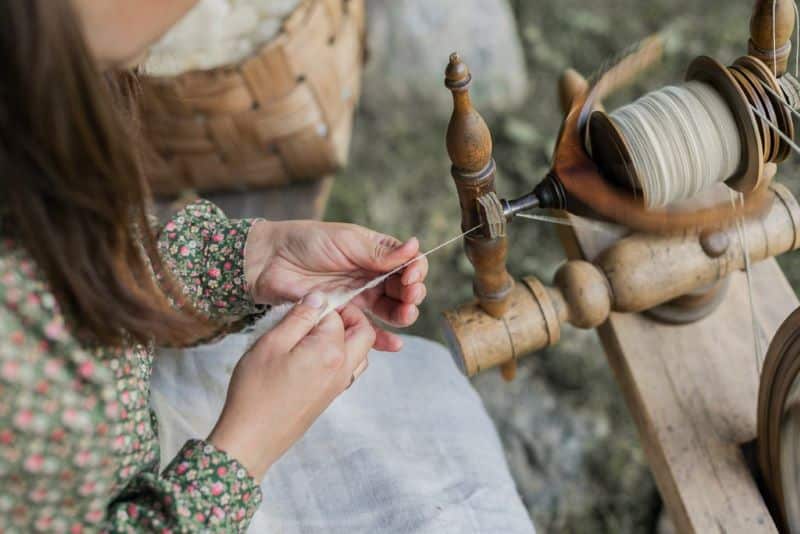
Tools of the Trade
First, let’s talk about the tools used. The most primitive, and oldest form, of tool used for spinning wool is a straight rod that is usually made of wood with a circular weight near one end. Sometimes, the spinner places the wool on something called a distaff, which is simply a stick that is used to hold the carded wool so that the spinner has more control over the final product. A distaff is not necessary, and some spinners do not use one.
The first part of the spinning process is called drafting. This is where the spinner takes a small chunk of fibers and stretches them out until they resemble a long cord. During this time, they have the spindle spinning. This puts twist into the wool, and it will eventually hold together into a strong thread or yarn.
The more highly skilled the spinner, the thinner and stronger the yarn they can produce. There are many technical aspects to this process, such as how thin and even the spinner can draft the wool and how many twists they put in. Putting in too little twist will mean that the wool will fall apart easily as it is being dyed and woven. Too much twist and it may break. It takes skill to get a yarn that is balanced and strong for weaving.
Hand spindles go back as far as Neolithic man, and there are still some primitive tribes that use this method to produce the yarn for carpets. It is labor-intensive, but it is possible to create an excellent quality product using these primitive methods. There are subtle differences in the exact technique used in different regions, but the principle of the process is mostly the same.
Spinning wheels were known in Europe from about the 1400s, but these were not like the ones that are familiar to most. They had a large wheel that was turned by hand, and the fiber was drafted while standing. The person walked backward while drafting, and then forward to wind the yarn on a spindle. Even though spinning wheels were available, it is not known how widespread they were, or if they were used in weaving the extraordinary carpets of the Safavid Dynasty. Spinning wool with a wheel is faster, but you can produce the same quality of yarn with a primitive hand spindle.
Spinning Warp vs. Weft
During some periods in history, spinners who specialized in spinning warp were different than those who specialized in spinning weft. This is not always the case, and most of the time, the yarn is spun by the same person from the beginning of the process through the end. It was more highly specialized in cities than among the remote nomadic tribes.
In an earlier article, we discussed the difference between combing and carding in terms of the quality and characteristics of the yarn that is produced. Just as the processing of wool to be used warp threads and weft threads are different, so are the spinning techniques.
Wool that is combed is often more suitable for producing warp. You can use cards to produce warp threads, but it must be done to the point where almost all of the fibers are aligned. This is so that the wool can be spun into a yarn that is strong and smooth. Warp will not be the softest wool produced because the spinner must put a little bit of extra twist into it to get the strength.
For warp threads that will be placed vertically on the loom and held under tension, more than one single strand is plied. This is twisting two strands together much in the way one makes a wire cable. This also adds strength and assures that the warp will not break as the rug is being woven. The spinning technique is done so that the fibers remain in a line as they are being spun. It takes a high amount of skill and practice to produce warp threads.
The spinning of weft threads is a bit more forgiving. The yarn for weft must still be strong, but it can be a little bit fluffier and softer. It is not as crucial that the fibers remain in perfect alignment for the spinning of weft yarn. The first yarn that spinners usually begin with is weft because it is easier to spin. It is spun so that there is a little less twist than when spinning warp yarns. Loosely spinning the weft is what gives the carpet a soft feeling underfoot.
After the wool is spun, it is sent onto the dyeing process. Once it has been dyed and the beautiful colors have been created, it is then ready for the weavers to begin working their magic. As you can see, spinning yarn is simple in the tools and techniques used, but there is quite a bit of skill involved to make a yarn that is suitable for use in excellent quality carpets.
We hope that you have enjoyed your trip through the process of making the beautiful rugs in our collection. As you can see, the weaving is only part of the process, and there is much more that goes on behind the scenes before you even get to that point. Please enjoy exploring our collection now that you have a greater appreciation for the technology and artistry behind them. Perhaps you will see something that sparks your interest, and that is perfect for your home or office.