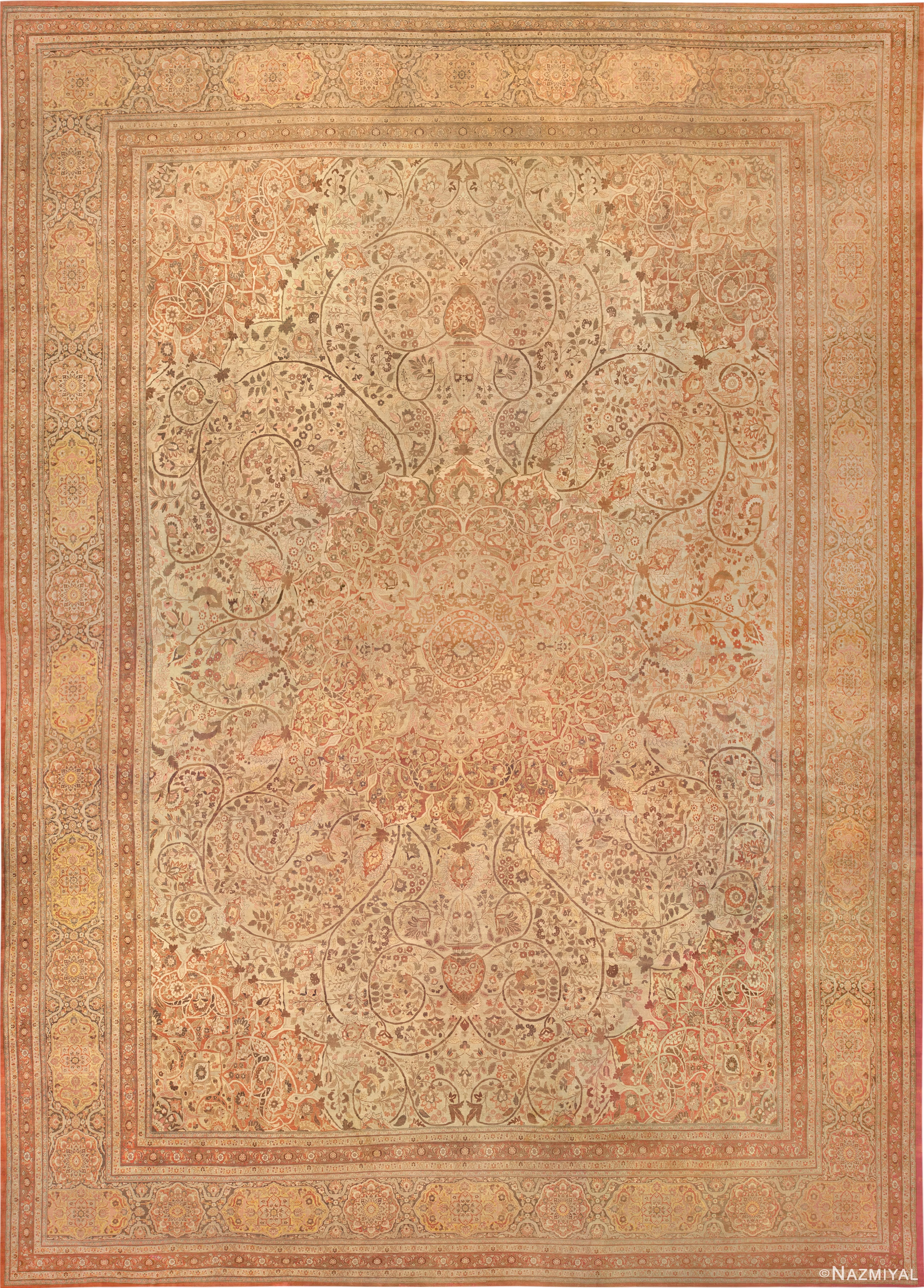
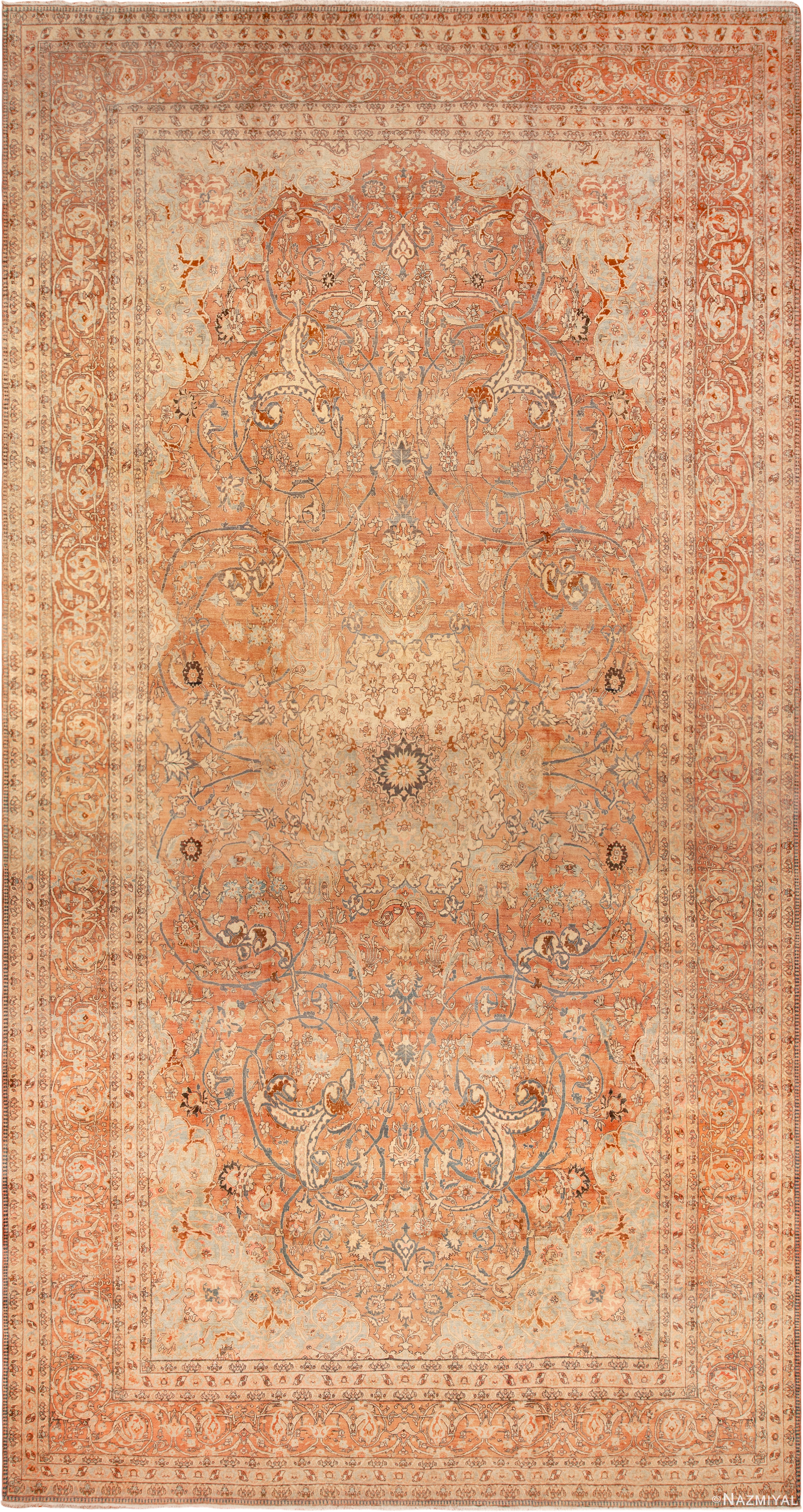
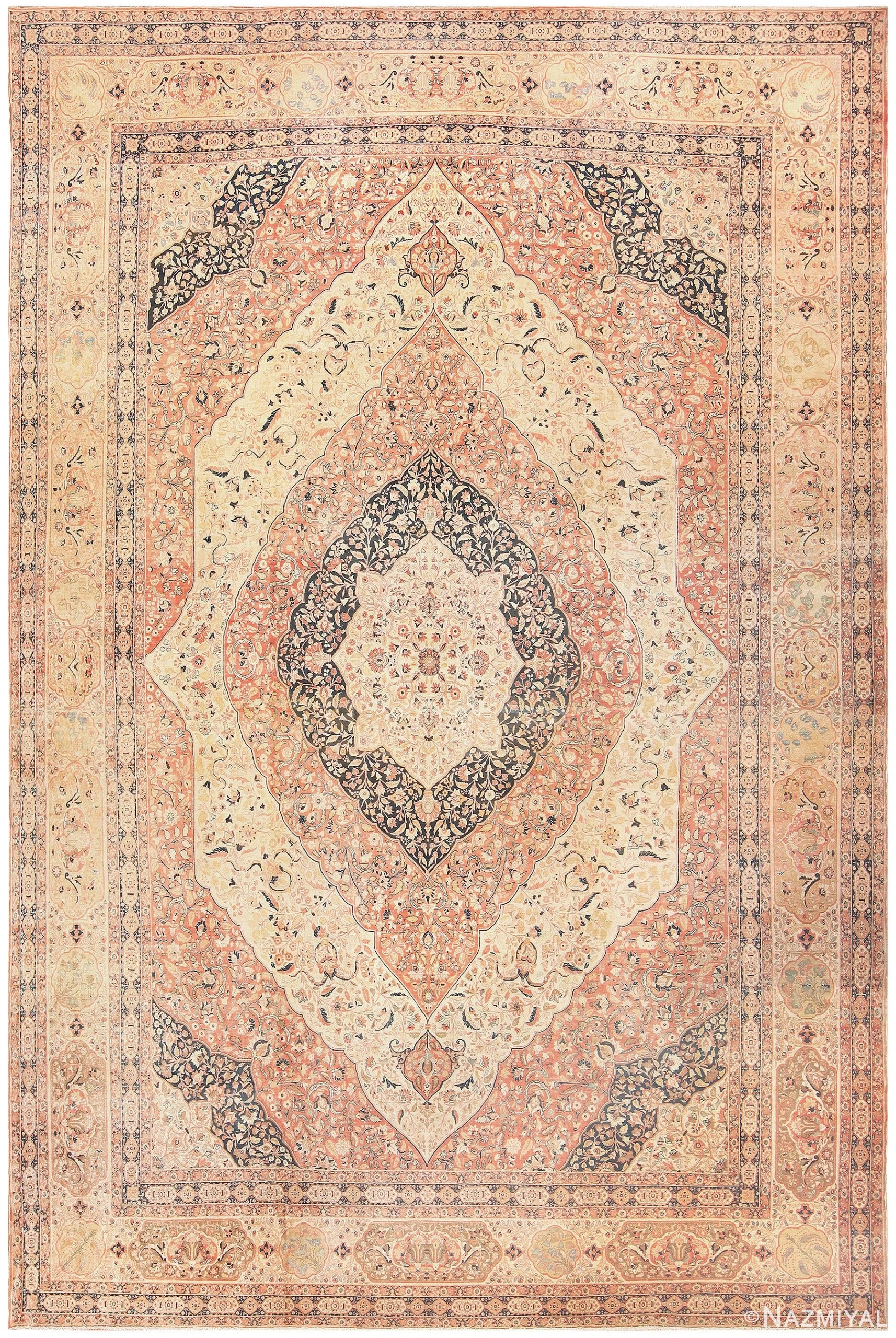
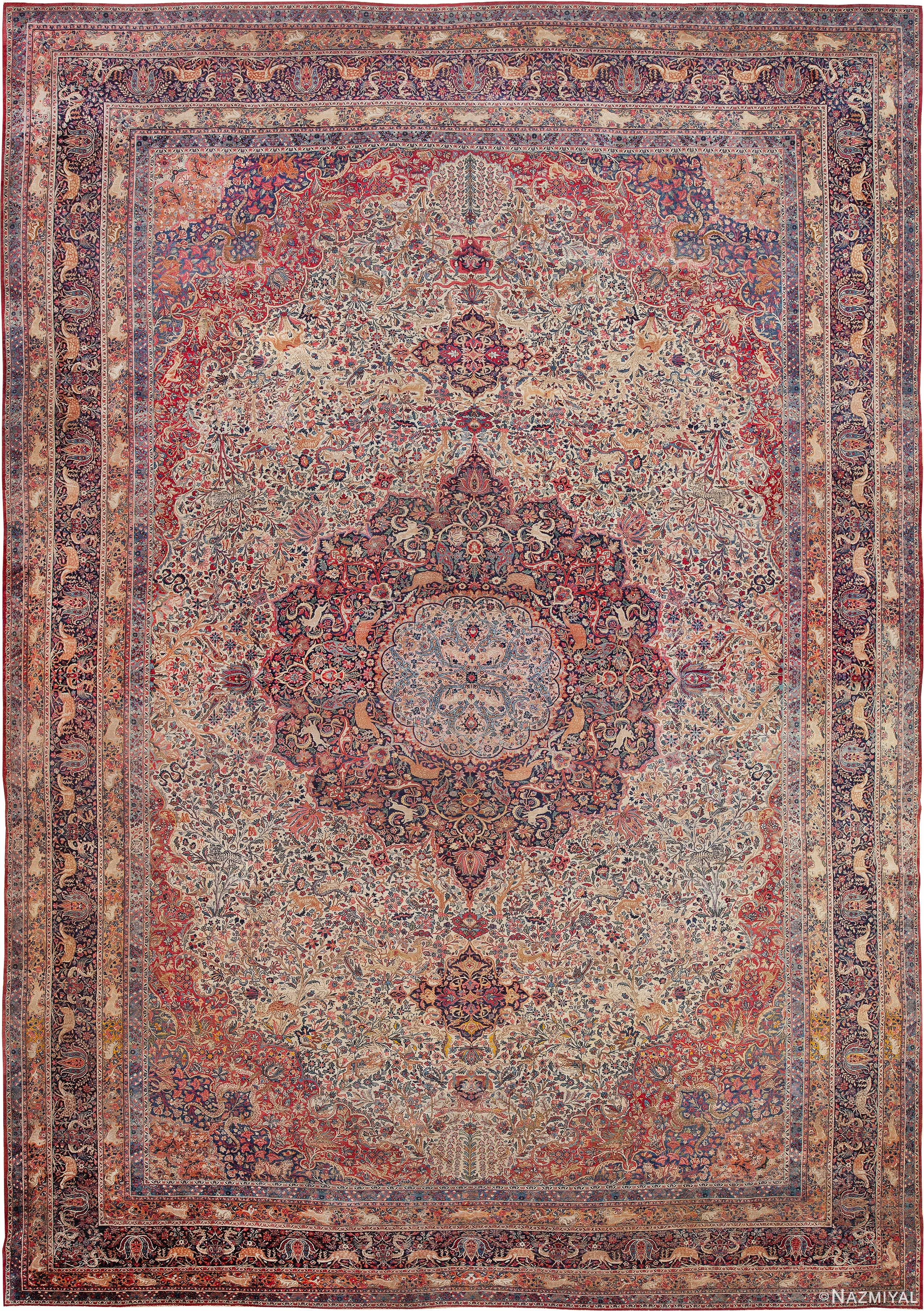
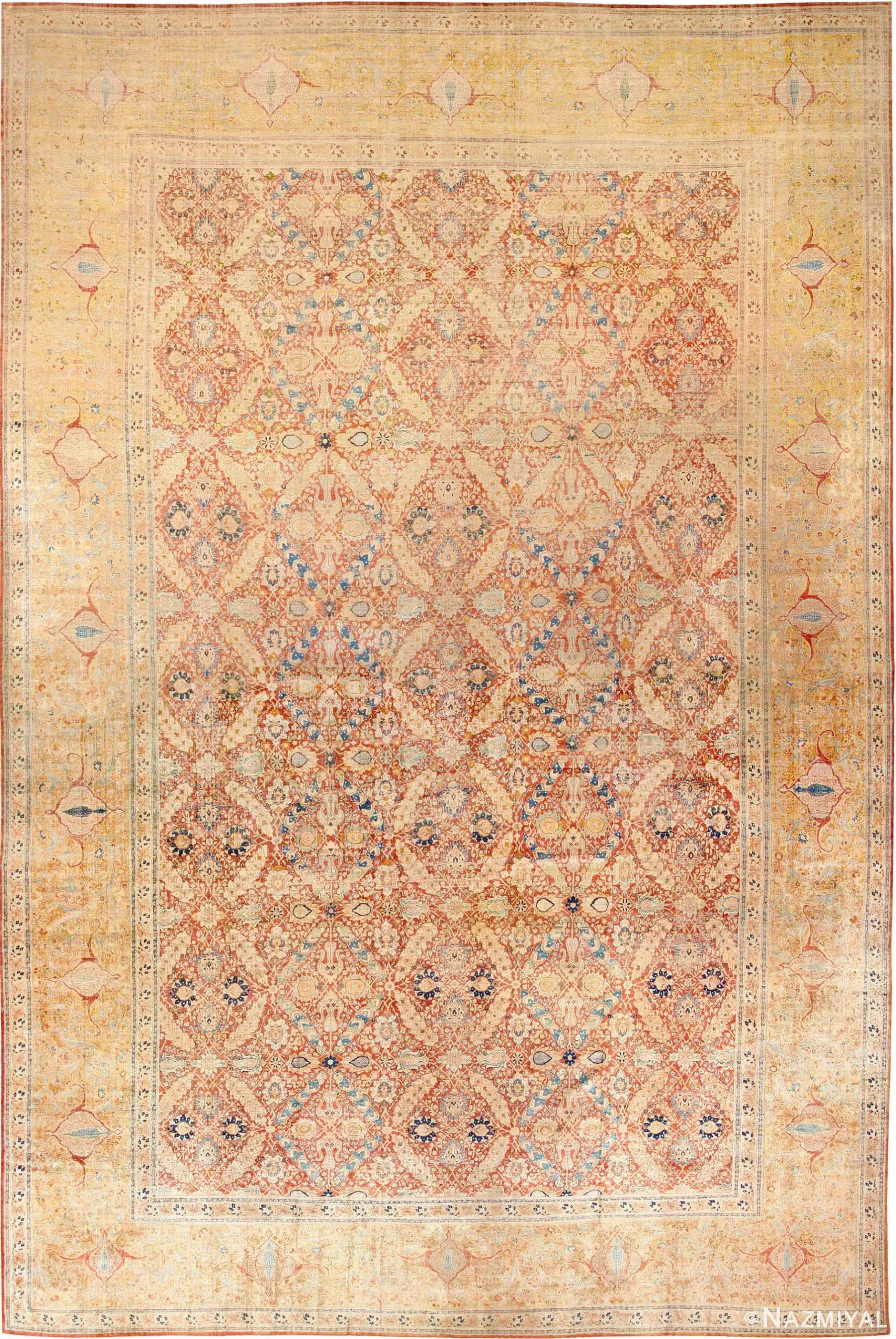
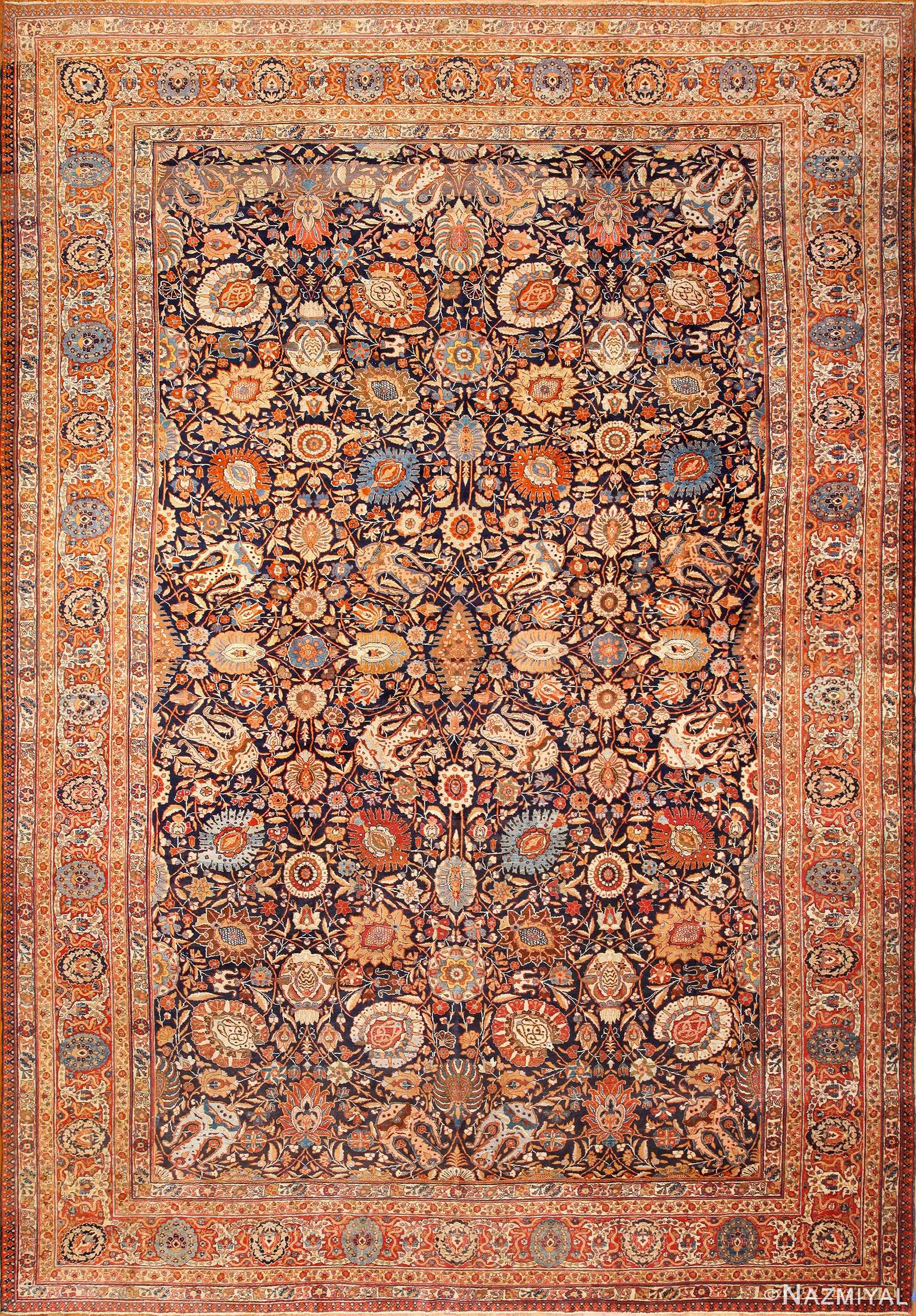
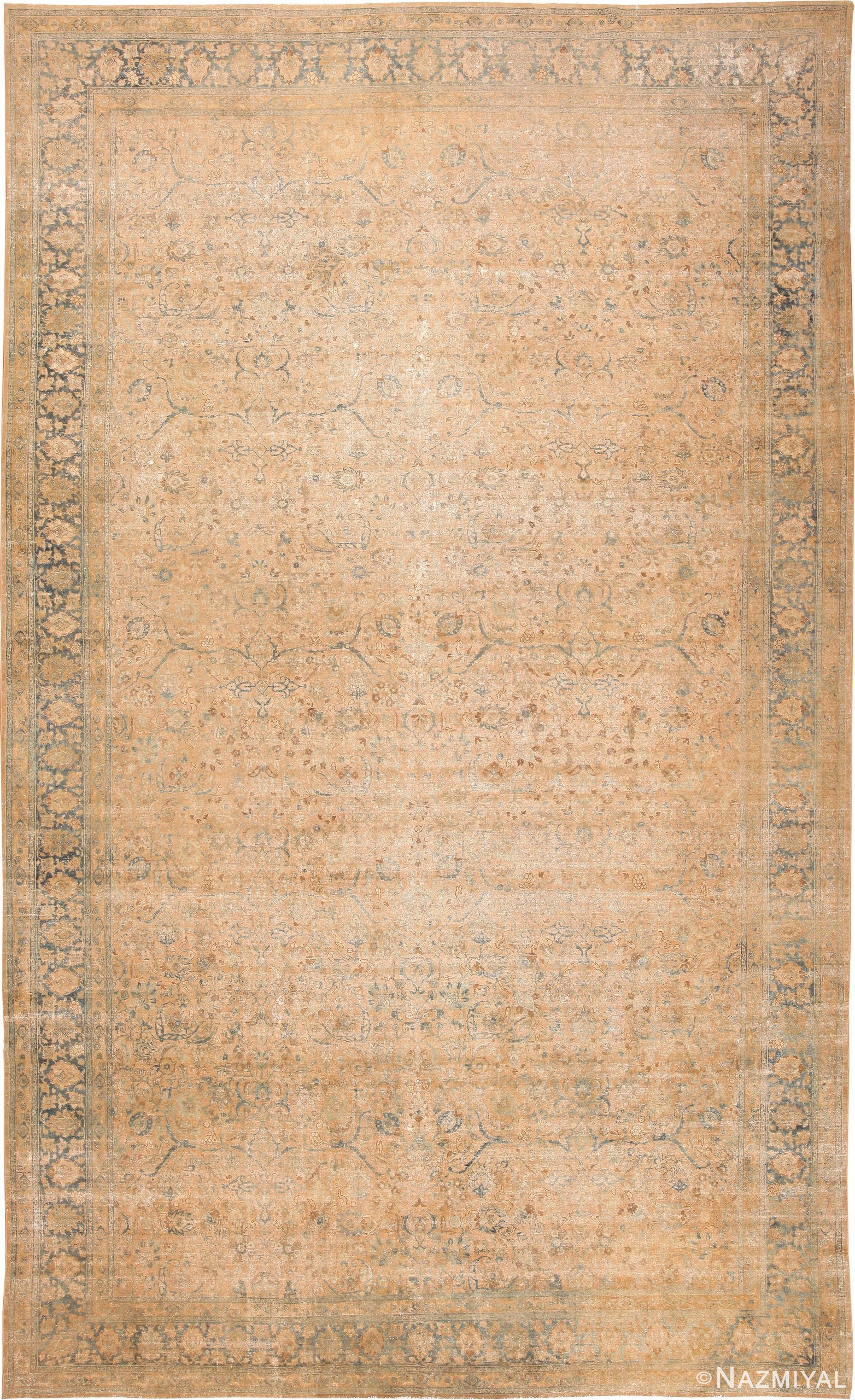
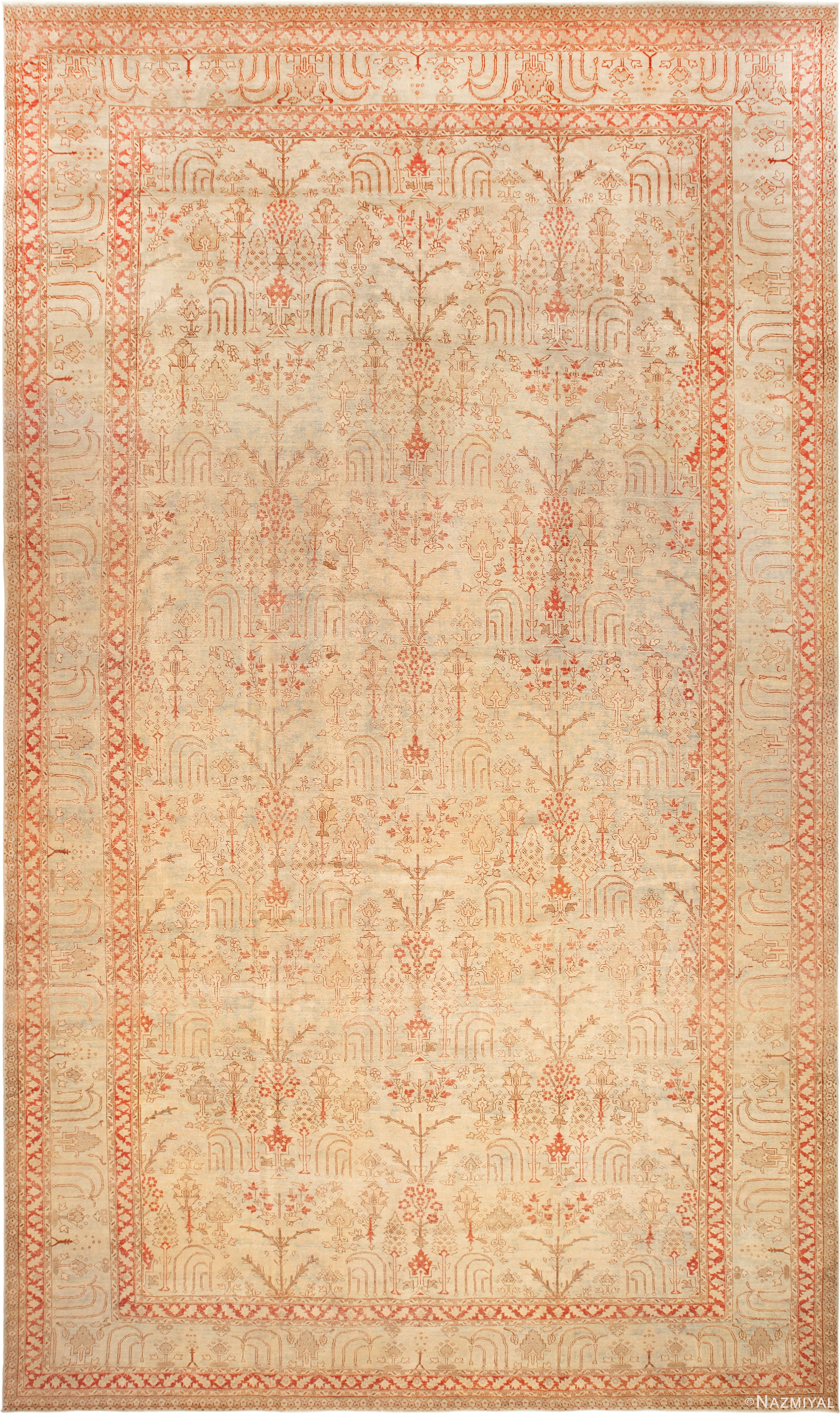
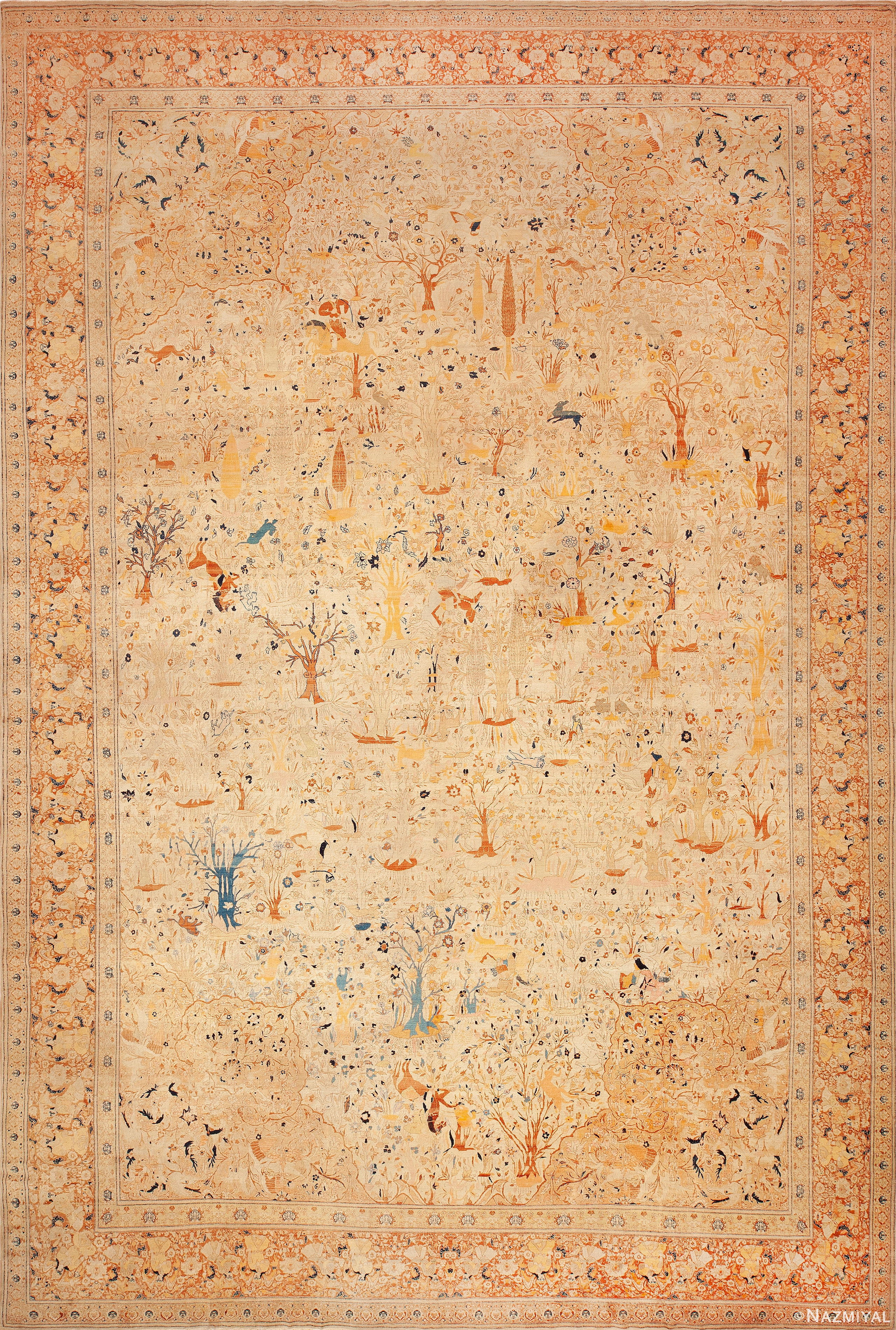
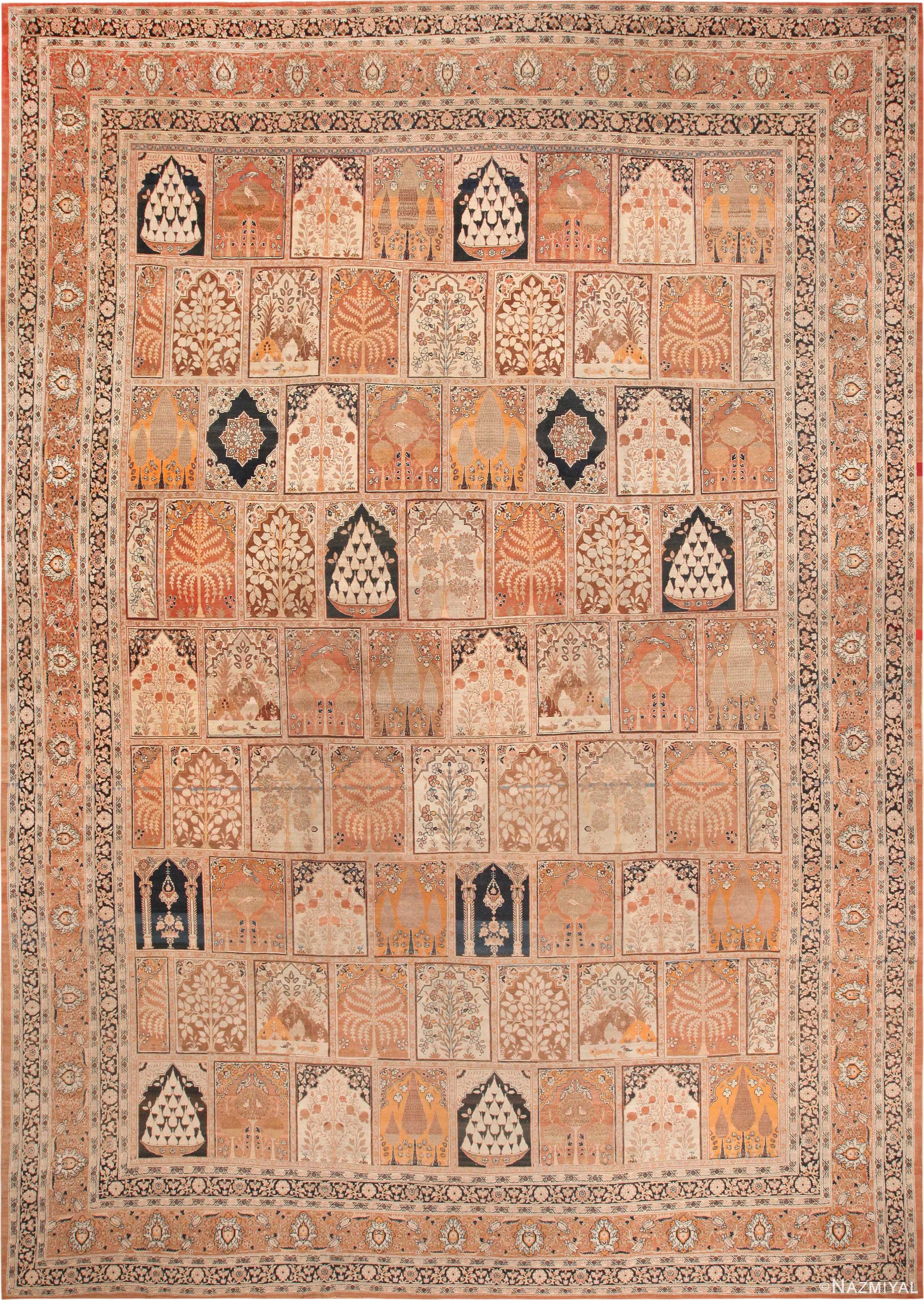
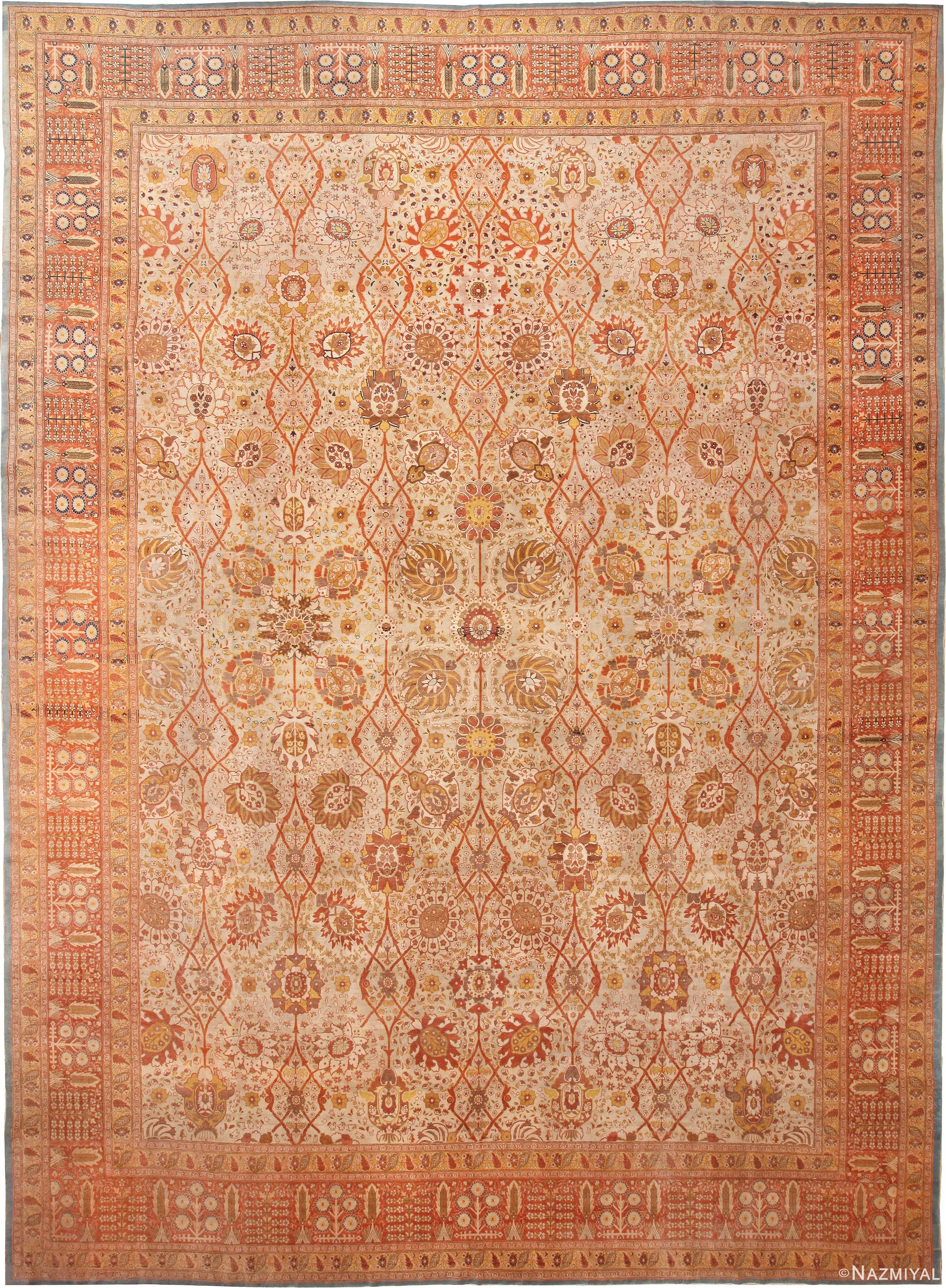
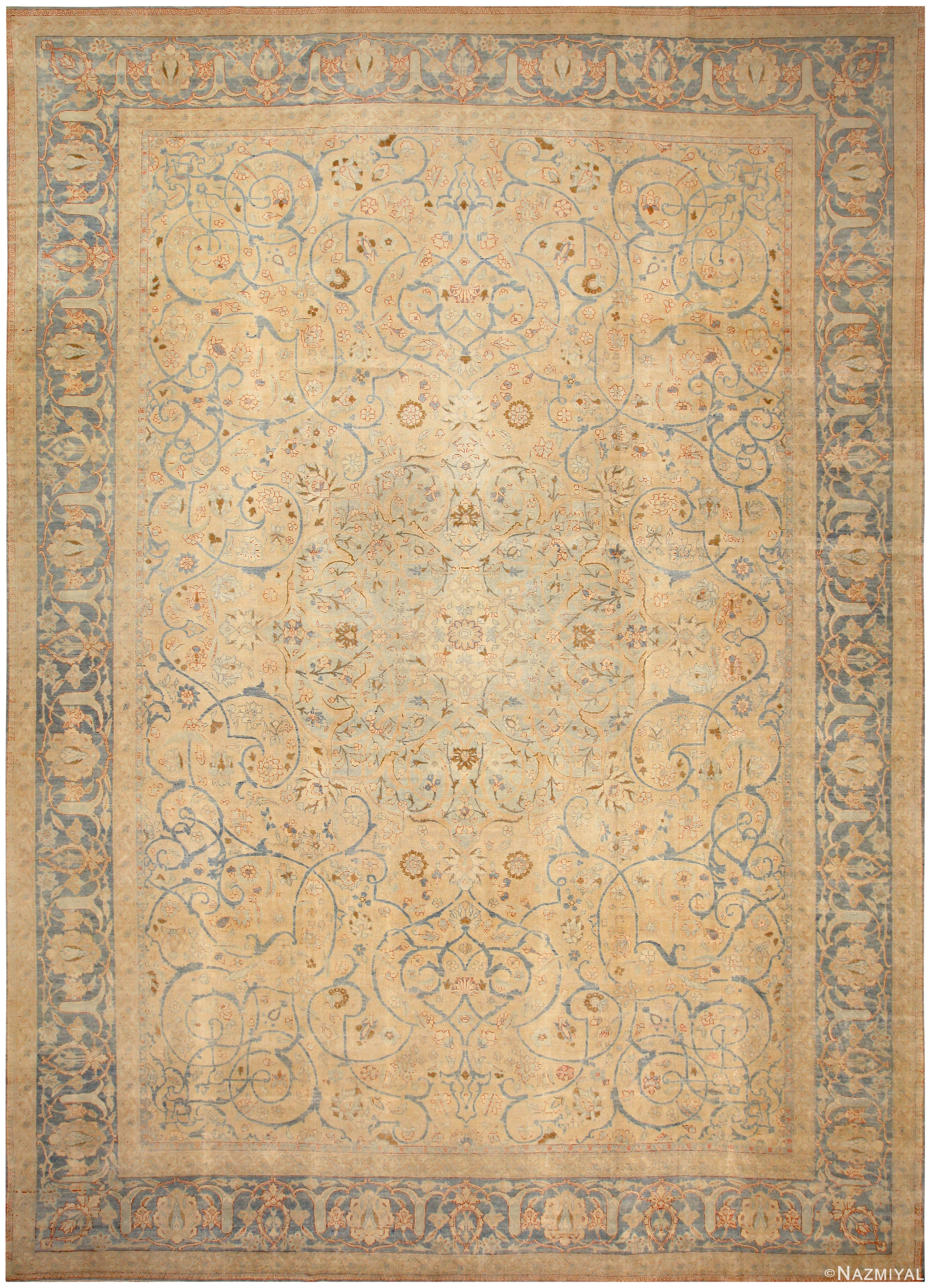
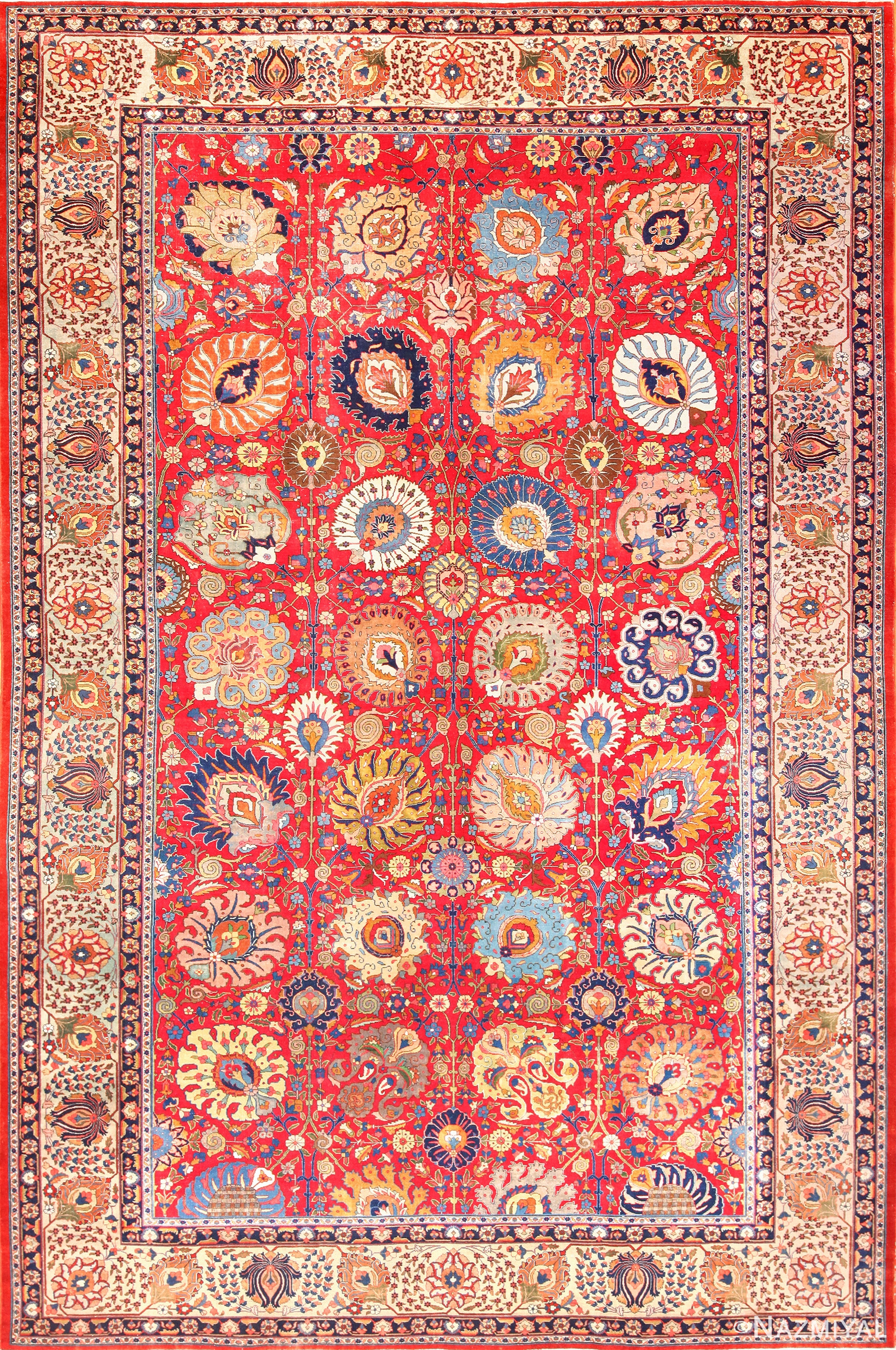
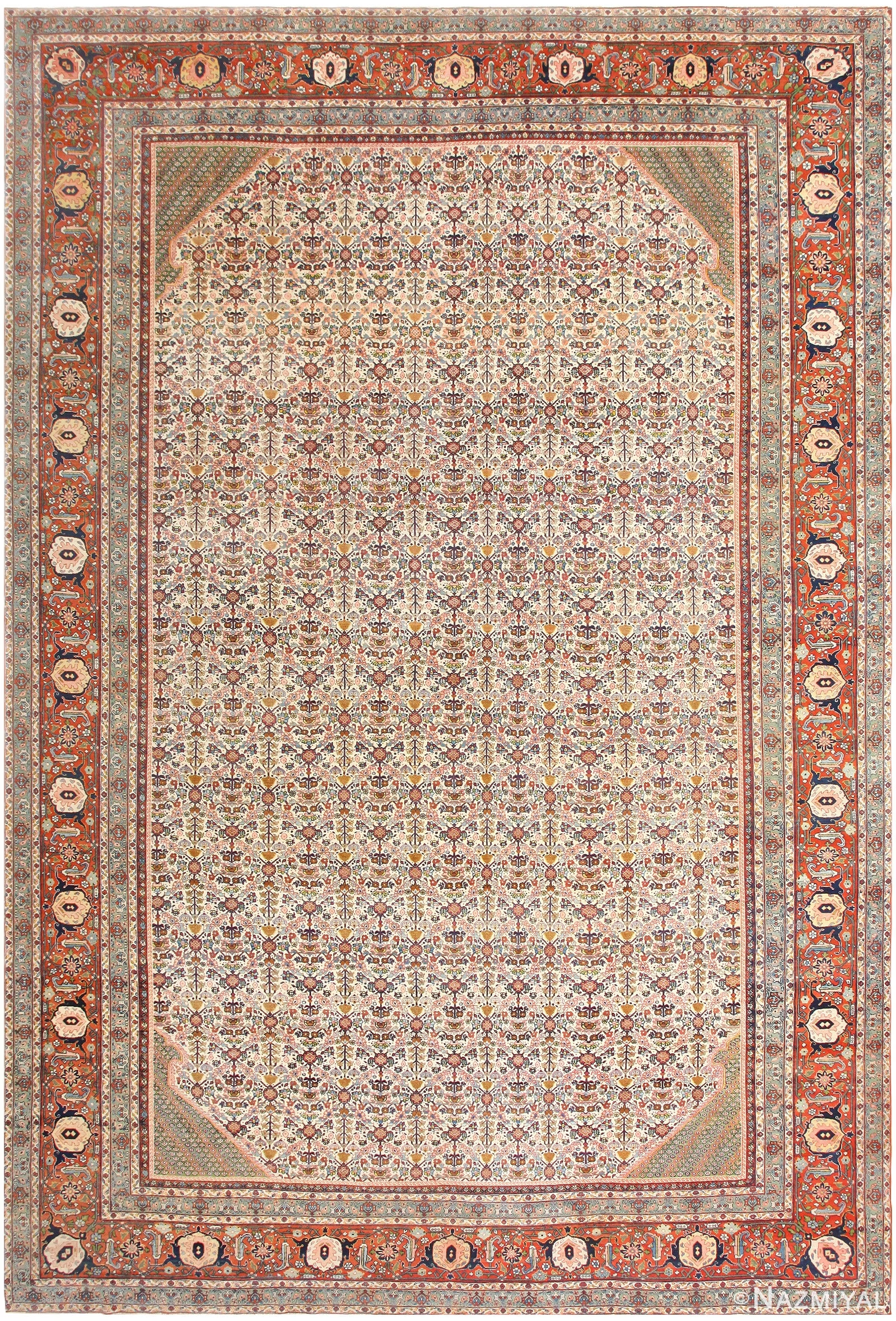
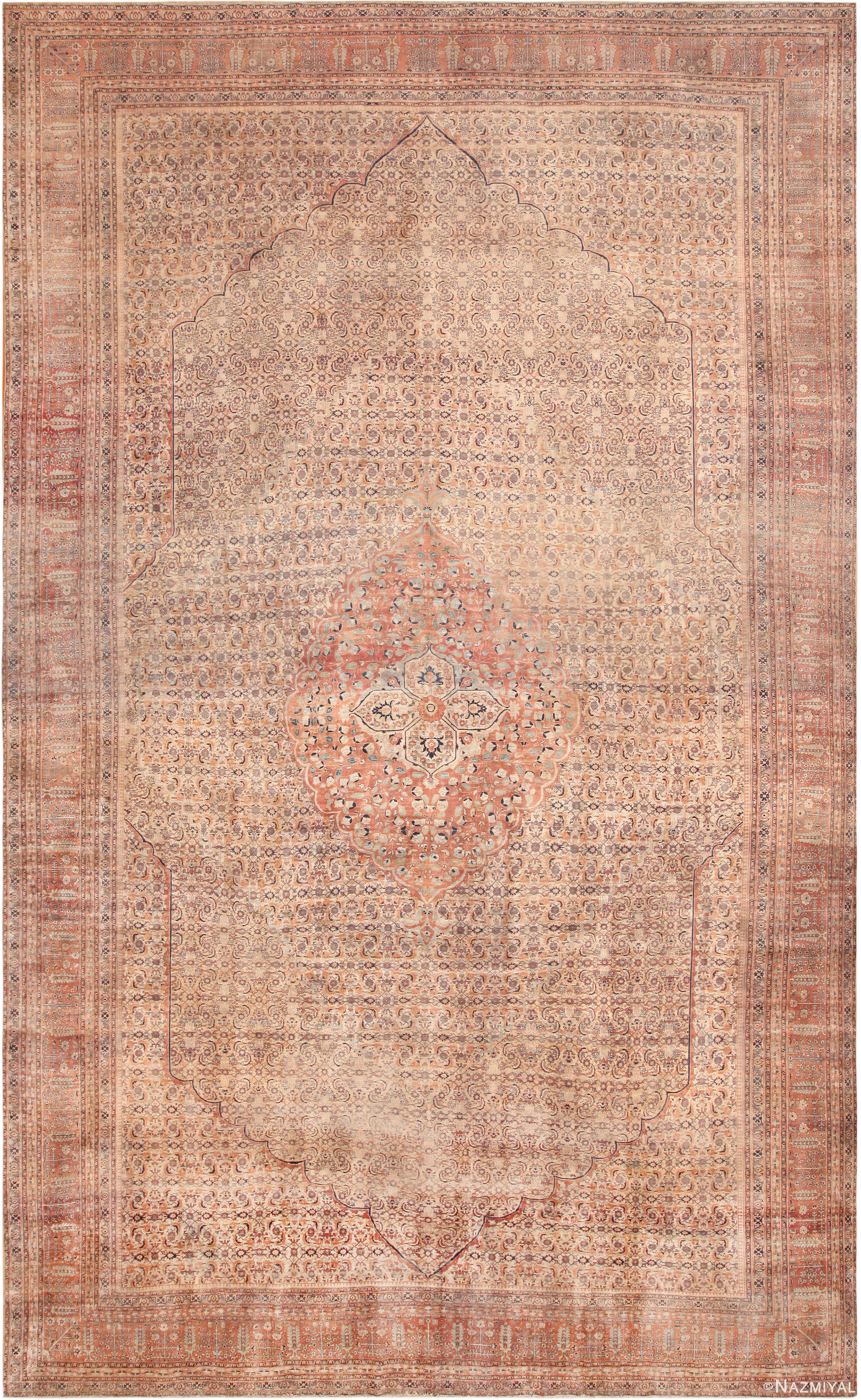
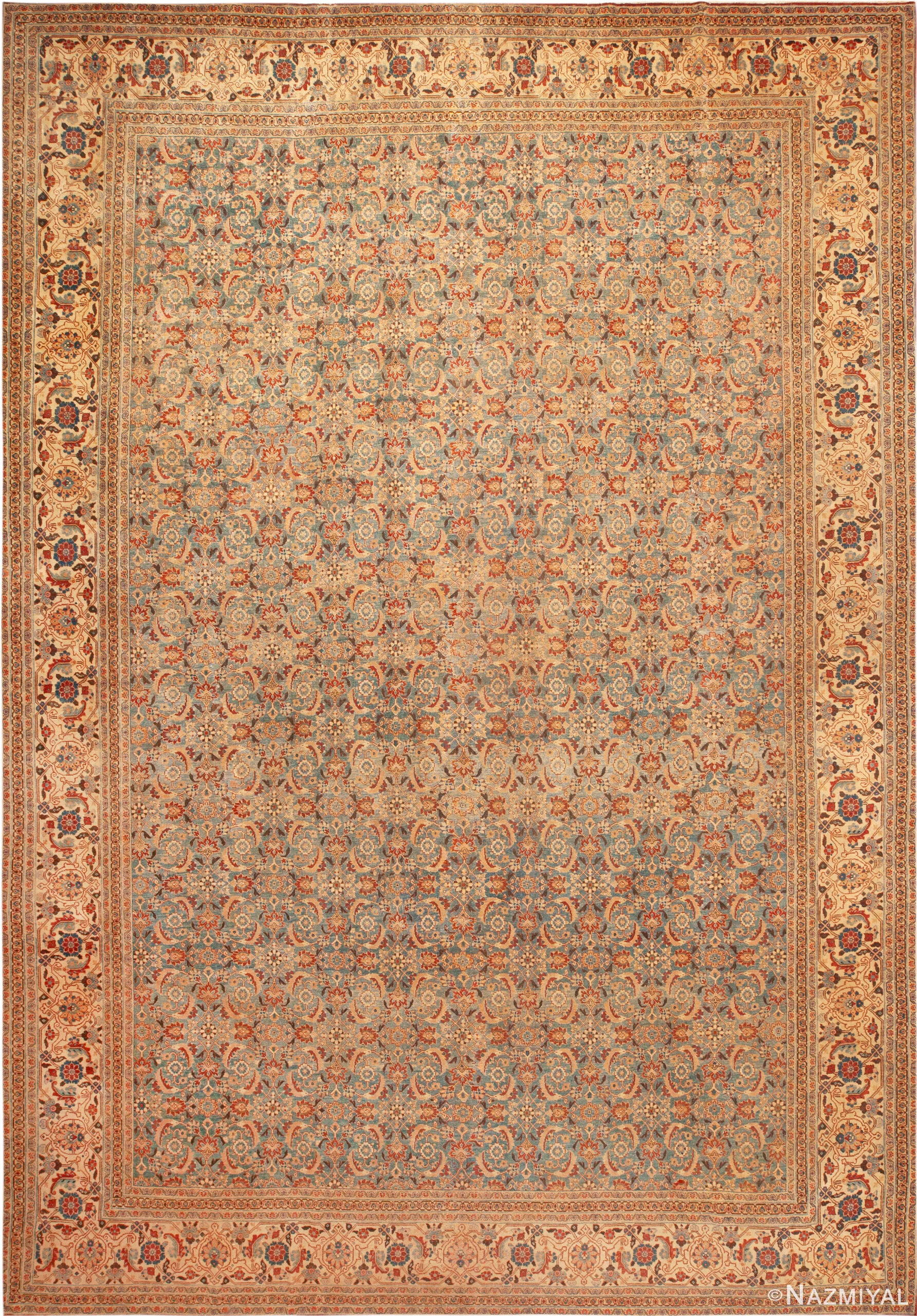
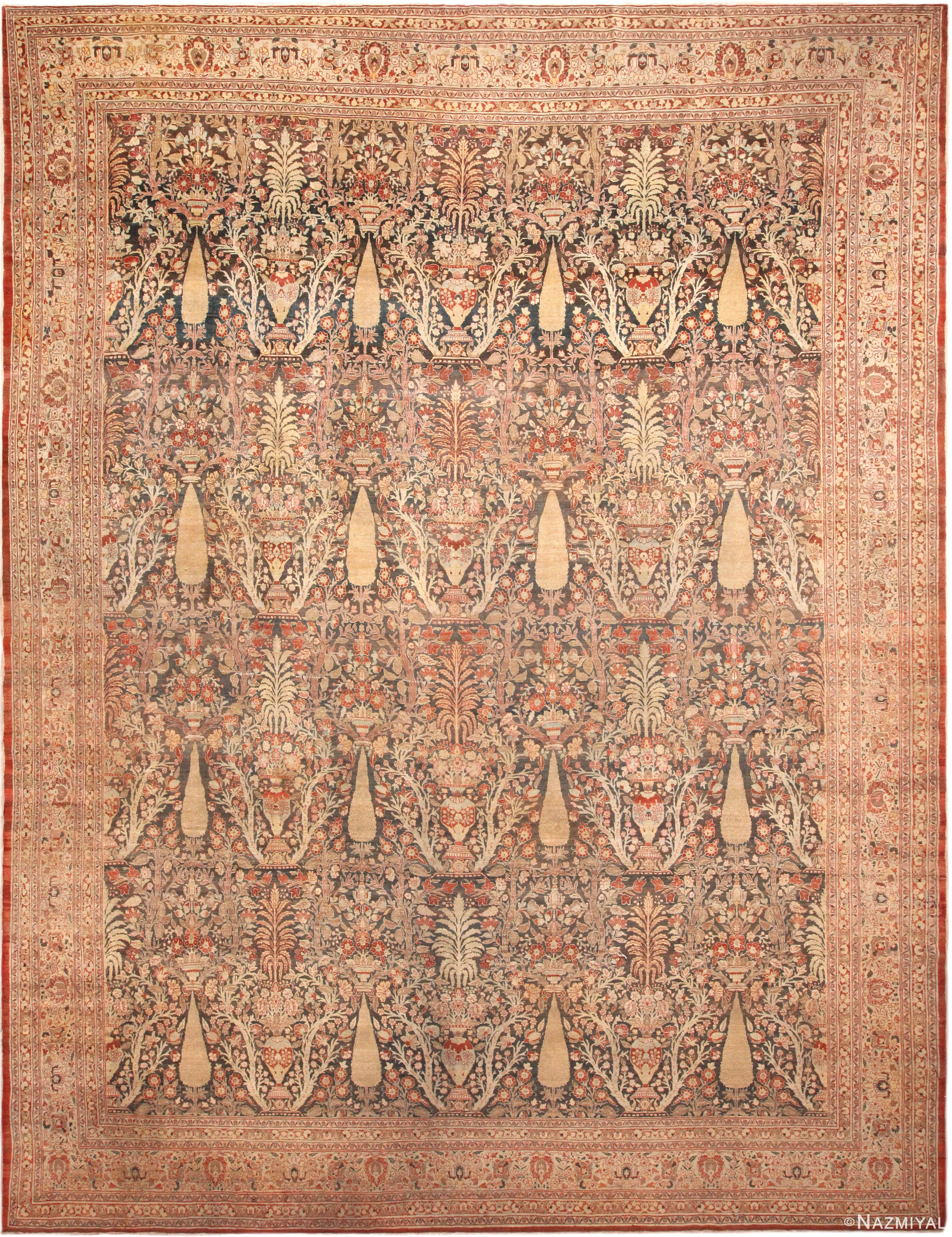
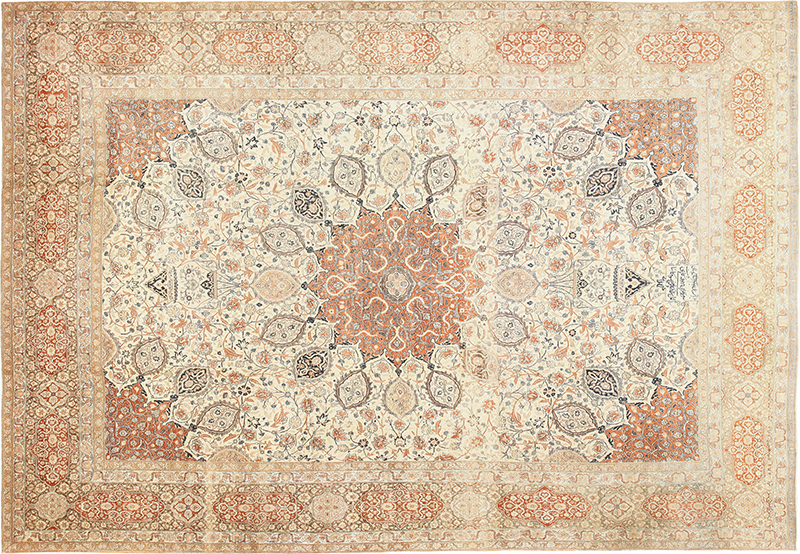
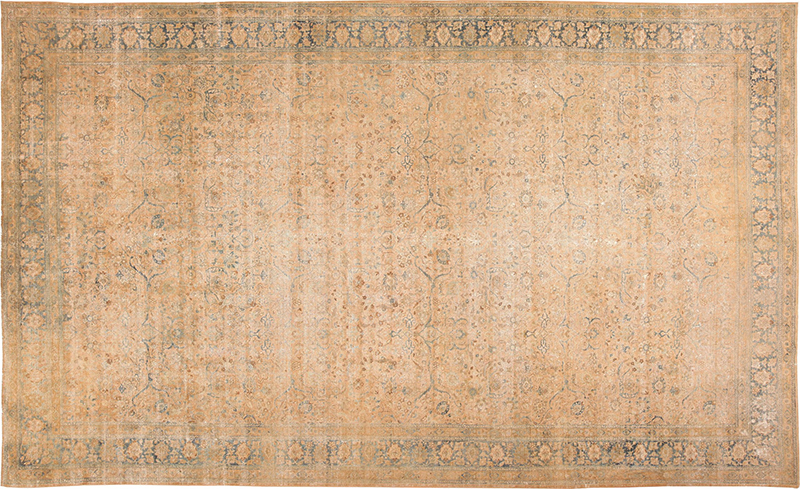
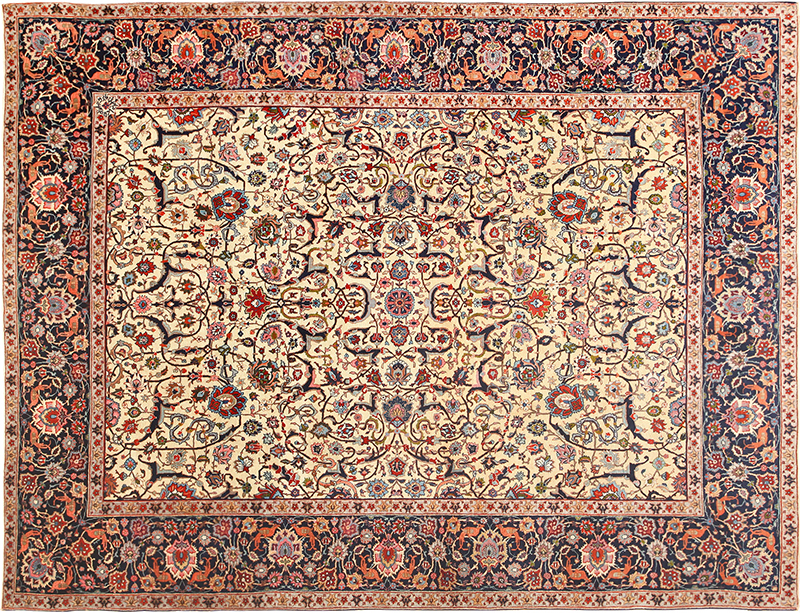
If you want a Persian rug where the drawing reads clean from across the room—and still holds up when you walk right up to it—Tabriz rugs are one of the best places to start. Woven in northwest Iran within a long workshop tradition, many Tabriz carpets show consistent structure, balanced composition, and a wide design range (from classic medallions to garden and pictorial formats). At Nazmiyal Collection, we curate antique and vintage examples and help you compare quality, condition, and scale within our broader Persian Rugs selection.
Tabriz rugs are hand-knotted Persian carpets woven in the city of Tabriz, prized for workshop-level precision, fine knotting, and designs drawn from detailed cartoons.
Tabriz is a historic weaving center in northwest Iran with a long workshop tradition. That workshop culture is what gives many Tabriz rugs their “architectural” feel—clean planning, consistent execution, and designs that were often drawn and followed closely. Historically positioned along major trade routes, Tabriz workshops also produced rugs for export markets, which encouraged stylistic variety without abandoning disciplined construction.
For broader regional context—how weaving families relate across countries, cities, and traditions—start at our Rug Origins hub and then return to Tabriz once you know the “voice” you’re after.
How to Identify an Authentic Tabriz Rug
Because “Tabriz” is sometimes used as a commercial label, authenticity is best determined by structure and drawing—not the name alone. Look for a combination of disciplined construction and crisp design logic:
Turkish (symmetrical) knot construction is common in Tabriz rugs
Fine to very fine knot density (curves stay sharp and readable)
Older dye behavior that shows tonal depth rather than flat color
Structural consistency across the whole rug (no “one end is different” surprises)
Reference note: for knot terminology, the Ghiordes/Turkish knot is the symmetrical knot form.
Tabriz Rugs in Decoration
Tabriz works when you want a rug that reads “organized” in a room—clear composition, a border that frames properly, and patterns that don’t collapse visually at a distance. The practical approach is simple: pick the scale first, then the composition, then the color. If the layout is right for the room, you can make a wide range of palettes look intentional.
If you want to compare the look across eras and budgets, start by browsing our Antique Rugs, Vintage Rugs, and Modern Rugs collections—then come back to Tabriz when you’ve narrowed the right mix of clarity, patina, and practicality.
Tabriz Rugs vs Heriz Rugs
Both come from northwest Iran, but they behave differently in a room. Tabriz tends to reward close viewing with refined detail; Heriz rugs lean bolder and more graphic, often chosen when you want monumentality.
Very broad: medallion, allover, garden, pictorial, silk
Narrower but iconic: powerful medallions and angular fields
Room “feel”
Formal, planned, and legible at distance
Monumental, anchoring, and visually assertive
Best when you want
Detail, clarity, and composed elegance
Bold geometry and a strong focal foundation
Quick guidance: Choose Tabriz when you want detail, clarity, and a more formal “planned” look. Choose Heriz when you want bold geometry and a strong graphic anchor.
Closest Cousins
Heriz Rugs — more monumental geometry; closely related northwest Persian family
Kashan Rugs — classic Persian workshop elegance and formal composition; a useful “city rug” comparison
Why Tabriz Rugs Are Valuable
Tabriz rugs are valued for technical mastery and coherent design. Well-preserved examples remain desirable because the workshop standard tends to produce rugs that still “read” correctly decades later—assuming structure and materials are intact.
What Drives Value
Age and weaving period
Knot density and precision
Materials (wool vs silk)
Design complexity and balance
Dye characteristics
Condition (structure first, surface second)
Provenance and credibility of sourcing
Types of Tabriz Rugs
Antique Tabriz rugs: older workshop materials and methods; patina and period drawing are major factors
Vintage Tabriz rugs: early-to-mid 20th century pieces with refined production and export influence
Silk Tabriz rugs: high detail and sheen; often made for decorative or ceremonial intent
Pictorial Tabriz rugs: historical, literary, or architectural scenes; strongest when drawing stays crisp
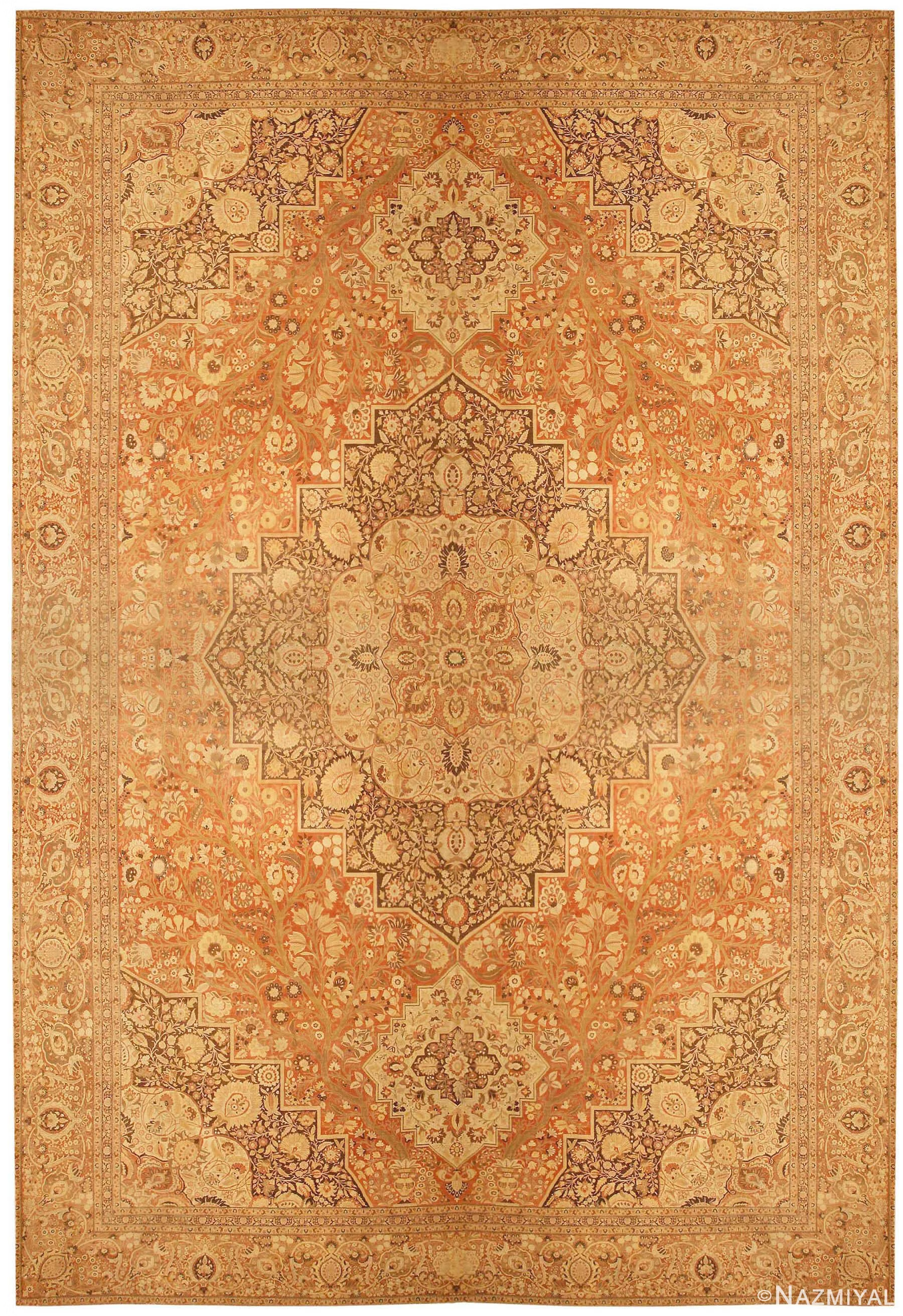
Medallion Tabriz rugs: classic central medallion compositions with balanced borders
Allover Tabriz rugs: repeating patterns that suit large rooms and long sight lines
Cartoon: A detailed pattern plan (often a full drawing) used by workshop weavers to execute complex designs accurately.
Foundation: The underlying warp and weft structure (often cotton in workshop rugs) that supports the knots.
Symmetrical (Turkish/Ghiordes) knot: A knot form wrapped symmetrically around two warps; common in many northwest Iranian workshop rugs.
Allover design: A repeating field pattern without a dominant central medallion—useful for large rooms and long sight lines.
Medallion: A central focal motif that organizes the composition and frames the field pattern around it.
For more terminology used by collectors and dealers, see our Rug Glossary.
Frequently Asked Questions
What defines an antique Tabriz rug?
Generally, rugs woven before the mid-20th century are evaluated by structure, materials, and wear patterns. In practice, “antique” is confirmed by construction cues and condition—not the label alone.
Are all Tabriz rugs finely woven?
Most are, but quality varies by workshop and period. The best examples show consistent structure and crisp drawing, especially in curves and small details.
Do Tabriz rugs use natural dyes?
Many older examples do; later pieces may include synthetics depending on date and intended market. Dye behavior and tonal depth can be strong clues when paired with structural indicators.
Can Tabriz rugs be professionally restored?
Yes—when done by specialists who understand Persian workshop construction. Prioritize structural stabilization (ends, sides, foundations) before cosmetic work.
Are Tabriz rugs a good investment?
High-quality antique and early-vintage pieces can maintain demand when age, structure, design, and condition align. As with all antique rugs, informed evaluation matters more than name recognition.
Why Nazmiyal Collection? Three Pillars of Nazmiyal
For decades, clients have relied on Nazmiyal Collection for guidance on identifying, valuing, and placing Tabriz rugs correctly—so the rug you choose fits the room and holds up to real-life use.
Unmatched Inventory Depth — broad selection across sizes, design families, and quality tiers.
Rigorous Authenticity Standards — expert-vetted pieces represented accurately, with structure and condition prioritized.
Expert Advisory — practical help on sizing, placement, value considerations, and long-term care.
Nazmiyal White-Glove Service
We make it easy to shop with confidence—whether you’re choosing a single statement piece or curating a full room.
For decades, clients have relied on Nazmiyal for guidance on identifying, valuing, and collecting rugs by origin—pieces chosen for design impact, documentation, and lasting value.
Trustindex verifies that the original source of the review is Google.
The only ones I'd ever buy rugs from. The best.
Posted on Google
Jeffrey NeumanB
Trustindex verifies that the original source of the review is Google.
I bought two gorgeous Serapi rugs from Farhad at Nazmiyal Rugs! Beautiful carpets, fair prices and great service. Very happy customer. Farhad (the sales person) was very patient and gave us great service.
Posted on Google
john haid
Trustindex verifies that the original source of the review is Google.
Alen is a gentleman and an expert. Really great to work with.
Posted on Google
Edward Yasuna
Trustindex verifies that the original source of the review is Google.
I recently purchased a modern Kandinsky rug from Nazmiyal Auctions. It was just as described, and the director (Farhad) of the auctions had it sent to me quickly and safely. Payment was easy, the rug was reasonably priced, and I highly recommend Nazmiyal Auctions and Antique Rugs. Quality merchandise and first-class service.
Posted on Google
Nicholas Carr
Trustindex verifies that the original source of the review is Google.
Had a excellent experience buying a rug in Nazmiyal's 1/18/26 online auction. First, prior to the auction, viewing a number of lots at the 32nd St showroom (I had prepared a list from the online catalog). The staff were great to work with: helpful, knowledgable, honest, and flexible. Second, after placing an online bid and winning the desired item, arranging payment and pickup was simple and straightforward. Everything went seamlessly and the overall experience was educational and fun. Many thanks to Jason and his team.
Posted on Google
Andrea Gared
Trustindex verifies that the original source of the review is Google.
Everyone at Naziyal is proffessional, especially Jason and Farhad.
They are knowledgeable, truthful, and true gentlemen. I have sold several rugs through them and will always go to them first, to buy or sell. The best in the business!
Posted on Google
Lori Silverberg
Trustindex verifies that the original source of the review is Google.
Posted on Google
Jesse Zilberman
Trustindex verifies that the original source of the review is Google.
Excellent customer service! Alen was very helpful over the phone and email. The rug we acquired was stunning, and photos do not do it justice. I would definitely work with Alen and team again!
Posted on Google
Rachel Paul
Trustindex verifies that the original source of the review is Google.
Jason was incredibly kind and helpful! I work for a small museum that had some rugs we had no information on. Jason responded to us quickly and gave us the information we needed for free! Incredible service, we are super thankful for his help!

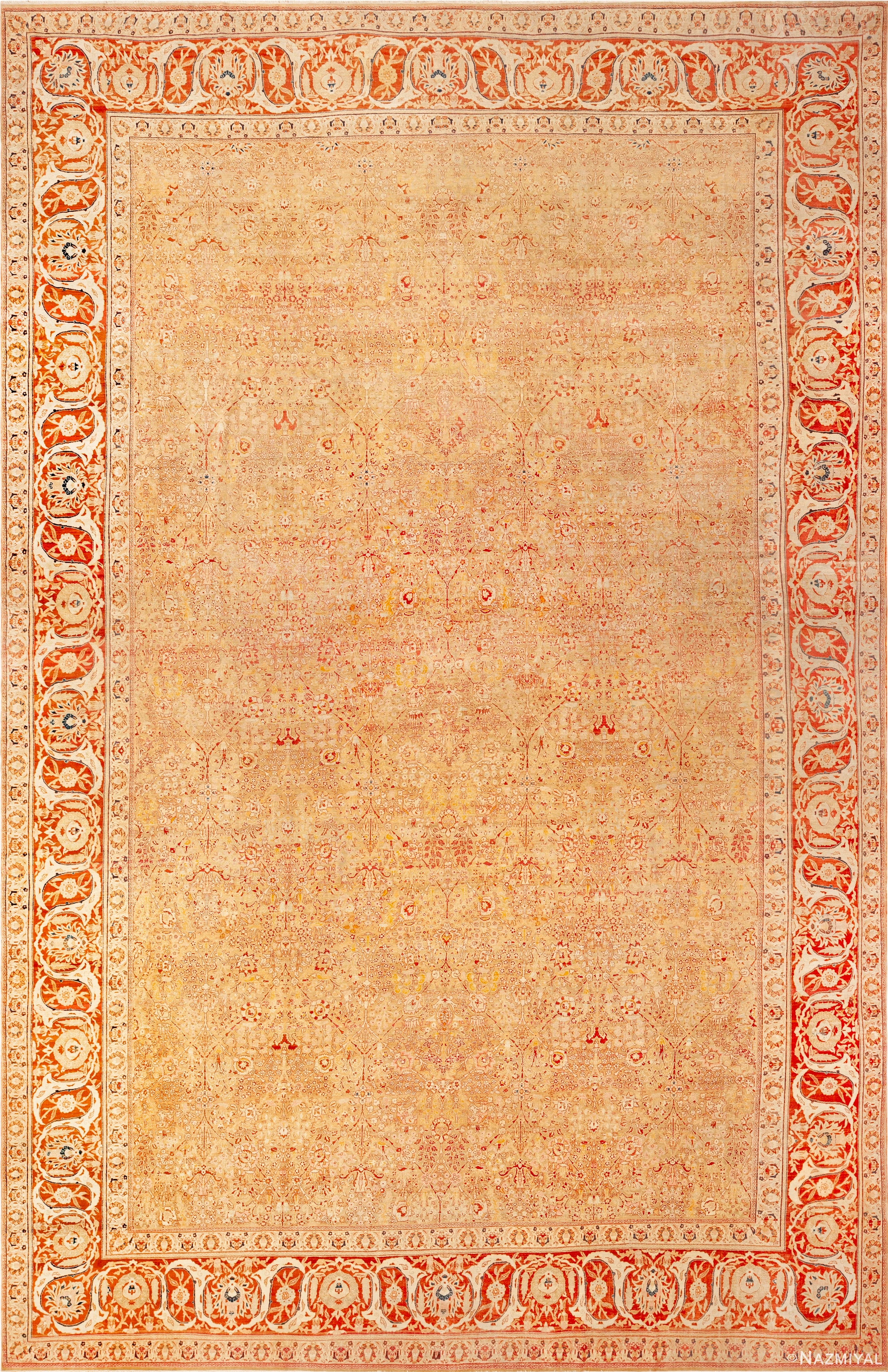
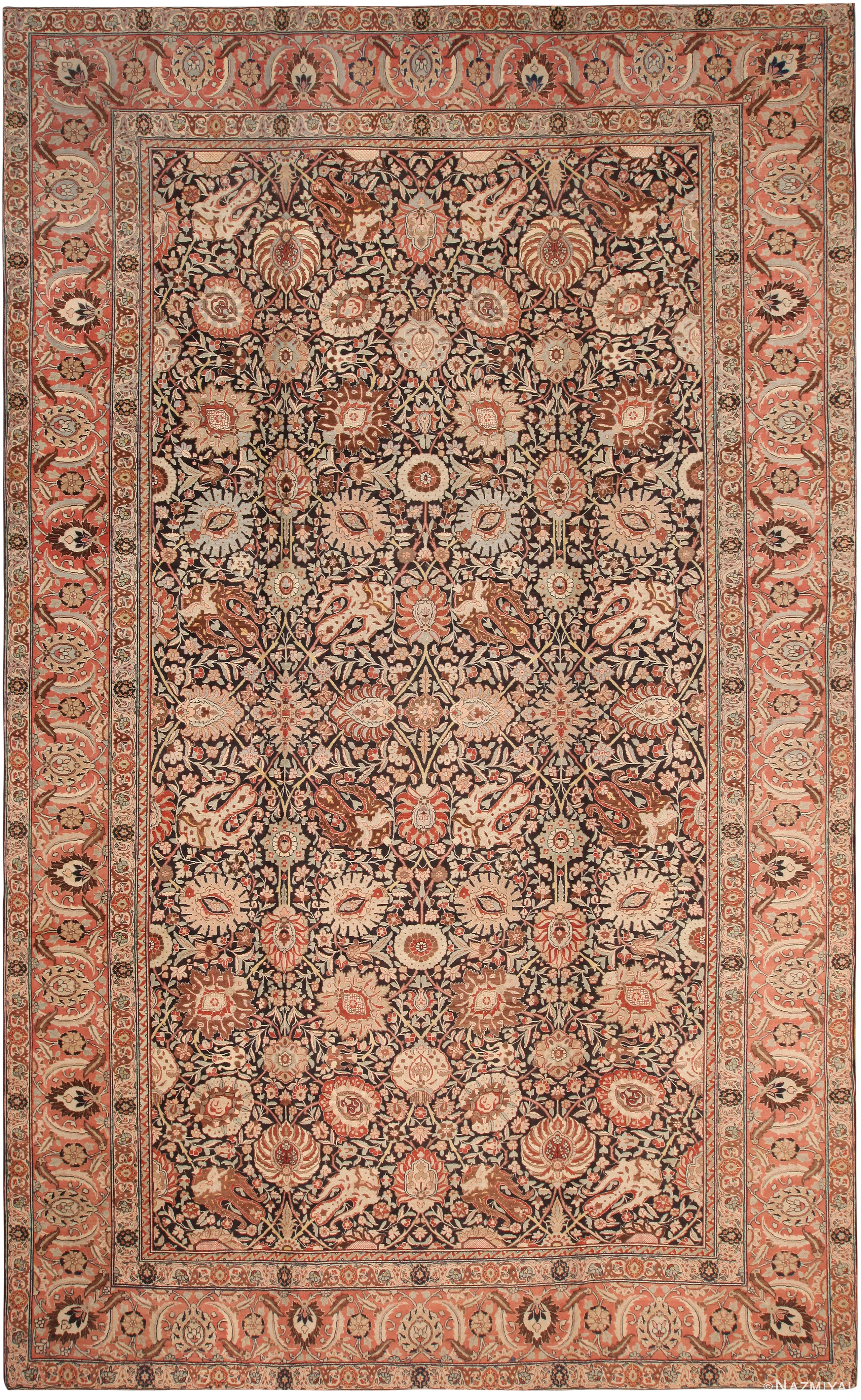
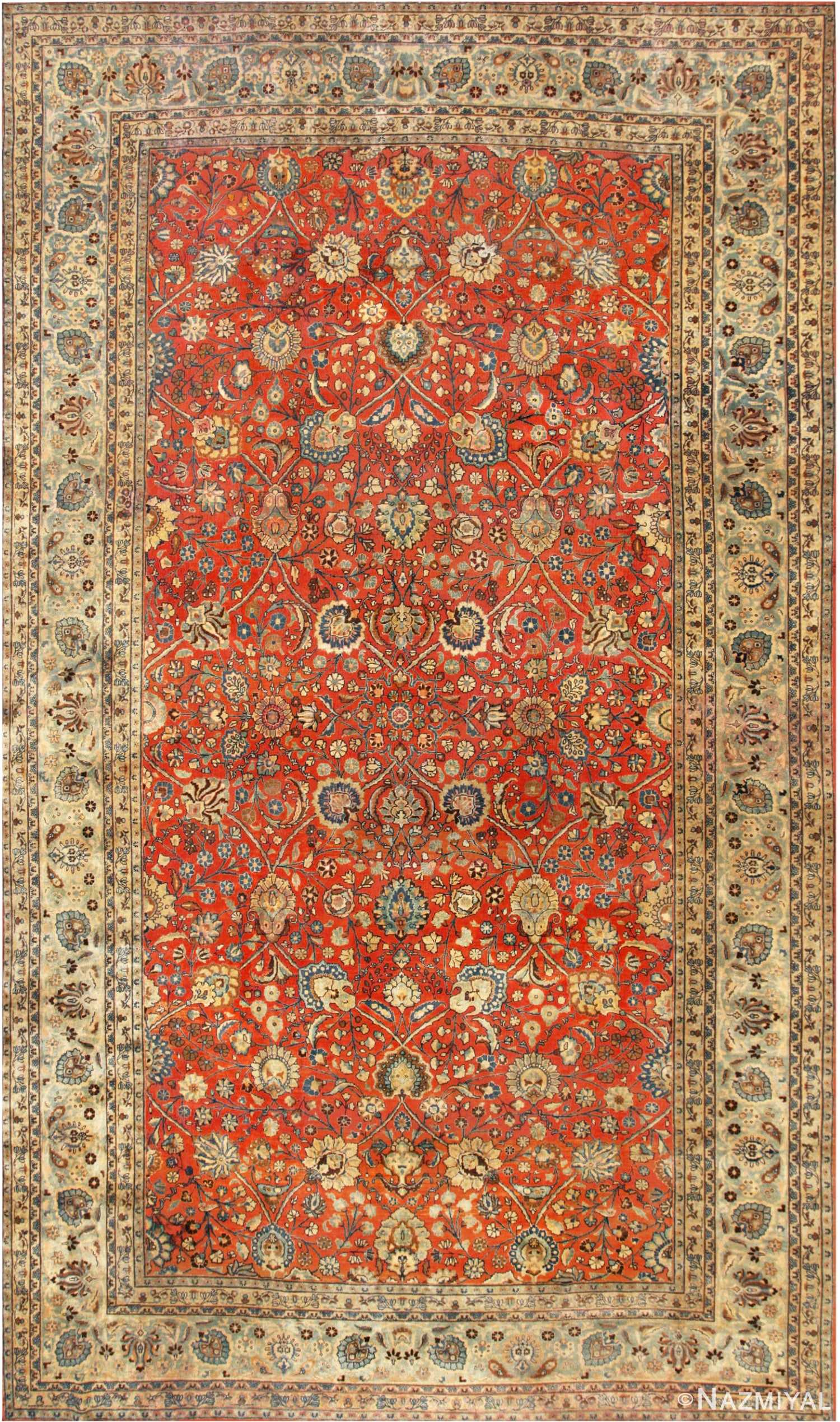
 Luxury Antique Oversized Persian Tabriz Rug with Sophisticated Floral Pattern and Coral Border 73648Size: 13 ft 7 in x 21 ft 7 in (4.14 m x 6.58 m)
 Size: 21 ft 2 in x 32 ft 3 in (6.45 m x 9.83 m)
 Size: 22 ft 5 in x 32 ft (6.83 m x 9.75 m)
 Size: 14 ft 2 in x 27 ft (4.32 m x 8.23 m)
 Size: 16 ft x 25 ft 4 in (4.88 m x 7.72 m)
 Size: 18 ft x 25 ft (5.49 m x 7.62 m)
 Size: 17 ft x 24 ft 7 in (5.18 m x 7.49 m)
 Size: 15 ft 9 in x 24 ft 2 in (4.8 m x 7.37 m)
 Size: 14 ft 8 in x 22 ft (4.47 m x 6.71 m)
 Size: 12 ft 10 in x 21 ft 3 in (3.91 m x 6.48 m)
 Size: 12 ft 3 in x 20 ft 10 in (3.73 m x 6.35 m)
 Size: 12 ft 9 in x 20 ft 3 in (3.89 m x 6.17 m)
 Size: 14 ft 6 in x 20 ft (4.42 m x 6.1 m)
 Size: 14 ft x 19 ft 6 in (4.27 m x 5.94 m)
 Size: 12 ft 10 in x 19 ft 6 in (3.91 m x 5.94 m)
 Size: 13 ft x 18 ft 6 in (3.96 m x 5.64 m)
 Size: 11 ft 2 in x 18 ft 6 in (3.4 m x 5.64 m)
 Size: 13 ft 8 in x 18 ft 3 in (4.17 m x 5.56 m)