 |
Glossary of Oriental Rugs / Carpets
 |
|
|
P |
Paramamluk - The term ‘Paramamluk’ was coined by the rug scholar Charles Ellis to distinguish a variant of the Mamluk production that utilized allover patterns of smaller concentric hexagons, octagons, and squares – the so-called “Chessboard carpets.” These have been attributed to Damascus, a major center in the Syrian portion of the Mamluk realm. At the time they were produced, however, this region was already under Ottoman rule. |
|
Pashmina wool - A type of fine slky wool that comes from the soft downy layer closest to the skin of the animal. Calssical Mugal carpets are famed for the use of such wool. |
|
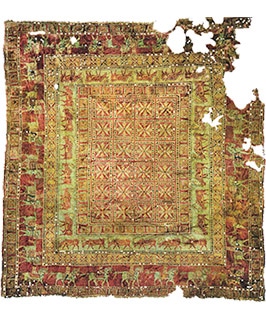
Pazyryk – A findspot in the Altai mountains of Siberia where a frozen tomb was discovered containing the worlds oldest complete carpet, dating from 400 to 300 B.C. |
|
Peking - Peking carpets represent a newer antique production that began in China immediately following World War I, when carpet manufacturing moved from Ningshia and other interior centers to the capital. Peking carpets were now made in larger sizes intended to be more usable as decorative room-size rugs in the Europe and the United States. |
|
Persian knot - See asymmetrical knot. |
|
Pile – The thick body or surface of a knotted pile carpet usually trimmed to a uniform length, but sometimes left long and shaggy. |
|
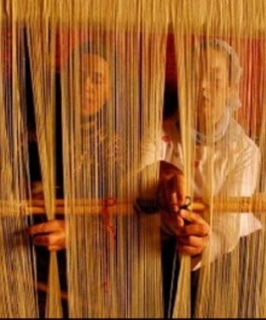
Pile or Knotted Carpets - Rugs produced by looping short lengths of yarn around successive pairs of warps in horizontal rows, and letting the excess wool hang downward in a shaggy mass. The shaggy ends of the knots may be trimmed as the carpet is being woven, or after it has been completed. This trimming creates the surface of the pile.
|
|
Plying - Fibers used in carpets and textiles may be plied by taking two or more spun yarns and spinning them yet again into a still thicker yarn. Plying must be spun in the opposite direction in which the component yarns are spun, e.g. S-spun yarns may be plied with a Z-spin and vice versa. See yarn. |
|
Polonaise - Polonaise carpets are among the most elegant and lavish of the court productions made under the Safavid dynasty in Iran during the seventeenth century. Large numbers of such carpets were exported to. Some were even custom made with the heraldic devices of specific Polish noble families, which led to the erroneous opinion that these carpets were actually made in Poland. Their soft golden coloration and additional detail in gold and silver thread make the Polonaise carpet a masterpiece of bygone grandeur.
|
|
Prayer Rugs - Technically any small carpet or rug can be used for prayer, so all such rugs are potentially prayer rugs. What distinguishes a prayer rug in terms of design is the use of an arched doorway, niche or "mihrab" as an organizing compositional theme or motif. This mihrab replicates the "qibla "or niche in the main wall of a mosque, which enables the faithful to orient themselves toward Mecca when in engaged in prayer or "namaz."
|
|