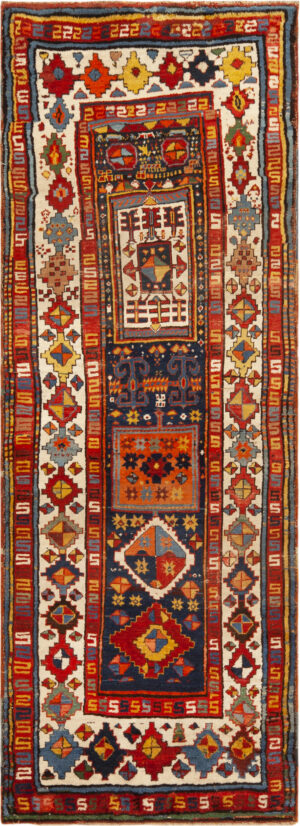
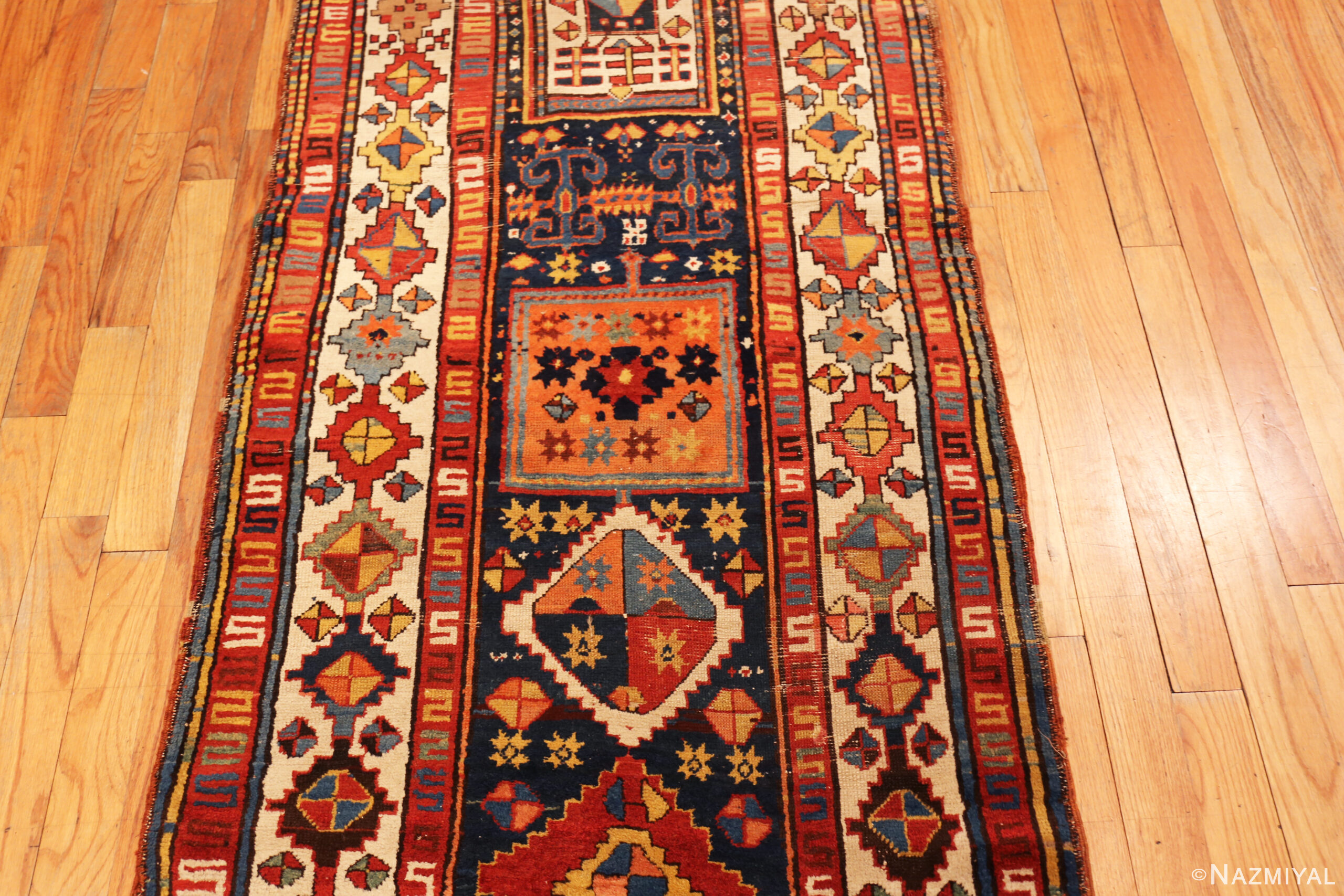
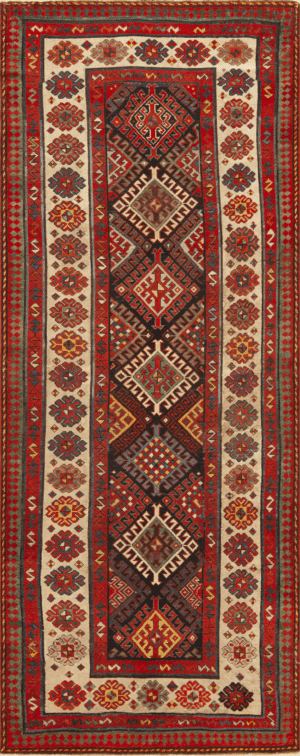
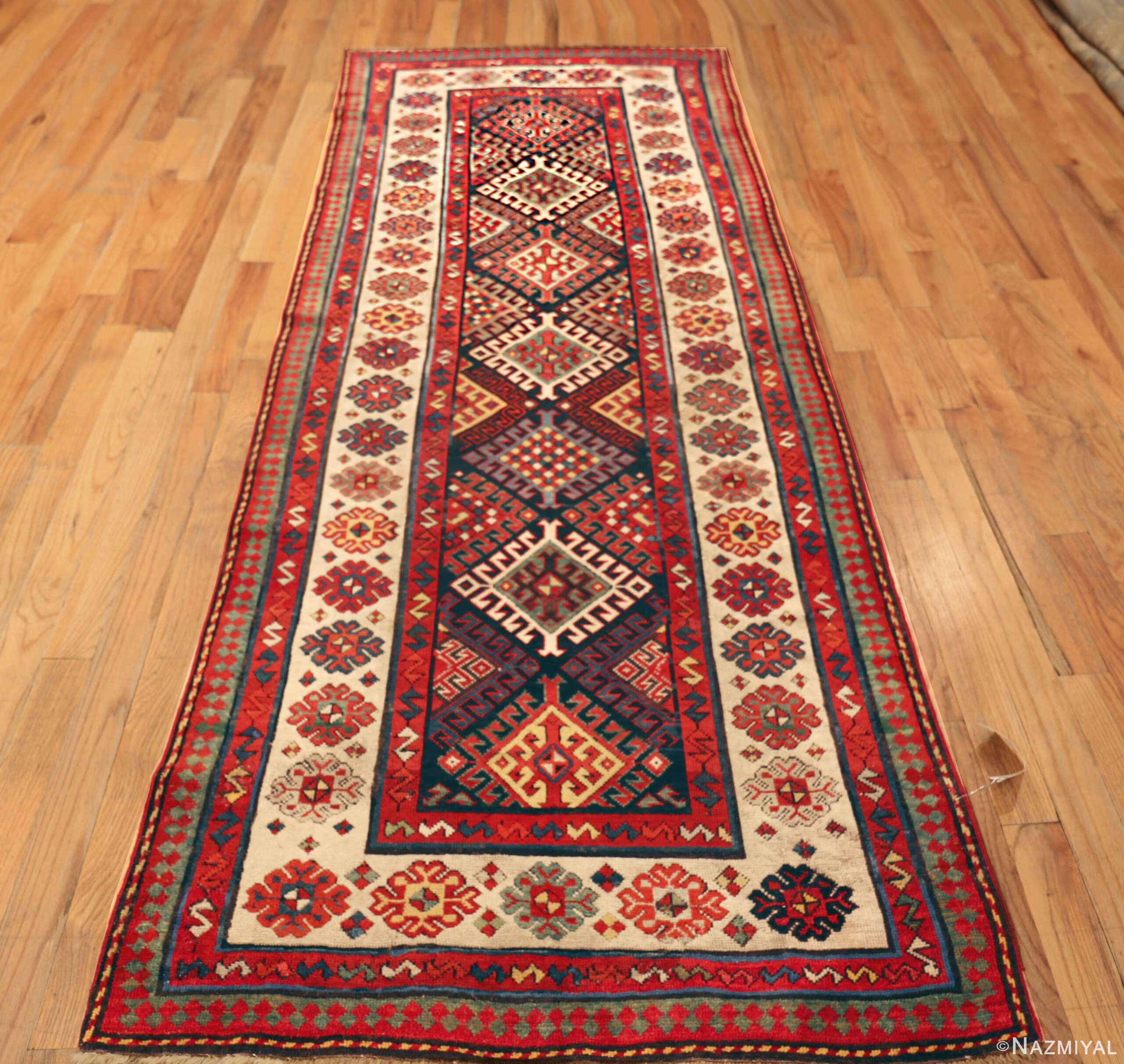
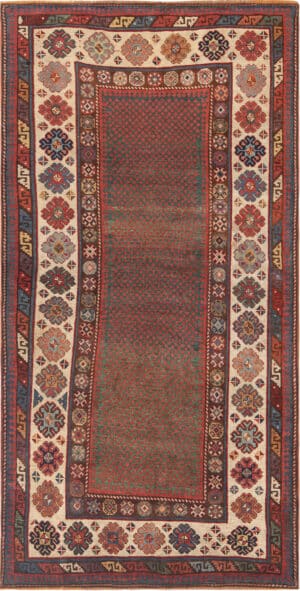
East of Moghan, on the coast of the Caspian Sea, is Talish. This region known in the ancient times as Talish (from the name of the Talish nation living in this region) is one of the earliest inhabited regions of Azerbaijan. The archaeological researches made in the region prove that the life in the region began in the III-II millenniums before Christ. During the formation of early states in the territory of Azerbaijan, Talish was under the control of Kichik Midia or Atropatena (one of the oldest states in the south of Azerbaijan, IV century B.C.). Carpets from this area are particularly well woven with fine soft wool of medium pile. The sizes of Talish rugs are always between about 3 and 5 feet by about 7 to 10 feet in length.
One of the most famous Talish rug designs has a long narrow field of monochrome blue or blue-green without any decoration, except for a serrated edge of a contrasting color. It is surrounded by four guard and border strips, the wide border having a series of round floral motifs. The borders in total are about one and half times the width of the field. A very fine example of this type of Talish rug, sold at auction by Lefevre in London in 1976 had a field piled in several shades of blue and blue-green; in the center was a small cream quadrangle containing an inscription and the date 1851. Other Talish rugs have the same general layout, but the field is filled with star motifs within an octagonal lattice, or with myriad small poly chrome starts resembling flower heads. Designs of three hooked diamonds on the long axis are extremely rare, the edges of which are echoed by a wide parallel zigzag on either side, in the channels of which are parallel rows of small petaloid motifs.
In the Talish area is the coastal town of Lenkoran, which produces carpets differing in design from the main Talish rug types. One has an enormous series of boteh medallions and scorpion-like bars in the field. A superb example illustrated by Schurmann and dating from the 18th Century, is woven in a rich subtle palette of red, aubergine, green, blue, brown, yellow, cream and purple on a dark blue-black field, with a reciprocal trefoil border in red-brown and white. Another design, again on a blue-black field, has a series of large and small octagons and cruciform medallions down the length of the field. The larger octagons are flanked by S-shaped motifs which, it is reasonable to suppose, were derived from earlier dragon carpets.