
A Comprehensive Rug and Carpet Glossary: From A – Z (Definitions You Can Actually Use)
Updated: February 7, 2026 · Reviewed by: Jason Nazmiyal
This A-Z rug glossary explains the most common rug and carpet terms. From materials, dyes, knots, motifs, regions, and condition language, this guide makes it easy to shop and collect with confidence.
If you’re shopping for a rug and keep running into terms like abrash, jufti knot, or allover, you’re not alone. Rug language is full of casual trade shorthand and can be difficult to decipher. Many of these terms directly refer to quality, durability, value, and how a rug will age.
Use this glossary to decode what you’re seeing and explore real examples in our collection. Start at Nazmiyal and browse Antique Rugs, Vintage Rugs, and Modern Rugs. For geography, use the Rug Origins hub, and for deeper context explore Persian Rugs.
Jump To Letter:
A B C D E F G H I J K L M N O P Q R S T U V W X Y Z
Antique Rug Glossary Terms: A
Abrash
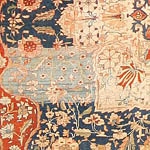
Abrash is a natural variation in color across a rug’s field. Subtle shifts in tone occur when wool is dyed in small batches. In many handmade rugs, abrash is considered character and proof of authenticity, especially with natural dyes.
See also: Vegetable Dyes • Wool • Patina • Persian Rugs • Antique Rugs
Agra
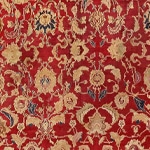
Agra is a major Indian carpet weaving center. It’s known historically for workshop rugs developed during the Mughal era and later production traditions. Antique Agra rugs can offer remarkable scale, drawing, and decorative presence. They often represent some of the best classical Indian carpets.
See also: Mughal Rugs • Indian Rugs • Allover Pattern • Rug Origins • Antique Rugs
Allover Pattern
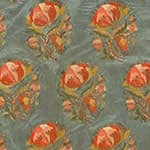
An allover pattern is a repeating design that fills the entire rug’s surface. This is as opposed to organizing the composition around a single dominant medallion. Allover designs tend to feel calmer and more “room-filling”. They often hide wear and everyday life better than a centered configuration as well.
See also: Medallion • Herati • Boteh • Rug Patterns
Alpujarra
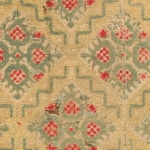
Alpujarra rugs are thick, folk-art weavings from southern Spain, near Granada. Their designs typically include bold geometry and looped, uncut piles. Some examples show fringe around multiple edges. Their structure and texture read very differently from classic Persian and Turkish pile rugs. Instead, they’re more rustic, sculptural, and graphic.
See also: Flatweave • Pile • Folk Art • Rug Origins
Americana
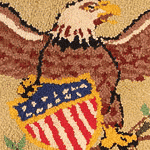
“Americana” refers to textiles and designs tied to American folk culture. Hooked rugs, rag rugs, needlepoint, quilts, and utilitarian decorative objects all fall into this category. These pieces are often collected as cultural artifacts as much as home decor. In many cases, condition and charm matters more than a perfect structural precision.
See also: Hooked Rug • Needlepoint • Folk Art • Antique Rugs
Amritsar
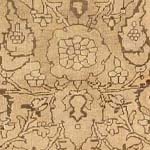
Amritsar rugs are a distinctive Indian production that expanded in the 19th century. Many feature softer, earthier palettes with refined decorative balance influenced by Persian workshop taste. They can deliver a classical, lived-in elegance, and are often easier to place in modern interiors than sharper, higher-contrast designs.
See also: Indian Rugs • Vegetable Dyes • Allover Pattern • Vintage Rugs • Antique Rugs
Angora Wool
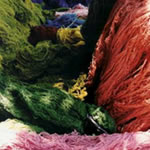
Angora Wool is an exceptionally soft, fine wool used for a silky handle and refined surface. They are often associated with prized “belly wool” qualities in trade usage. Finer wool typically allows cleaner drawing and a more luxurious feel, especially in certain Turkish workshop carpets.
See also: Wool • Pile • Oushak • Antique Rugs
Aniline Dyes
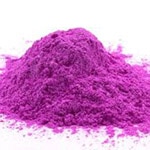
Aniline dyes are early synthetic dyes widely used in the late 19th and early 20th centuries. They’re often responsible for producing intense reds that can fade with light exposure. Dye type affects both beauty and long-term color behavior. Understanding aniline helps explain why some rugs mellow and others shift dramatically.
See also: Vegetable Dyes • Abrash • Colorfastness • Rug Making
Animal Motifs
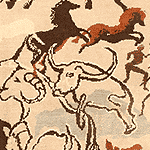
Animal motifs are representations of both real and mythical animals. They’re used across many weaving cultures, from stylized tribal figures to finely rendered courtly hunting scenes. Motif type can hint at region, period, and cultural meaning. In many traditions it’s also tied to protection, power, status, or storytelling.
See also: Hunting Scene • Dragon • Phoenix • Tribal • Rug Origins
Animal Pelt Motifs, Particularly Tiger Pelts
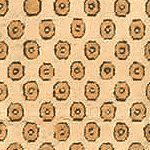
Animal pelt motifs, especially tiger pelts, appear notably in some Tibetan and Himalayan contexts. They can symbolize power, protections, and spiritual authority. Double headed forms may carry added symbolic meaning in certain traditions. These are often highly collectible pictorial motifs where imagery clarity and condition are critical.
See also: Tibetan Rugs • Pictorial Rugs • Symbolism • Antique Rugs
Antique

In rug trade language, “antique” typically refers to rugs at least 80 years old. Many dealers use the term “vintage” for rugs roughly 50-80 years old. Consequently, newer rugs fall under the “modern” category. Age alone doesn’t equal value, though. Authenticity, materials, origin, and condition matter just as much.
See also: Vintage • Patina • Restoration • Antique Rugs • Vintage Rugs
Arabatchi
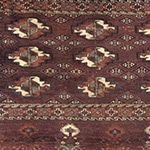
Arabatchi refers to one of the Turkoman tribal groups of Central Asia. Their earlier weavings are especially sought after for their distinctive design character. Attribution can affect rarity and value with dye behavior varying depending on when each piece was made.
See also: Turkoman • Gul • Synthetic Dyes • Rug Origins
Architectural Elements
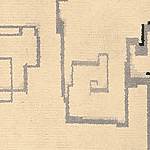
Architectural Elements refer to depictions of buildings or building characteristics. This includes columns, monuments, temples, ruins, or sacred structures. They’re often used as major designs or supporting motifs in a rug’s composition, especially within cultural contexts. They connect directly to religion, pilgrimage, imperial identity, or historical storytelling, important in both scholarship and collecting.
See also: Prayer Rugs • Pictorial Rugs • Cartouche • Persian Rugs
Art Deco
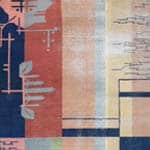
Art Deco rugs reflect early 20th century modern decorative arts often linked to the 1920s-30s and related movements. This style of design is characterized by bold geometry, stylized florals, and a painterly abstraction. Deco rugs can bridge classic rug craft with modern interiors beautifully. Because of this, they are some of the most design-forward collectible carpets.
See also: Modernism • Nichols • Donegal • Modern Rugs • Vintage Rugs
Ardabil Carpet
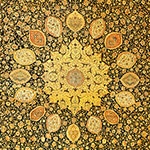
The Ardabil Carpets are a famed pair of Safavid era Persian carpets dated in the 16th century. They’re associated with the shrine of Sheikh Safi al-Din in Ardabil, celebrated for their medallion composition and refined floral field. The Ardabil design became a foundational reference point for Persian workshop aesthetics and later weaving traditions worldwide.
See also: Safavid • Medallion • Mosque Lamp • Spandrel • Persian Rugs • Antique Rugs
Jump To Letter:
A B C D E F G H I J K L M N O P Q R S T U V W X Y Z
Antique Rug Glossary Terms: B
Bakshaish
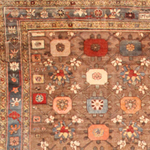
Bakshaish rugs are weavings from northwest Iran, near the Caucasus. They’re admired for their bold geometry, dynamic drawing, and an unusually modern, abstract feel. Bakshaish rugs often read as contemporary regardless of their actual age. This makes them great choices for collectors and designers who want a strong graphic presence.
See also: Heriz • Serapi • Caucasian Rugs • Geometric Design • Persian Rugs • Antique Rugs
Baluch
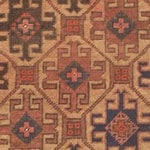
Baluch refers to nomadic weaving groups of mixed Persian and Turkic background spanning eastern Iran into western Afghanistan. Their rugs are known for rich colors, varied design conventions, and tribal characteristics. Baluch rugs can offer excellent “authentic tribal” value, especially when dyes and wool are strong and condition is honest.
See also: Turkoman • Tribal Rugs • Prayer Rug • Natural Dyes • Rug Origins
Berber Tattoo Motifs on Moroccan Rugs
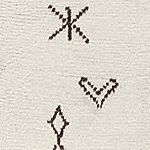
Berber tattoo motifs are symbols drawn from traditional Amazigh, or Berber, tattoo language. These symbols were adapted into Moroccan rug designs and passed down through generations of female weavers. Common forms include zigzags, triangles, crosses, stars, and checks. Each carry meaning such as protection, fertility, or protection against the evil eye. These motifs serve as a key “tell” of cultural identity and authenticity in many Moroccan tribal rugs.
See also: Moroccan Rugs • Geometric Design • Symbolism • Tribal Rugs
Beshir
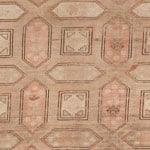
Beshir rugs are a subgroup of Ersari Turkoman weavings. Their designs are made up of a more refined patterning, influenced by Persian floral systems or Central Asian ikat textiles. Beshir sits at the intersection of tribal roots and workshop polish, useful for attribution and collecting.
See also: Ersari • Turkoman • Mina Khani • Ikat • Rug Origins
Bezalel
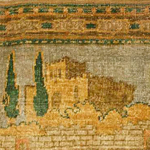
Bezalel rugs are workshop carpets associated with the Jerusalem Bezalel art school, woven by students and sold through the school. These pieces combine design intention with cultural storytelling, making them of high interest to collectors, pictorial weaving enthusiasts, and Judaica.
See also: Israeli Rugs • Pictorial Rugs • Cartouche • Inscriptions • Rug Origins
Bibikabad
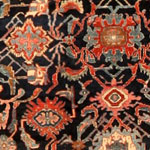
Bibikabad is a town in Iran’s Hamadan region known for its rug productions. Its carpets are related to Malayer weavings and commonly appear in allover Herati or boteh designs, sometimes with a medallion. Knowing Bibikabad helps you identify structure and design related to the Hamadan region, useful when shopping for Persian village rugs.
See also: Hamadan • Malayer • Herati • Boteh • Persian Rugs
Bijar
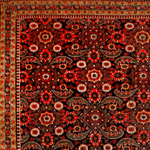
Bijar rugs, among the toughest Persian rugs in the trade, are famous for their exceptionally dense and durable weave. They’re originally from northwestern Iran and appear in both medallion and allover formats. Bijar rugs are the perfect choice for those seeking textiles with both beautiful Persian design and long-lasting structural integrity.
See also: Persian Knot • City Rugs • Medallion • Allover Pattern • Persian Rugs • Antique Rugs
Bokara
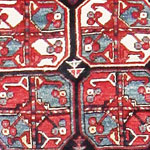
Bokara, sometimes spelled Bukhara, is a Central Asian caravan city. However in rug trade language, it isn’t a reference to a single Bokara origin. Instead the term is used loosely for various Turkoman-style rugs exported through that market. It’s a common labeling trap, and better attribution comes from the actual Turkoman pattern structure.
See also: Turkoman • Tekke • Ersari • Yomud • Rug Origins
Border
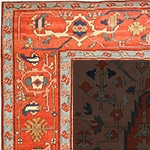
A rug border is the framing band (or bands) surrounding and enclosing the general composition. Borders can include a main border plus one or more minor borders known as “guards”. They often affect proportion, style, and dating clues as they’re often strongly regional or period specific.
See also: Field • Main Border • Guard Border • Cartouche • Rug Patterns
Boteh
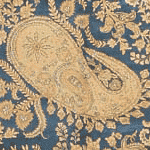
Boteh is a paisley shaped motif found across Persian, Caucasian, and Turkish weaving traditions. It can appear as a small repeating element or become the dominant allover pattern. They’re one of the most recognizable designs in rugs and are useful for identifying regional taste and pattern families.
See also: Paisley • Allover Pattern • Herati • Caucasian Rugs • Persian Rugs
Jump To Letter:
A B C D E F G H I J K L M N O P Q R S T U V W X Y Z
Antique Rug Glossary Terms: C
Cairene
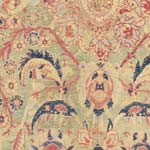
The term “Cairene” refers to Egypt’s capital city of Cairo. Cairene rugs emerged in the 16th century under Ottoman rule. Their designs are largely Persian influenced, with vines, palmettes, medallions, and subdued color palettes as common features. The Cairerne category can be a useful bridge between Ottoman and Persian designs.
See also: Ottoman • Medallion • Palmette • Arabesque • Rug Origins
Camels
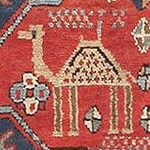
Camels within the context of rugs and textiles refer to stylized imagery meant to emulate the literal animal. They appear frequently in Central Asian and Middle Eastern textiles because of their essential role in trade and daily life. Animal motifs can signal region and cultural symbolism, especially in tribal and nomadic weaving. This is especially true of the camel, whose imagery was often treated as a blessing motif.
See also: Animal Motifs • Central Asia • Tribal Rugs • Symbolism • Rug Origins
Canakkale
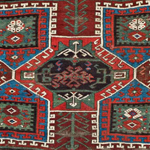
Canakkale is a northwestern Turkish town known for its rug production and sometimes grouped with Bergama production. These rugs can have soft apricot, blue, and ivory palettes paired with classically derived Anatolian design. Palette is often the giveaway, helpful when sorting specific northwest Anatolian rugs beyond the broad “Turkish” labeling.
See also: Bergama • Anatolian Rugs • Geometric Designs • Turkish Rugs
Carding
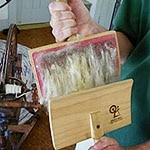
Carding is the term used to describe the process of cleaning and combing fibers. It’s an important step in fiber processing, removing debris and aligning strands so they can be spun into usable yarn. Better fiber prep typically means a stronger, more consistent yarn as well resulting in a better final weave.
See also: Spinning • Wool • Rug Making • Rug Making & Weaving
Carpet
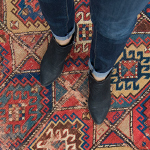
Carpet – A term of Armenian origin denoting any form of woven floor covering, but usually referring to knotted pile weavings of any size. Equivalent to the English term rug, Turkish “Hali,” Turkoman, “Khali,” and Farsi “Ghali.”
Cartoon
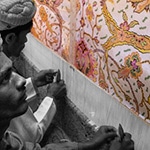
A cartoon is a weaving plan, usually a drawn diagram or sketch, used to guide weavers through a rug’s design. It’s a crucial component in the weaving process that ensures symmetry and precise repetition. Cartoons are a hallmark of organized workshop or city productions versus purely memory based village and nomadic weaves.
See also: City Rugs • Workshop Rugs • Knot Counting • Rug Making & Weaving
Cartouche
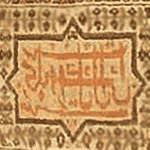
A cartouche is a framed panel used to contain inscriptions, verses, signatures or dates within a rug design. The panel is often rectangular with rounded ends and are common in formal workshop traditions.
See also: Inscriptions • Signature • Border • Ardabil Carpet • Persian Rugs
Central Asia
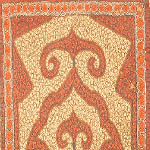
“Central Asia” is a large geographic umbrella term useful for regional attribution to several nomadic productions. Nomadic textiles are strongly associated with Turkoman peoples but also includes groups like the Kyrgyz, Uzbeks, and Karakalpaks. These textiles are not specific just to carpets, but embroideries and felt traditions as well. The broadness of the term is useful as a first category before refining attribution by tribe and structure.
See also: Turkoman • Tekke • Ersari • Felt • Rug Origins
Chinese
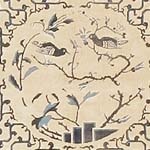
Chinese rugs are highly varied and often influenced by silk textile traditions. Designs are medallion based or allover, typically with more open space and frequent pictorial elements like trees, clouds, and animals. Chinese rugs often behave differently within an interior. They’re more atmospheric, with distinct design compositions from western Asian carpets.
See also: Pictorial Rug • Medallion • Clouds • Chinese Dragon • Rug Origins
Chinese Dragon
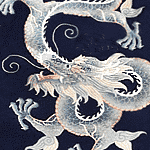
In Chinese symbolism, dragons represent a benevolent force linked to water or rain, expressing balance between earth and heaven. Claw count and color can indicate status, either imperial, nobility, or common. These symbolic details can help interpret imagery and sometimes hint at intended prestige or cultural context.
See also: Phoenix • Clouds • Chinese • Symbolism • Rug Patterns
Chintamani
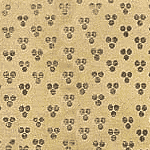
Chintamani is a Sanskrit motif depicted as a gem with the power to fulfill wishes. The symbol is commonly shown as three circles above wavy lines, which were later adopted into Ottoman design. It’s a highly recognizable motif that can instantly place a rug within certain stylistic lineages.
See also: Ottoman • Symbolism • Medallion • Turkish Rugs
Chodor
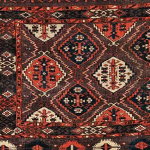
Chodor refers to one of the Turkoman weaving groups. Their designs are less common than the Tekke, Yomud, and Ersari, recognized by distinctive pattern and color tendencies. The rarity of Chodor textiles affect desirability and value within Turkoman collecting.
See also: Turkoman • Tekke • Yomud • Ersari • Rug Origins
Coat of Arms
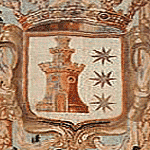
A coat of arms is a heraldic emblem used to identify a family, institution, or authority. In textiles it can appear as either a commemorative or prestige motif. Heraldic imagery often signals intended patronage or Western influence and helps identify historical context.
See also: Cartouche • Inscriptions • Pictorial Rug • Rug Patterns
Chrome Dyes
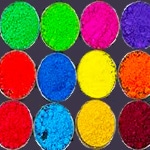
Chrome dyes are synthetic dyes that use chrome-based mordants, popularized after the 1920s. They’re stable and don’t fade easily, but have a harsh look to them that doesn’t mellow with age the way natural dyes do. Dye chemistry affects how a rug ages and chrome dyes tend to look “fixed” rather than gently patinated.
See also: Aniline Dyes • Vegetable Dyes • Abrash • Rug Making & Weaving
City Rugs
City rugs are produced in organized urban workshops rather than tribal, nomadic, or village productions. They typically use design plans known as cartoons, as well as standardized production methods. This includes knot counting systems, ensuring a level of organization and uniformity to their products.
See also: Cartoon • Workshop Rugs • Village Rugs • Nomadic Rugs • Persian Rugs
Cochineal
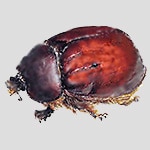
Cochineal is a versatile red dye produced from insects found in the American continents. Its hues can range from bluish reds through pink-magenta tones. Historically, its use spread widely after Spanish introduction from the “New World”. The introduction of cochineal into the wider textile market was a game changer. Understanding it helps interpret older palettes and dye behavior.
See also: Natural Dyes • Madder • Aniline Dyes • Rug Making & Weaving
Cotton
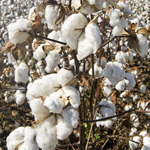
Cotton is a plant based fiber widely used in rug foundations depending on tradition and technique. Foundations made from cotton can indicate workshop organization and affect handle, durability, and structure.
See also: Warp • Weft • Foundation • Wool • Rug Making & Weaving
Cupid
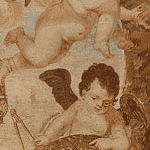
Cupid is a classical motif rooted in Greco-Roman mythology, commonly used as a symbol of romantic love. In later decorative arts, the cherub form can suggest innocence, leisure, or a heavenly theme. Cupid often signals Western decorative influence and can help place a piece stylistically.
See also: Pictorial Rug • Tapestry • European Rugs • Rug Origins
Cypress Tree
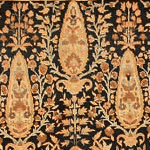
The cypress tree is a recurring motif in Asia Minor and Persian decorative arts. It’s often associated with the Tree of Life and ideas of eternity, appearing frequently in garden carpets. Cypress motifs can be a strong cultural cue, and the rendering style of naturalistic vs geometric can hint at region.
See also: Tree of Life • Garden Carpet • Persian Rugs • Anatolian Rugs
Jump To Letter:
A B C D E F G H I J K L M N O P Q R S T U V W X Y Z
Antique Rug Glossary Terms: D
Dagestan
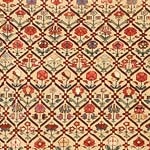
Within the context of rugs, Dagestan refers to a group of finely woven Caucasian rugs produced in the East Caucasus. They are characterized by repetitive, detailed patterns that span the entire surface of the textile. Dagestan rugs showcase intricate Caucasian design composition and fine weaving, appealing to regional carpet collectors.
See also: Shirvan • Kuba • Caucasian Rugs • Rug Origins
Dead Wool
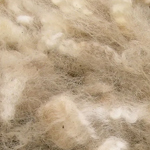
“Dead” wool refers to inferior wool fiber chemically stripped from hides, lacking natural luster and durability. Identifying dead wool is crucial to distinguishing low-quality, short-lived rugs from authentic, resilient handwoven pieces.
See also: Wool • Natural Wool • Rug Materials
Density Of Knots
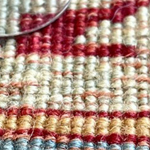
Density of knots is a measure of how many knots, wefts, and warps are packed into a given area. Higher counts indicate a finer, tighter weave. This is a key indicator of technical skill, clarity of design, and long-term durability in fine rugs.
See also: Knot Count • Finer Weaves • Rug Making
Depressed Warps
Depressed Warps are a weaving feature where alternate warp threads are pulled lower by tight wefts. This creates a ribbed or layered structure in the foundation. Depressed warps affect texture and can help identify specific regional techniques or workshop practices.
See also: Warp • Weft • Foundation • Rug Making
Design
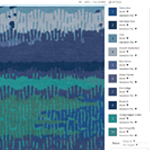
Design refers to the specific pattern arrangement of motifs, symmetry, and coloration that define a rug’s composition and visual character. It’s the essence of a rug’s artistic identity and guides aesthetic appeal, cultural meaning, and market classification.
See also: Pattern • Motif • Rug Patterns
Donegal
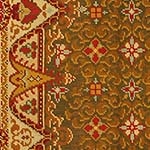
Donegal is a geographical term referring to a town in the northern part of the Republic of Ireland. Rugs produced in Donegal typically reflect an Arts & Crafts and later Art Nouveau sensibility. These pieces illustrate how Western art movements influenced rug making outside traditional Eastern weaving cultures.
See also: European Rugs • Arts & Crafts Rugs • Decorative Rugs
Drawing
Drawing is the rending of line and form in the woven design, from precise and mechanical to free and spontaneous. Evaluating drawing quality helps distinguish workshop precision from village spontaneity and folk characteristics.
See also: Motif Execution • Design Technique • Rug Patterns
Dyes
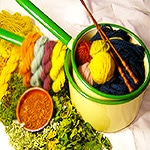
Dyes are substances used to color fibers, often requiring mordants or fixatives for permanence. They can be made synthetically or naturally, involving plants, insects, or other natural byproducts. Dye type influences color brilliance, aging behavior, and value. Because of this, natural dyes often command premium collector interest.
See also: Vegetable Dyes • Aniline Dyes • Chrome Dyes • Dye History
Jump To Letter:
A B C D E F G H I J K L M N O P Q R S T U V W X Y Z
Antique Rug Glossary Terms: E
Early Period
“Early Period” is a designation reserved for exceptionally old antique rugs, or anything considered pre-commercial. These rugs were produced before the early-19th century. Distinguishing early period rugs helps collectors understand rarity, technical evolution, and historical context beyond the broader label of antique.
See also: Antique • Semi-Antique • Vintage • Early Rugs
Eight Pointed Stars
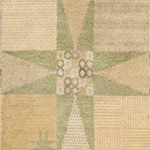
An eight pointed star is a geometric star motif commonly seen in Islamic art. It was first introduced in designs during the Middle Ages before becoming a staple pattern, appearing across multiple cultures. The motif carries symbolic and aesthetic significance, often relating to cosmological or spiritual themes in Islamic and cross-cultural art.
See also: Geometric Motifs • Symbolism in Rugs • Rug Patterns
Evil Eye
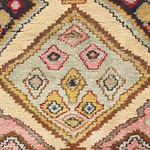
The evil eye is a very common protective symbol used in rug designs to ward off malevolent glances or curses. The evil eye motif appears frequently in West Asian and North African weaving traditions. Its roots date back to ancient times, carrying immense cultural significance, though it has since been commercialized in modern aesthetics.
See also: Protective Motifs • Symbolism in Rugs • African Rugs
Ersari
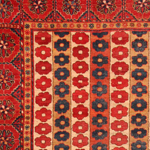
Ersari is a Turkoman tribe with weaving traditions known for bold, colorful carpets with robust tribal character. They’re vibrant palette and graphic strength are a key part of Central Asian tribal weaving heritage.
See also: Ersari Rugs • Tribal Rugs • Gul Motifs • Rug Origins
Jump To Letter:
A B C D E F G H I J K L M N O P Q R S T U V W X Y Z
Antique Rug Glossary Terms: F
Farahan
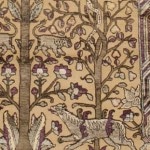
Farahan refers to rugs produced in the Arak region of Iran. Their designs share similarities with Heriz and Serapi rugs, though they exhibit more delicate scales and refined motifs. Farahan rugs combine tribal vigor with compositional elegance, making them prized classics in Persian weaving.
See also: Heriz • Serapi • Persian Rugs
Field
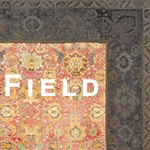
The “field” of a rug is the central surface area where the main design elements reside. The rug field is usually framed by at least one border and drives the visual impact of the design. Bold medallions, allover repetitions, or pictorial scenes are all foundational in identifying origin and stylistic classification.
See also: Border • Medallion • Allover • Rug Patterns
Folk Art Rugs
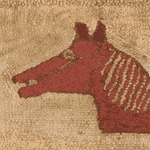
Folk art rugs are created primarily for utilitarian use but imbued with the artistic and cultural sensibilities of their makers. Their weavers are often self-taught or community artisans. They convey unfiltered cultural expression, practical intention, and an authenticity distinct from workshop or court productions.
See also: Tribal Rugs • Nomadic Rugs • Decorative Rugs
Fostat
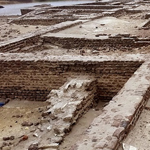
Fostat is a geographical term referring to an incredibly important archaeological site, offering historical insight into early weaving. Also known as “Old Cairo”, some of the earliest known Islamic carpet fragments were recovered there. Fostat fragments are historically significant, anchoring scholarship on the early development of Islamic rug making.
See also: Early Rugs • Rug History
Foundation
A rug’s foundation is the underlying structure consisting of warps and wefts that supports the knotted or woven surface. Foundation materials and technique directly affect the durability, flexibility, and character of a weave. They also inform origin and workshop methods.
See also: Warp • Weft • Knot • Rug Making
Fuchsine

Fuchsine is a bright, magenta-purple tone synthetic dye introduced from Europe in the 1860s. Despite its vibrant hue, it fades dramatically when exposed to light, sometimes into gray or even white. Understanding fuchsine’s fading behavior helps collectors and conservators date pieces and assess original color intent versus present palette.
See also: Aniline Dyes • Vegetable Dyes • Dye History
Jump To Letter:
A B C D E F G H I J K L M N O P Q R S T U V W X Y Z
Antique Rug Glossary Terms: G
Garden Design
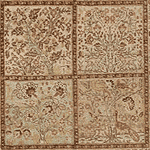
A garden design is a kind of rug composition depicting flora, fauna, and often a central fountain. These designs are inspired by Persian garden symbols of paradise. Garden designs embody cultural ideals of harmony and nature. They give great insight into how worldly aesthetics and philosophical themes influenced weaving traditions.
See also: Floral Rugs • Pictorial Rugs • Symbolism in Rugs • Rug Patterns
Geometric People
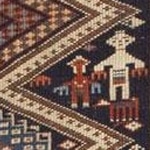
Geometric people are stylized human figures rendered in geometric form within a rug’s design field. These forms can reflect literal cultural narratives or symbolic representation, especially valuable in identifying tribal and nomadic weaving styles.
See also: Tribal Rugs • Symbolic Motifs • Figurative Rugs
Gol or Gul
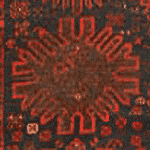
A gol is a medallion or rosette motif found across many weaving traditions, from Persian to Caucasian. It’s referred to as such because it’s also the Farsi word for “flower”. The gol is a foundational motif in many tribal and classical designs. It often carries symbolic meanings of celestial bodies or nature.
See also: Medallion • Floral Motifs • Rug Patterns
Golfarnag or Gulfarang
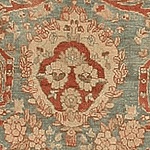
A “foreign flower” design influenced by French Savonnerie and Aubusson carpet floral designs. It was later adapted into Persian and Kurdish weaving. Golfarnag motifs are wonderful examples of cross-cultural exchange between European decorative arts and Oriental weaving traditions. They’re a key marker for dating and attributing certain antique rugs.
See also: Floral Design • Savonnerie Rugs • Aubusson Rugs • Rug Patterns
Jump To Letter:
A B C D E F G H I J K L M N O P Q R S T U V W X Y Z
Antique Rug Glossary Terms: H
Haji Jalili
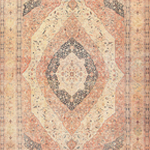
The Haji Jalili designation is one reserved for very high-grade Persian carpets produced in Tabriz during the late 19th century. They’re associated with a master weaver by the same name, though no signed examples are still in existence. Haji Jalili carpets are known among collectors for their superior craftsmanship and refined design.
See also: Tabriz Rugs • Persian Rugs
Hamadan
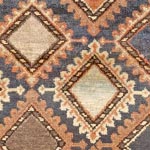
Hamadan is a town in Iran. Rugs produced here reflect influences from local tribal and Kurdish village weaving with varied design repertoires. Hamadan rugs are among the most exported and recognized Persian village rugs. They’re prized for their design variety and authentic regional character.
See also: Village Rugs • Tribal Rugs • Rug Origins
Heddle
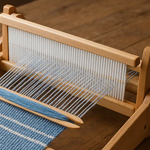
The heddle is a component of a loom that holds loops for alternate warp threads. This enables an easier control of warp separation and weave structure. Understanding the heddle reveals fundamental aspects of loom technology and weaving techniques that influence pile structure and weaving efficiency.
See also: Loom • Weaving Tools • Rug Making
Herati (Fish/Mahi)
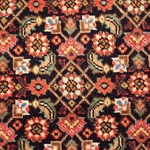
Herati refers to a repeating design motif featuring a rosette within a diamond flanked by curling leaves. It’s commonly called fish or mahi in rug terminology, given its flowy resemblance to the aquatic creature. The herati motif is a recurring field pattern in many Persian and Caucasian rugs. Its frequent appearance in rug design makes it a key visual identifier for style classification.
See also: Pattern Motifs • Medallion • Rug Patterns • Caucasian Rugs • Persian Rugs
Heriz
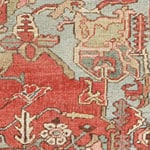
The term “heriz” is used specifically for rugs woven in northwest Iran with bold geometric medallions and a durable construction. Heriz rugs are highly collectible for their powerful scale, architectural design, and suitability for large interiors.
See also: Serapi • Persian Rugs
Holbein
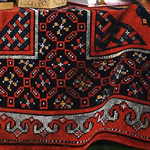
Holbein is a popularized name given to a geometric rug pattern depicted in Renaissance European paintings. The term is named after German painter Hans Holbein the Younger, who frequently used Anatolian weaves as artistic devices in his backgrounds. Holbein carpets document early East-West textile exchange and help date Anatolian and early Ottoman weaving traditions.
See also: Lotto • Geometric Rugs • Pictorial Rugs • Turkish Rugs
Hooked Rugs
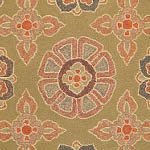
A hooked rug is a type of folk-art floor covering. They’re made by pulling strips of fabric or yarn through a foundation, creating a looped or cut pile surface. Hooked rugs represent a distinctly American and Canadian folk weaving tradition. They’re distinct in both construction and aesthetic when compared to hand-knotted Oriental rugs.
See also: Folk Art Rugs • Loop Pile • Decorative Rugs
Horizontal loom
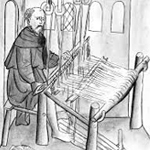
Horizontal looms are a kind of loom arranged parallel to the ground. Nomadic weavers were the ones typically working with them given their portability. Horizontal looms are characteristic of nomadic and tribal weaving, influencing scale, design spontaneity, and structural traits.
See also: Vertical Loom • Nomadic Rugs • Rug making
Hunters and Archers
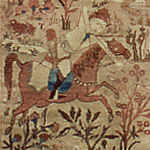
Hunters and archers are a common form of human figure depicted in pictorial rugs. They’re depicted in active pursuit, shown on horseback with weapons. These figures appear in historical contexts to convey narrative, royal imagery, and symbolic power, notably in Safavid-era carpets.
See also: Hunting Scene • Pictorial Rugs • Rug Patterns • Safavid Rugs
Hunting Scene
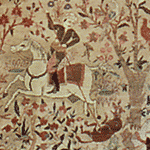
Hunting scenes are lively allover designs depicting hunts with riders, animals, trees, and landscape motifs, rooted in Persian royal imagery. They represent narrative complexity and historical artistry in rug weaving, often seen in workshop pieces from the Safavid period.
See also: Pictorial Rugs • Persian Rugs • Rug Patterns • Safavid Rugs
Jump To Letter:
A B C D E F G H I J K L M N O P Q R S T U V W X Y Z
Antique Rug Glossary Terms: I
Ilkahaid
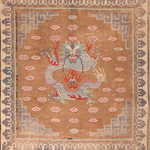
Ilkhaid was the name of the Mongol dynasty in power in Iraq and Persia in the late thirteenth century. No actual rugs of this period are known to survive but they’re depicted in various Islamic and Chinese paintings. The Ilkhaid period provides valuable historical context for early rug iconography and the spread of weaving traditions under Mongol rule.
See also: Safavid Rugs • Rug History • Mongolian Rugs
Ingrain
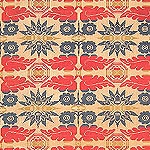
Ingrain are textiles with fibers dyed prior to weaving, allowing for reversible patterns. They were popularized in the 19th century and made both by loom and machine. Many were used as flatwoven decorative pieces. Ingrain rugs are distinct from traditional hand-knotted rugs and reflect industrial weaving influences of the 1800s.
See also: Kilim • Decorative Rugs • Industrialization • Natural Dyes
Irish
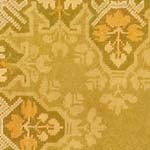
Irish is a geographic classification pertaining to rugs produced in Ireland and occasionally Scotland, especially during the Arts and Crafts movement. Notable examples were created by the Donegal company and evolved into Art Nouveau styles. Irish rugs represent European weaving traditions influenced by Celtic arts distinct from Oriental ones.
See also: Donegal • European Rugs • Decorative Rugs
Isfahan
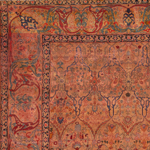
Isfahan was a premier Persian rug weaving center whose production dates back to at least the Safavid period. These rugs are known for classical designs, a refined palette, and precise technicality. Isfahan rugs exemplify high art in Persian carpet weaving, serving as a benchmark for classic aesthetics and collector recognition.
See also: Court Carpets • Persian Rugs
Islimi
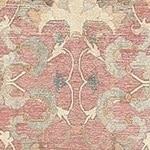
Islimi is a design pattern also known as the arabesque. It’s a floral based shape with spiraling vines and Shah Abbasi motifs, working to connect larger elements within its composition. Islimi motifs are foundational to classical Persian design conventions, contributing to compositional flow.
See also: Floral Scroll • Shah Abbasi • Rug Patterns • Persian Rugs
Jump To Letter:
A B C D E F G H I J K L M N O P Q R S T U V W X Y Z
Antique Rug Glossary Terms: J
Joshagan
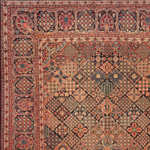
Joshagan is one of the oldest continuous rug-weaving centers in Persia. Its name is used to distinguish a regional style of antique Persian carpets. They’re known for their stylized geometric and floral ornament with lattice design. Joshagan rugs help establish geographic origin and historical continuity within Persian weaving traditions.
See also: Persian Rugs • Rug Origins • Vase Design Rugs
Judaic Motifs
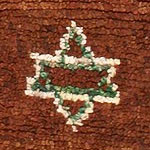
Judaic motifs are symbolic designs drawn from Jewish religious, cultural, or historical imagery, sometimes incorporated into rugs and textiles. The presence of Judaic motifs can indicate intended patronage, cultural context, or ceremonial use, adding historical significance.
See also: Pictorial Rugs • Judaica Rugs
Jufti Knot
A jufti knot is a knotting technique in which yarn is looped around four warp threads instead of two. This allows for faster production with fewer knots. Jufti knotting affects durability, density, and value. Additionally, it can be a key indicator when assessing quality, workmanship, and longevity.
See also: Knot Density • Weaving Techniques • Rug Making
Jump To Letter:
A B C D E F G H I J K L M N O P Q R S T U V W X Y Z
Antique Rug Glossary Terms: K
Karabagh
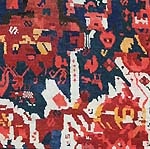
Karabagh refers to rugs produced in the Karabagh region of the Caucasus. These textiles are known for bold colors and large-scale geometric and floral designs. Karabagh rugs help identify Caucasian regional production, valued for their expressive designs and strong decorative presence.
See also: Kazak • Kuba • Caucasian Rugs
Karapinar
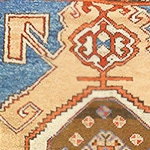
Karapinar is a weaving region in central Anatolia associated with village rugs featuring geometric motifs and earthy palettes. They provide insight into Anatolion village traditions, useful for distinguishing rural production from workshop carpets.
See also: Konya • Village Rugs • Turkish Rugs
Kashan
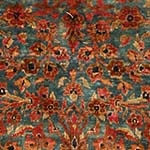
Kashan refers to a historic Persian city known for producing finely woven carpets with floral medallions and rich color palettes. They’re a benchmark for classical Persian workshop weaving and are widely collected for their refinement and craftsmanship.
See also: Kerman • Floral Rugs • Persian Rugs
Kazak
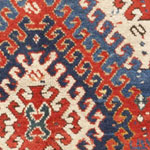
Kazak rugs are a far reaching tribal style originally from the southern Caucasus region. They’re characterized by bold geometric patterns, saturated colors, and robust construction. Kazak weavers were semi-nomadic, giving each piece a unique cultural context. They’re easily recognizable and highly decorative, important for both stylistic identification and market appeal.
See also: Caucasian Rugs • Tribal Rugs • Geometric Rugs
Kerman
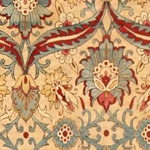
Kerman is a major Persian weaving center known for elegant floral designs, curvilinear patterns, and fine wool craftsmanship. They represent high-level Persian workshop production, significant for understanding late classical and commercial weaving.
See also: Kashan • Floral Rugs • Persian Rugs
Khorassan
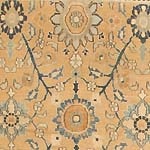
Khorassan is a large historical region in northeastern Persia associated with a variety of rug styles and tribal influences. They have very classical Persian ornamentation with confident spacing and border hierarchy. Identifying Khorassan rugs helps contextualize broad regional production rather than a single city or workshop origin.
See also: Tribal Rugs • Persian Rugs • Rug Origins
Khotan
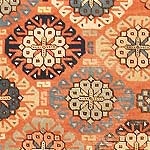
Khotan rugs originate from the Xinjian region of western China, known for their blend of Chinese, Central Asian, and Islamic designs. Their main design elements are generally Chinese, though common compositions of central or allover medallions relate more to western conventions. Their rich coloration is another indicator of this cross-cultural exchange, appearing mostly along the Silk Road.
See also: Silk Road • Chinese Rugs • Central Asian Rugs • Persian Rugs • Turkish Rugs
Kilim
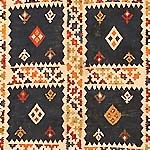
“Kilim” is a weave construction term pertaining exclusively to flatwoven textiles. This means there aren’t any piles, as they’re created using a weft-faced weaving technique. Kilims represent some of the oldest weaving traditions and are important for understanding non-pile textile construction.
See also: Flatweave • Rug Making • Tribal Rugs
Kirshehir
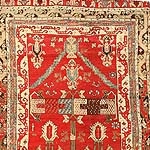
Kirshehir refers to rugs woven in central Anatolia, often featuring geometric patterns and traditional village aesthetics. Cultural context helps identify Anatolian regional styles distinct from nearby weaving centers.
See also: Konya • Village Rugs • Turkish Rugs
Kizilayak
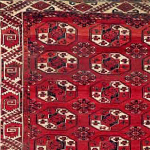
Kizilayak is one of the Central Asian Turkoman tribes known for their rug production. They share many similarities with Ersari weavings, though these tend to be finer with more precise drawings. Recognizing Kizilayak patterns helps attribute Caucasian rugs to specific stylistic subgroups.
See also: Kazak • Caucasian Rugs • Geometric Rugs
Knots
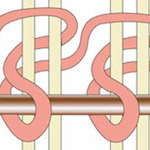
Knots are basic structural units used to create pile in knotted rugs, tied around warp threads during weaving. There are different types of knots, depending on cultural and regional backgrounds. Knot type and density directly affect durability, texture, and value. It’s worth noting that of all the pile pieces, only Spanish rugs consist of real tied knots.
See also: Jufti Knot • Turkish Knot • Persian Knot • Spanish Rugs
Knotted Pile Carpets
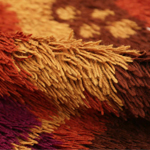
Knotted pile carpets are rugs constructed by tying individual knots onto warp threads, forming a raised surface. These threads are then sheared, determining the length of the carpet’s pile. This construction method defines most traditional rugs, as well as longevity and craftsmanship quality.
See also: Knots • Pile Rugs • Rug Making
Konya
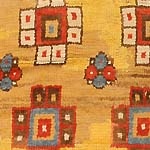
Konya refers to a historic Anatolian weaving region known for early geometric designs and strong tribal foundations. With vibrant color palettes and bold patterning, they tend to be rarer collectibles than Kazaks, their Caucasian counterparts. Konya rugs are important for tracing early Anatolian carpet traditions and Islamic design development.
See also: Karapinar • Kirshehir • Kazak Rugs • Turkish Rugs
Kuba
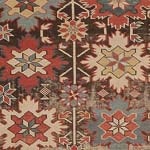
Kuba rugs come from the northeastern Caucasus, considered the finest of the region and known for their intricate geometric patterns. Their construction consists of a high knot density and tight weaving, giving them a ribbed structure. They favor delicate allover designs and are closely related to Shirvan and Dagestan rugs.
See also: Knot Density • Caucasian Rugs • Shirvan Rugs • Dagestan Rugs
Kufic
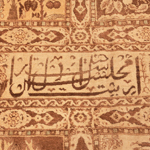
Kufic is a form of early angular Arabic calligraphy that appears as a decorative stylized script motif in rug borders. These written elements help date rugs and indicate early Islamic artistic influence, as kufic became a widespread feature in textiles. It makes an appearance in early Turkish carpets as well as later Caucasian ones.
See also: Turkish Rugs • Caucasian Rugs • Prayer Rugs
Kula
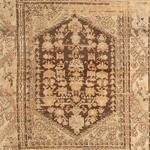
Kula is a western Turkish weaving region known for prayer rugs and restrained designs, soft palettes, and classic central medallions. They’re significant for understanding Ottoman-era aesthetic preferences and regional specialization.
See also: Prayer Rugs • Turkish Rugs • Rug Origins
Kurdish
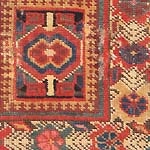
Kurdish rugs are woven by groups spanning across parts of Iran, Turkey, and the Caucasus. Their broad cultural reach makes them an eclectic collection of textiles with distinctly bold tribal designs. Kurdish rugs reflect tribal identity and regional diversity rather than centralized workshop production.
See also: Tribal Rugs • Persian Rugs • Turkish Rugs
Jump To Letter:
A B C D E F G H I J K L M N O P Q R S T U V W X Y Z
Antique Rug Glossary Terms: L
Lac
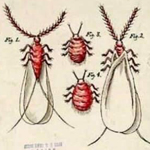
Lac is a natural red dye derived from the secretions of the lac insect, historically used in textile and rug dyeing. It was used widely in early Indian, Persian, and Turkish productions, though eventually displaced with cochineal dyes from the Americas. Lac dye helps explain color saturation and aging characteristics in antique rugs, and can aid in dating and attribution.
See also: Cochineal • Natural Dyes • Rug Making
Ladik
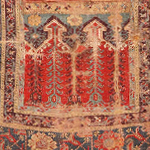
Ladik is a Central Turkish weaving region known for its prayer rugs, featuring designs common in religious architecture. This includes columnar designs, mihrabs, and stylized floral motifs. Ladik rugs are important examples of Ottoman-era Anatolian carpet design and religious textile use.
See also: Prayer rugs • Turkish Rugs • Religious Rugs
Loom
: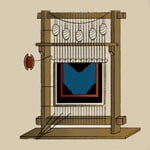 A loom is the frame contraption used to hold warp threads in place during the weaving of rugs and textiles. Rug looms vary in both scale and type, influencing rug size, structure, and weaving techniques. Determining the loom type used for a rug can help determine cultural context.
See also: Warp • Weft • Rug Making
Looped Pile
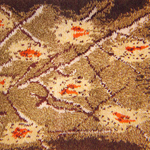
Looped pile refers to a weaving technique where yarn loops are left uncut, creating a textured, raised pattern. This construction method affects both appearance and durability, commonly seen in hooked and specialty rugs.
See also: Pile • Rug Making • Hooked Rugs
Lotto
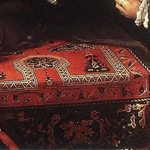
Lotto refers to a repeating geometric lattice design pattern often seen in early Anatolian rugs. Similarly to Holbein rugs, the term is derived from the name of Italian Renaissance painter Lorenzo Lotto. The pattern made frequent appearances in the background of his paintings. It was used as an artistic device symbolizing the wealth and status of patrons commissioning work. Lotto patterns help date and stylistically place rugs.
See also: Holbein • Rug Patterns • Turkish Rugs
Luri
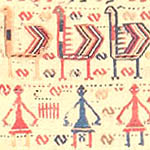
Luri refers to rugs woven by Lur tribal groups in western Persia, typically featuring bold geometric motifs and robust construction. Though rudimentary, their designs are decidedly pictorial, featuring stylized animal and human forms in allover patterns. Luri rugs reflect tribal weaving traditions and regional identity rather than urban workshop production.
See also: Tribal Rugs • Persian Rugs • Geometric Rugs
Jump To Letter:
A B C D E F G H I J K L M N O P Q R S T U V W X Y Z
Antique Rug Glossary Terms: M
Mahal Rugs
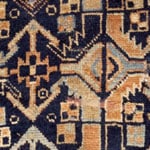
Mahal rugs are Persian carpets woven in the Sultanabad, now known as Arak, region. They are known for their large-scale designs of curvilinear vinescroll and soft, decorative palettes. Their compositions are based on classical Persian styles, though more stylized with robust drawing. Mahal rugs bridge village and workshop production and are prized for their versatility in Western interiors.
See also: Persian Rugs • Sultanabad Rugs • Rug Origins
Makri
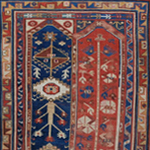
Makri refers to antique rugs originating in the southwest region of Turkey. They are characterized by an elongated hexagonal field and a vibrant color palette of red, blues, yellows, and ivory. Makri rugs represent localized Anatolian weaving traditions with distinct regional characteristics.
See also: Tribal Rugs • Turkish Rugs • Rug Origins
Malayer
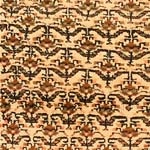
The term Malayer comes from the northwestern Iranian city, which was a major center for rug production. Malayer rugs were diverse in style, but typically featured dense, repeating geometric patterns with elongated formats. Their designs exist in a middle plane between workshop precision and rudimentary tribal patterns, valued for this balance among collectors today.
See also: Tribal Rugs • Persian Rugs • Geometric Rugs
Mamluk
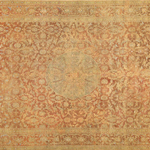
Mamluk rugs originated in Egypt and are known for complex geometric designs arranged around central medallions. They represent a distinct Islamic court tradition and are important to the history of early carpet design.
See also: Medallion • Geometric Rugs • Egyptian Rugs • Rug Origins
Medallion
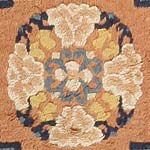
A medallion is a central ornamental motif used in rug design, often serving as the primary visual focus. Medallions exist across cultures, featured in nearly every style of carpet composition. Oftentimes, the medallion is complimented by four quartered medallions or corner pieces. Medallion layouts help identify design traditions and historical periods in rug weaving.
See also: Field Design • Medallion Rugs • Rug Patterns
Melas
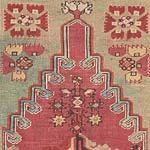
Melas is a southwestern Turkish weaving region known for its distinctive prayer rugs with stepped niches and rich colors. Designs often included abstract floral imagery and red features. Melas rugs are significant for their consistent regional identity and religious design traditions.
See also: Prayer Rugs • Turkish Rugs • Rug Origins
Memling Gul
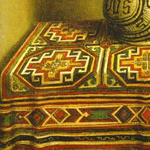
The memling gul is an octagonal geometric motif common in allover Turkish patterns. The motif is named after German painter Hans Memling, as the design makes frequent appearances in the background of his work. This motif helps date rugs and link them to early Ottoman and European artistic exchange.
See also: Lotto • Holbein • Turkish Rugs • Rug Patterns
Millefleurs
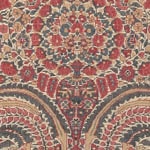
Millefleurs describe an intricate and repetitive floral design pattern featured across various weaving styles and cultures. Its name comes from French, meaning “thousand flowers”, and are common in textiles produced in ancient India. Millefleurs patterns indicate refined workshop production and high decorative intent.
See also: Floral Rugs • Indian Rugs • Millefleurs Rugs
Mohtashem
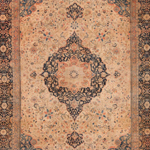
Mohtashem refers to high-quality Kashan rugs from the Mohtashem workshop, responsible for some of the finest Persian productions of the late 19th century. Their carpets are known for their superior materials and craftsmanship, with only two surviving inscribed carpets made from silk.
See also: Kashan • Workshop Carpets • Persian Rugs
Mongolian
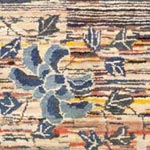
Mongolian rugs are those made in association with regions influenced by Mongolian culture and nomadic traditions. The Mongol rule was far-reaching but heavily influenced by Chinese design, making them an interesting blend of cultural design aesthetics. These textiles favor more minimalist compositions and neutral palettes. They reflect nomadic design principles and cross-cultural influences.
See also: Nomadic Rugs • Tribal Rugs • Central Asian Rugs • Chinese Rugs
Mordant
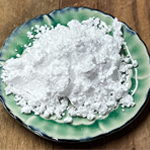
A mordant is a chemical additive used in dye processing to fix color to fibers. Mordants affect color longevity and tonal variation in antique rugs.
See also: Natural Dyes • Lac • Cochineal • Rug Making
Moroccan
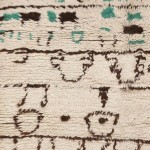
Moroccan rugs are those made in Morocco, often characterized by dynamic abstract designs and thick pile. The nomadic nature of several North African peoples makes this specific tribal style hard to pin down. Moroccan rugs represent North African weaving traditions and modern decorative appeal.
See also: Tribal Rugs • Berber Rugs • African Rugs
Mughal
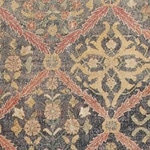
Mughal rugs are carpets produced during the Mughal empire in India, spanning the late 15th to early 18th century. They’re known for their refined floral designs, courtly aesthetics, and particular Safavid Persian influence. Mughal carpets are key to understanding Indo-Persian artistic exchange and imperial patronage.
See also: Indian Rugs • Mughal Rugs • Imperial Court Weaves • Persian Rugs
Jump To Letter:
A B C D E F G H I J K L M N O P Q R S T U V W X Y Z
Antique Rug Glossary Terms: N
Navajo rugs
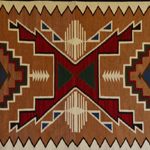
Navajo rugs are handwoven textiles produced by weavers of the Native American southwestern Navajo tribe. The construction is made traditionally, with natural vegetable dyes and wool, while the designs are geometric and tribal. Navajo rugs are central to Native American textile history and valued for their cultural authenticity and distinctive visual language.
See also: American Rugs • Tribal Rugs • Kilims
Needlepoint
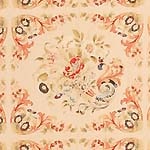
Needlepoint is a technique for textile construction done by stitching yarn through a canvas foundation rather than knotting or weaving. It’s done with a needle tool and was a popular method for embroidery weaving and tapestry making in Renaissance Europe. Needlepoint construction distinguishes decorative floor coverings from traditional knotted rugs, and affects durability and value.
See also: Embroidery and Tapestries • Needlepoint Rugs • Portuguese Needlepoint
New (Rug)
A “new” rug is one made within the last 30 years. Any construction older than that can be sorted into either the Modern, Vintage, Antique, or Early category.
See also: Modern Rugs • Vintage Rugs • Antique Rugs • Early Rugs
Ningxia
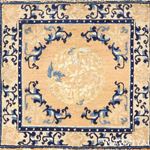
Ningxia rugs are those produced in the Ningxia region of China, often characterized by restrained palettes and traditional Chinese motifs. Understanding distinctions helps identify northern Chinese weaving traditions and regional stylistic differences. These are among the most collectible rugs made in China.
See also: Chinese Rugs • Rug Origins • Rug Patterns
Nomadic Rug
A nomadic rug is a textile woven by migratory or semi-migratory groups, typically using portable looms and traditional patterns. The term does not belong to one specific group or region of peoples, and is instead a broad contextual descriptor. Nomadic rugs reflect cultural identity, practical use, and regional symbolism rather than commercial workshop production.
See also: Tribal Rugs • Rug Origins
Northwest Persian
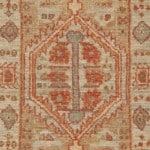
Northwestern Persian is a label used for rugs created in that region but cannot be more precisely allocated. These often feature bold geometry and tribal influence, as is common with other Persian constructions. This designation helps distinguish regional Persian styles from central and southern workshop traditions.
See also: Tribal Rugs • Caucasian Rugs • Persian Rugs • Rug Origins
Jump To Letter:
A B C D E F G H I J K L M N O P Q R S T U V W X Y Z
Antique Rug Glossary Terms: O
Oriental Rug
An Oriental Rug is any rug made in Asia. Purposefully broad, this term includes countless cultures, countries, and regions, while differentiating from European, African or American productions.
See also: Rug Origins • Chinese Rugs • Indian Rugs • Persian Rugs • Turkish Rugs
Ottoman
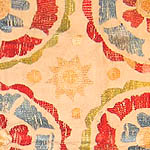
Ottoman refers to rugs and textiles produced within the Ottoman Empire, reflecting imperial, court, and regional Anatolian design traditions. The Ottoman Empire was vast and long-standing, and its categorization, though broad, offers important historical and cultural context.
See also: Turkish Rugs • Rug Origins
Ottoman Embroidery
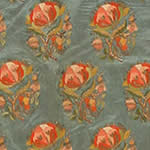
Ottoman embroidery is a distinct category given the nature of its textiles. Instead of a floor covering, this instead refers to decorative needlework produced during the Ottoman period. Embroideries were often made using materials such as silk, and metallic thread, creating stylized floral motifs. These embroideries illustrate courtly taste and influence later textile and rug designs.
See also: Textiles and Embroideries • Turkish Rugs • Rug Origins
Oushak (Ushak)
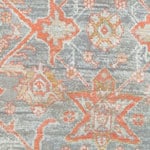
Oushak is a style of weaving originating from the western Turkish city of Uşak. Textiles produced here are known for their large-scale floral designs and soft, luminous color palettes. Oushak rugs are among the most influential Anatolian carpets, widely used in European interiors from the Renaissance onward.
See also: Turkish Rugs • Rug Origins
Jump To Letter:
A B C D E F G H I J K L M N O P Q R S T U V W X Y Z
Antique Rug Glossary Terms: P
Paramamluk
Paramamluk refers to rugs inspired by or derived from traditional Mamluk carpet designs, produced in later periods or different regions. This version of Mamluk rugs use smaller, more delicate patterns, featuring squares, hexagons, and octagons. Paramamluk rugs show the transmission and reinterpretation of historic Mamluk design systems beyond their original context.
See also: Mamluk • Egyptian Rugs • Geometric Rugs
Pashmina Wool
Pashmina wool is a fine fiber obtained from the undercoat of Himalayan goats, prized for its softness and warmth. The fiber is incredibly fine, about one sixth the width of a strand of human hair. Fiber quality affects texture, durability, and luxury perception in textiles and rugs.
See also: Wool • Rug Making
Pazyryk
Within the context of rugs, Pazyryk refers to an ancient knotted carpet discovered in Siberia. The textile dates back to the 5th century BCE and is the earliest known example of a knotted pile rug. It’s an essential point in the historical context of carpet weaving.
See also: Nomadic Rugs • Pile Rugs • Antique Rugs • Rug Origins
Peking
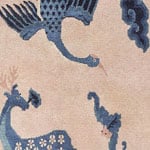
A Peking rug is a kind of Chinese weaving produced in or associated with Beijing. Of the antiques, Pekings are a newer style, introduced when carpet manufacturing moved from Ninghsia just after World War I. They often feature Chinese symbols and a restrained palette, as well as larger sizing, intended as Western decorative furnishings. Peking rugs help distinguish Chinese workshop production from regional or export-oriented carpets.
See also: Ninghsia • Chinese Rugs • Rug Origins
Persian Knot
The Persian knot is sometimes also known as the asymmetrical knot. It’s tied around one warp thread and looped under another. Knot type affects flexibility, fineness, and design detail in rugs.
See also: Knots • Knot Density • Turkish Knot • Persian Rugs • Rug Making
Pile
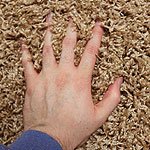
The pile of a rug is its raised surface, formed by cut or looped yarn ends. Pile height and density influence texture, durability, and appearance. Not every rug has a pile, though all rugs fall into either the “pile” category or the “kilim” (flatweave) category.
See also: Pile Rugs • Knots • Rug Making • Kilims
Pile or Knotted Carpets
A pile carpet is a rug with a raised surface created by knots, loops, or cut yarns. Pile construction defines most traditional rugs and affects wear and longevity. Whether or not a rug has a pile can add historical context, as piles were often a utilitarian feature used for warmth.
See also: Pile • Knots • Rug Making
Plying
Plying is the process of twisting two or more yarn strands together to create stronger thread. This impacts strength, elasticity, and overall rug durability.
See also: Spinning • Yarn • Rug Making
Polonaise
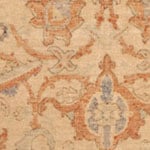
Polonaise rugs were luxurious silk carpets made with metal thread highlights during Persia’s Safavid period. The name is derived from the large number of rugs exported to Polish noble families. They’re known for their soft colors and fine details, made to adorn the interiors of the wealthy. Polonaise carpets represent elite court production and international trade in luxury textiles.
See also: Persian Rugs • Silk Rugs • Safavid • Silk & Metallic Threading Rugs
Prayer Rugs
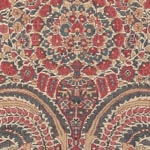
Prayer rugs are carpets designed specifically for the purpose of Islamic prayer. These textiles are designed with a niche motif indicating the direction of prayer. Prayer rugs reflect religious practice and are key to identifying functional and symbolic design elements.
See also: Mihrab • Turkish Rugs • Rug Patterns
Jump To Letter:
A B C D E F G H I J K L M N O P Q R S T U V W X Y Z
Antique Rug Glossary Terms: Q
Qajar
Qajar refers to rugs and textiles produced in Persian during the Qajar dynasty between 1789-1925. Rugs from this era often feature pictorial and floral designs. The Qajars fostered a cultural revival that encouraged traditional crafts like rug production, making this an important historical point. Qajar-period rugs help date Persian carpets and reflect changing tastes influenced by European art and photography.
See also: Pictorial Rugs • Persian Rugs • Rug Origins
Qashqai
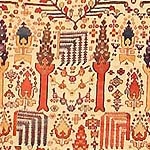
Qashqai refers to rugs woven by the Qashqai nomadic tribes of southern Persia, known for geometric motifs and rich colors. These textiles embody nomadic weaving traditions and strong tribal identity.
See also: Tribal Rugs • Persian Rugs • RUg Origins
Quatrefoil
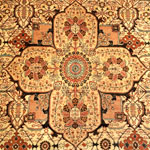
A quatrefoil is a decorative motif formed by four lobes or petals arranged symmetrically to form a medallion. It is a common Islamic ornamental textile design that appears across many rug traditions.
See also: Medallions • Geometric Rugs • Rug Patterns
Jump To Letter:
A B C D E F G H I J K L M N O P Q R S T U V W X Y Z
Antique Rug Glossary Terms: R
Re-piling
Re-piling is a restorative process in which missing or damaged or worn pile is replaced with new yarn. This portion-by-portion recreation of a rug’s surface affects condition, value, and authenticity assessments. Any record of re-piling must be disclosed in evaluations.
See also: Restoration • Pile • Rug Making
Rollakan
A rollakan rug is a kind of traditional Scandinavian flatweave known for its durability, geometric patterns, and muted palette. Rollakans were originally part of a bride’s dowry but were repopularized in the 1920s by Swedish designer Märta Måås-Fjetterström.
See also: Scandinavian Rugs • Kilims • Swedish Rugs
Rya
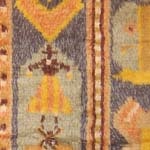
Rya refers to a kind of traditional utilitarian Scandinavian rug. They were characterized by long, shaggy piles and were used for warmth and insulation during the Nordic winters. Rya rugs illustrate functional textile design and regional European weaving traditions.
See also: Pile • Scandinavian Rugs • European Rugs
Jump To Letter:
A B C D E F G H I J K L M N O P Q R S T U V W X Y Z
Antique Rug Glossary Terms: S
S-spun
S-spun is a spinning technique where the yarn is twisted in a clockwise direction. This movement resembles the central stroke of the letter “S”, thus deeming it the “s-spun” technique. Spin direction affects texture and can help identify regional weaving practices.
See also: Z-Spun • Spinning • Yarn • Rug Making
Safavid
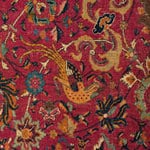
The Safavid dynasty was in power for centuries in Persia, cementing itself as a major production center for carpet production. Safavid rugs were known for their sophisticated designs and courtly production. They represent the golden age of Persian carpet weaving and influenced the style of rug design across cultures.
See also: Polonaise • Persian Rugs • Rug Origins
Salor
Salor rugs are those woven by the Salor Turkmen tribes of Central Asia. Featuring large, bold gul motifs, Salor rugs are among the most prestigious and collectible Turkmen weaves.
See also: Central Asian Rugs • Gull Motifs • Tribal Rugs
Saph
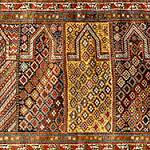
Saph rugs are a sub-category of Islamic prayer rugs intended for several people to use simultaneously. They’re distinguishable by a complex formatting that includes multiple niche motifs. Their religious utilitarian purpose offers context into the cultural background of these rugs.
See also: Prayer Rugs • Rug Patterns
Sarouk
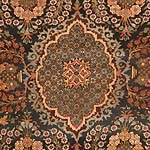
Sarouk rugs are textiles woven in the Arak region, known for their dense construction and rich floral designs. They’re known for their deep, hand-painted reds and are among one of the first mass-produced rugs.
See also: Floral Rugs • Persian Rugs • Rug Origins
Saryk
Saryk rugs are woven by Saryk Turkemen tribes such as the Tekke, Yomud, and Ersari peoples. Characterized by repeating gul motifs in deep red tones, they help distinguish Turkemen tribal subgroups and stylistic variations.
See also: Gul Motifs • Tribal Rugs • Rug Origins
Savonnerie
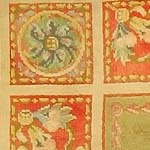
Savonnerie rugs are French weavings produced in the 17th century specifically to decorate royal and aristocratic interiors. The name comes from the French word for “soap”, as the rug manufacturing took place in an abandoned soap factory. Savonnerie carpets mark the emergence of European court carpet production.
See also: Aubusson • European Carpets • Court Carpets
Scandinavian
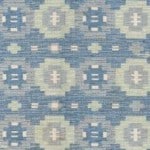
A Scandinavian rug is one produced in the Scandinavian region of Northern Europe. This includes the countries of Sweden, Denmark, Norway, and Finland. Their textiles are often minimalistic and functional, meant to withstand the frigid winters of the surrounding environment. Scandinavian rugs reflect modernist aesthetics and regional textile traditions.
See also: Rya Rugs • Kilims • Minimalist Rugs • Rug Origins
Seljuk
Suljuk rugs were weavings made during the reign of the Seljuk Empire in early Anatolia. They’re a foundational design style for Central Asian rug design, with bold geometric designs that influenced several centuries of styles.
See also: Konya • Early Rugs • Turkish Rugs
Selvedge
The selvedge of a rug is the finished edge formed by wrapping weft yarns around the outer warps. Selvedge construction affects durability and helps identify weaving techniques.
See also: Warp • Weft • Rug Making
Semi-antique
When a rug is described as “semi-antique” it’s a way to further categorize its production age. Semi-antique rugs are weavings with signs of aging but aren’t old enough to be fully antique, usually made between 1920-1970. This classification helps with dating, valuation, and market positioning.
See also: Antique Rugs • Vintage Rugs
Senneh
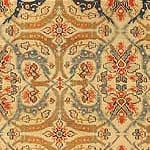
Senneh rugs are from the northwestern Kurdish Persian city of Sanandaj. They’re widely recognized as some of the finest carpets ever woven and considered works of art. Senneh rugs are admired for their precision and refined craftsmanship, as well as their intricate repeating patterns.
See also: Kurdish • Persian Rugs • Rug Origins
Spinning
Spinning is the process of twisting fibers from materials such as wool into yarn suitable for weaving or knotting. This process can be achieved both by hand or mechanically, but always with the help of the spinning wheel tool. Spinning quality affects strength, texture, and longevity of rugs.
See also: Wool • Loom • Rug Making
Jump To Letter:
A B C D E F G H I J K L M N O P Q R S T U V W X Y Z
Antique Rug Glossary Terms: T
Tabriz
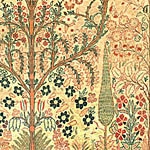
Tabriz is a city in western Persia known for fine craftsmanship and diverse design styles. Rugs produced here are central to Persian carpet history, widely used as reference points for quality and design. Additionally, Tabriz is still an active weaving center today, responsible for many modern constructions.
See also: Persian Rugs • Rug Origins
Talish
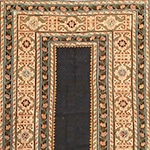
“Talish” refers to a Caucasian region along the Caspian coast. Rugs made here are typically long and narrow, with medium pile, monochromatic design, and highly decorative borders. Talish rugs help identify northern Persian and Caucasian weaving influences.
See also: Caucasian Rugs • Persian Rugs • Geometric Rugs
Tapestry
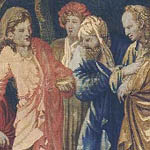
A tapestry is a flatwoven textile created by weaving designs directly into fabric. They’re strictly decorative pieces, meant as wall hangings rather than floor use, making their designs elaborate and often pictorial. Tapestries illustrate narrative and decorative textile traditions distinct from pile carpets.
See also: Wall Hangings • Textiles & Embroideries • Belgium Flemish Tapestries
Tehran
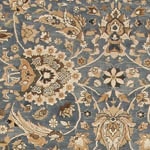
Tehran is the capital city of Iran, a historic Persian hub for urban workshop rug production and later commercial weaving. Rugs from here are typically from the late 19th century and onward. Many of the finer, more artistic rugs coming out of modern day Iran are made in Tehran. They help contextualize modern and late-period Persian carpet production.
See also: Persian Rugs • Rug Origins
Tekke
The Tekke people make up one of the leading rug producing Turkemen tribes in Central Asia. They’re characterized by repeating gul motifs and deep red palettes. Tekke rugs are among the most recognizable and collectible Turkmen rugs
See also: Gul Motifs • Tribal Rugs • Central Asian Rugs
Tibetan
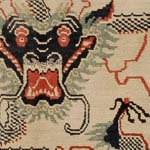
Tibetan rugs are weavings made in Tibet or Tibetan cultural regions, often featuring thick pile and symbolic motifs. Their designs are largely influenced by Chinese culture and artistic conventions, with dragons and cloud-bands making frequent appearances. Many Buddhist elements and tiger motifs make them uniquely Tibetan though, along with richer color palettes. Tibetan rugs represent distinct Himalayan weaving traditions and religious symbolism.
See also: Central Asian Rugs • Rug Patterns • Chinese Rugs • Rug Origins
Timuri
Timuri rugs are a sub-group of antique weavings produced by the nomadic Baluch tribes of Central Asia. Often derived from classical Persian styles, Timuri rugs are precise and complex. They reflect early Central Asian design systems and historical influence.
See also: Early Carpets • Central Asian Rugs • Baluch Rugs
Timurid
Timurid textiles were produced during the Turco-Mongol Timurid Empire, encompassing much of Central Asia, including modern-day Iran, Afghanistan, and Iraq. The Timurids were great patrons of the arts, producing weaves with refined ornamentation and architectural motifs. Timurid design influenced later Persian and Central Asian carpet transitions.
See also: Central Asian Rugs • Persian Rugs • Rug Origins
Tribal Rug
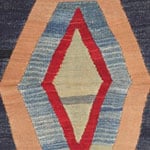
A tribal rug is woven by nomadic or semi-nomadic groups using established cultural traditional patterns and design. Made with portable looms, tribal rugs are often smaller in size. Tribal rugs preserve cultural identity and non-commercial weaving traditions.
See also: Early Rugs • Rug Origins
Turkish Rug Knot
The Turkish rug knot, also known as the symmetrical knot or the Ghiordes knot, is tied evenly around two warp threads. Knot type affects durability, structure, and regional attribution.
See also: Knot • Persian Knot • Rug Making
Jump To Letter:
A B C D E F G H I J K L M N O P Q R S T U V W X Y Z
Antique Rug Glossary Terms: U
Ukrainian
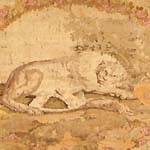
Ukrainian textiles are those produced in or associated with Ukraine, often reflecting Eastern European folk traditions. Similar to French Savonnerie productions, these are pile carpets with designs stemming from Rococo and Neo-classical styles. Ukrainian textiles help contextualize regional European weaving traditions and cultural influence.
See also: European Rugs • Pile Rugs • Rug Origins
Uzbek
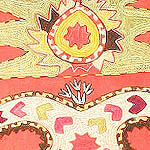
Uzbek rugs originate in Central Asia with most productions coming out of Tashkent. They often feature vibrant colors and geometric patterns, using a blend of materials. Most textiles were made with silk woven onto a linen back. Uzbek textiles represent Central Asian nomadic and village weaving traditions.
See also: Central Asian Rugs • Tribal Rugs • Embroideries & Textiles • Rug Origins
Jump To Letter:
A B C D E F G H I J K L M N O P Q R S T U V W X Y Z
Antique Rug Glossary Terms: V
Vertical Rug Loom
A vertical rug loom is an upright weaving frame that allows for the production of larger and more complex rugs. Vertical looms are typical of urban and weaving productions, and influence size capability and weaving technique.
See also: Loom • Rug Making
Village Rug
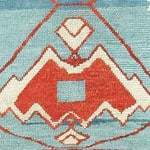
A village rug is produced in a settled rural community, blending traditional patterns with small-scale production methods. Village rugs tend to be made as part of a domestic family operation for local consumption rather than commercial export. These weavings sit between tribal and workshop carpets in terms of design and refinement.
See also: Tribal Rugs • Rug Making • Rug Origins
Vintage
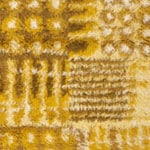
When a rug is labeled as “vintage”, it’s a chronological placement between antique and modern. Vintage rugs are typically produced between the mid-20th century and recent decades and show signs of aging. The vintage category helps with dating, valuation, and market classification.
See also: Antique Rugs • Semi-Antique Rugs • Modern Rugs
Jump To Letter:
A B C D E F G H I J K L M N O P Q R S T U V W X Y Z
Antique Rug Glossary Terms: W
Wagireh / Samplers
Wagireh, or samplers, are small reference textiles used as templates by weavers to test designs and color combinations. They’re typically used for the fundamental portions of larger carpets, which weavers can later expand upon. These sampler pieces provide insight into design, planning, workshop practice, and pattern transmission.
See also: Rug Patterns • Rug Making
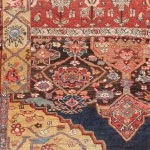
Rug Warps
The rug warp is the longitudinal foundation of threading stretched on a loom, around which knots or wefts are worked. Warp material and tension are foundational weave elements, affecting strength, structure, and longevity.
See also: Weft • Loom • Rug Making
Weft Faced Tapestry
A weft faced tapestry is a weaving technique in which weft threads dominate the surface, concealing the warp. This technique distinguishes flatwoven textiles from pile carpets.
See also: Tapestry • Kilim • Rug Making
Carpet Wefts
The carpet weft is the horizontal threading passed over and under warp threads to secure knots and form rug structure. Weft count and material influence flexibility, thickness, and durability.
See also: Warp • Loom • Rug Making
Wilton Rugs
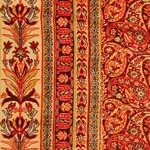
Wilton rugs are machine-made carpets produced using the Wilton weaving process, originating in England. They represent early industrial carpet manufacturing and differ structurally from handmade rugs.
See also: Machine-Made Rugs • European Rugs • English Rugs
Wool
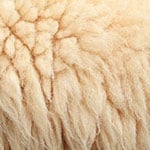
Wool is a natural fiber derived from thick animal coats. While it’s most commonly obtained from sheep, animals such as goats, camels, alpacas, and llamas also produce wool. It was a popular natural fiber for carpet making because of its resilience, softness, and warmth. Wool quality affects durability, texture, and dye absorption.
See also: Pashmina Wool • Rug Making • Natural Dyes
Jump To Letter:
A B C D E F G H I J K L M N O P Q R S T U V W X Y Z
Antique Rug Glossary Terms: X
Jump To Letter:
A B C D E F G H I J K L M N O P Q R S T U V W X Y Z
Antique Rug Glossary Terms: Y
Yarkand
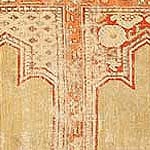
Yarkand rugs are produced in a region of western China, featuring tree-of-life and pomegranate designs. Despite its geographical proximity to China, Yarkand rug designs are much closer to Persian and West Turkestan styles. Their patterning often includes religious Islamic niches common in prayer rugs. They reflect Silk Road influences and help distinguish regional Chinese carpet traditions.
See also: Chinese Rugs • Persian Rugs • Central Asian Rugs
Yarn
Yarn is spun fiber used as the basic material for weaving and knotting rugs. The quality of yarn affects strength, texture, and longevity.
See also: Spinning • Plying • Wool • Rug Making
Yastiks
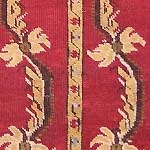
Yastik textiles are small Turkish weavings traditionally used as cushions covers. They illustrate functional weaving and small-scale Anatolian textiles. Their name is not region-specific, instead referencing a style that can appear in other weavings.
See also: Small Rugs • Turkish Rugs • Textiles & Embroideries
Yazd
Yazd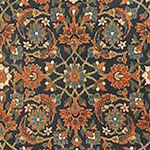 rugs are named after the Persian city they originate from. They’re characterized by finely woven construction, allover symmetrical patterns, and delicate floral designs with a rich color palette. Yazd rugs help distinguish central Persian urban weaving.
See also: Persian Rugs • Rug Origins
Yomud
Yomud rugs are named after a leading rug-producing Turkmen tribe in Central Asia. Their weavings have expressive designs, with a lot of pattern variation and repeating geometric motifs. Yomud rugs represent a major Turkmen tribal weaving tradition.
See also: Tribal Rugs • Central Asian Rugs • Geometric Rugs
Yuruk
Yuruk rugs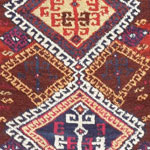 are produced in Eastern Anatolia by nomadic tribal groups. Their designs are influenced by western Oushak and Bergama styles, but utilize a darker color palette. Yuruk rugs preserve early Anatolian nomadic weaving traditions with bold and primitive designs.
See also: Oushak Rugs • Bergama Rugs • Turkish Rugs • Central Asian Rugs • Tribal Rugs
Jump To Letter:
A B C D E F G H I J K L M N O P Q R S T U V W X Y Z
Antique Rug Glossary Terms: Z
Z-Spun
Z-spun is a spinning technique where the yarn is twisted in a counter-clockwise direction. This movement resembles the central stroke of the letter “Z”, thus deeming it the “z-spun” technique. Spin direction affects texture and can help identify regional weaving practices.
See also: S-spun • Spinning • Yarn • Rug Making
Zakatala
Zakatala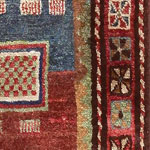 is a southern Caucasian region responsible for the production of many distinctive village weavings. This area has connections to a number of Caucasian regions, making their rug designs quite varied with different cultural influences. They’re known for their bold geometric designs featuring both allover and medallion compositions. Zakatala rugs help identify regional Caucasian weaving traditions.
See also: Kuba • Kazak • Caucasian Rugs
Jump To Letter:
A B C D E F G H I J K L M N O P Q R S T U V W X Y Z