
Characteristics of 19th Century Rugs
19th century rugs are authentic antique carpets woven in the 1800s, prized for natural-dye color, period craftsmanship, and region-specific design languages that still decorate beautifully today.
19th century rugs (the 1800s) are where antique collecting and real-world decorating overlap: natural-dye color, confident drawing, and regional character you can feel across the room. At Nazmiyal, we place these pieces in context—starting with the broader world of antique rugs, then zooming into major traditions like Persian rugs, and finally helping you browse by geography in our Rug Origins (Countries & Cities) hub.
Updated January 30, 2026 • Reviewed by Jason Nazmiyal
Quick Navigation
- Key Takeaways
- At-a-Glance Specs
- Popular Searches
- Featured 19th Century Rugs (Nazmiyal Collection)
- What Defines a 19th Century Rug?
- Style Snapshots by Region
- How to Shop 19th Century Rugs
- Care Notes
- 19th Century Rugs vs Vintage Rugs
- FAQ
- Nazmiyal White-Glove Service
Key Takeaways
- Decorator-friendly antiques: 19th century rugs often read “finished” in a room because their color and drawing have real depth.
- Regional variety: this century includes everything from village geometry to courtly floral refinement across Asia, Europe, and beyond.
- Shop smart: prioritize structure + condition first, then buy the best design and palette for your space.
At-a-Glance Specs
- Era: 1800s (19th century)
- Production map: Persia/Iran, the Caucasus, Anatolia, Central Asia, China, India, and European workshops
- Construction: primarily hand-knotted pile; some flatweaves (soumak, kilim, etc.) appear by region
- Materials: mostly wool (pile); foundations vary (wool/cotton/silk depending on region and type)
- Design range: medallion and allover florals, bold tribal geometry, lattice repeats, pictorial and “garden” concepts
- What to look for: crisp drawing, stable edges/ends, honest wear, and a palette that still “lights up” in natural daylight
Popular Searches
Large rugs | Oversized rugs | Floral rugs | Allover rugs | Medallion layouts | Shop by color | Rug size guide
Featured 19th Century Rugs (Nazmiyal Collection)
Three “anchor” examples designers love to compare: a bold Persian room rug, a long-format runner, and a decorative European carpet.
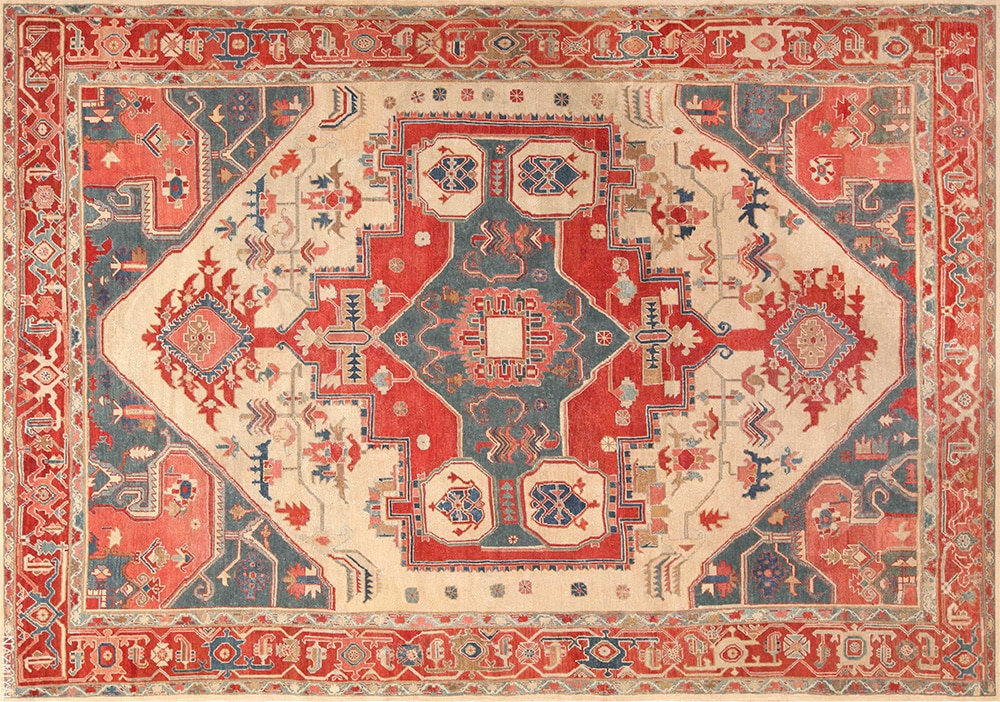
19th Century Persian Serapi Rug 72002— graphic geometry and warm, architectural color.
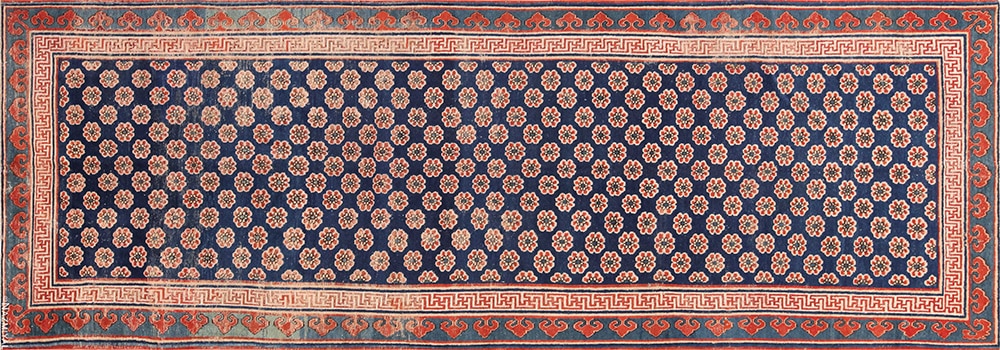
19th Century Chinese Kansu Runner Rug 72015— long-format elegance with strong visual rhythm.
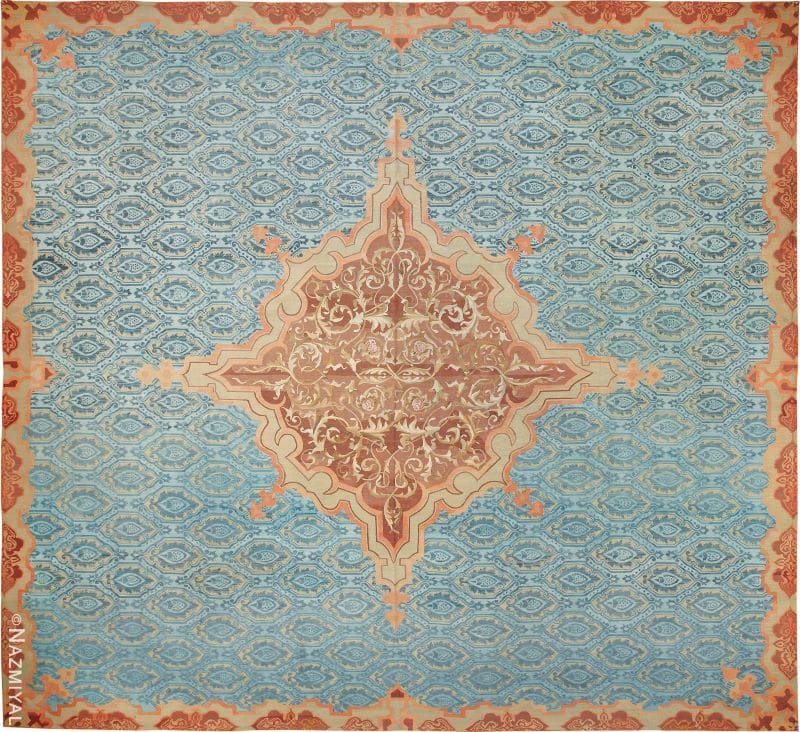
Mid-19th Century French Aubusson Carpet 49908— refined European decoration with classic border logic.
What Defines a 19th Century Rug?
“19th century” is a time label, not a single style—so the category is defined by period craftsmanship and regional identity.
In practical terms, you’re often looking for a combination of: confident drawing, coherent ornament, and color that feels layered rather than flat.
- Color depth: many 1800s palettes have a natural “glow” and tonal variation that reads beautifully in daylight.
- Design clarity: motifs and borders feel deliberate—even when the piece is folk or tribal.
- Material truth: wool quality, pile wear patterns, and foundation choices usually match the weaving tradition of the region.
- Condition realism: age-related wear is normal; structural weakness is not—shop for stability first.
Style Snapshots by Region
- Persia/Iran: wide range—from powerful tribal geometry to refined workshop florals and medallions.
- Caucasus: graphic geometry, strong symbols, and high-contrast color architecture.
- Anatolia: warm palettes and bold motifs, often with a direct, folk vitality.
- China: balanced compositions, elegant negative space, and distinctive border systems.
- India: workshop carpets that can feel classical, decorative, and room-scaling.
- Europe: decorative carpets (including tapestry traditions) with salon-style refinement.
How to Shop 19th Century Rugs (Checklist)
If you’re buying for a room (not just a rack), shop in this order: structure → scale → palette → design.
For a more “current” feel with the same collecting mindset, compare with vintage rugs and modern rugs, then finalize logistics with Worldwide Shipping.
- Measure first: confirm room and furniture footprints before you fall in love.
- Prioritize stability: secure edges/ends and a sound foundation matter more than cosmetic wear.
- Choose the “read” you want: bold geometry for architecture; florals for romance; restrained fields for calm.
- Expect honest age: repairs are normal in antiques—your goal is integrity and visual completeness.
Care Notes
- Use a rug pad to reduce abrasion and improve stability.
- Vacuum gently; avoid aggressive settings on fringe and fragile ends.
- Rotate periodically for even wear and balanced light exposure.
- For professional cleaning or restoration, use a specialist—especially with older natural-dye rugs.
19th Century Rugs vs Vintage Rugs
Both categories decorate beautifully, but they behave differently in a room. 19th century rugs often read more “antique” in color and texture,
while vintage rugs (typically 20th century) can feel slightly cleaner, lighter, or more modern depending on the piece.
| Feature | 19th Century Rugs | Vintage Rugs |
| Timeframe | 1800s | Typically 1900s |
| Color feel | Often deeper and more layered | Often cleaner, sometimes brighter or more “open” |
| Collecting profile | Earlier antiques; fewer surviving examples in top condition | Broader supply; quality varies widely by region and workshop |
| Best use | Statement rooms, collector interiors, heritage spaces | Everyday elegance, layered schemes, transitional rooms |
Closest Cousins
- Vintage Rugs
— the natural next step if you want period character with a slightly newer feel. - 17th Century Rugs & Carpets
— a deeper-collecting era where rarity and museum-level quality become central. - Early Rugs
— the broad “pre-1800” world for collectors focused on rarity and historic significance.
Glossary
Antique: generally older than “vintage,” typically associated with earlier production and patina.
Natural dyes: colorants derived from plant, insect, or mineral sources (varies by region and period).
Field / border: the central ground vs the framing system around it.
Medallion / allover: composition types—central focal design vs repeating pattern throughout.
Full A–Z: Rug Glossary
FAQ
Are 19th century rugs considered antique?
Yes. Rugs woven in the 1800s are antiques by any practical collecting definition.
What makes a 19th century rug different from a vintage rug?
The main difference is period: 19th century rugs are earlier antiques (1800s), while “vintage” typically refers to 20th century production. The look can also differ—older rugs often have deeper, more layered color and patina.
Are 19th century rugs good for everyday rooms?
Many are—if the structure is stable and the size is right. The smartest approach is to buy condition first, then decorate with confidence.
Do 19th century rugs hold value?
The best pieces can be stable long-term when design quality, condition, and provenance align. Value is evaluated rug by rug.
How should I care for a 19th century rug?
Use a rug pad, vacuum gently, rotate for even wear, and use a qualified professional for cleaning and repairs.
Nazmiyal White-Glove Service
We make it easy to shop with confidence—whether you’re choosing a single statement rug or curating a full room.
- Authenticity Guarantee
- 3-Day Return Policy
- Worldwide Shipping & International Home Approval
- Designer Trade Program
- White-Glove Delivery
Need help choosing the right scale, palette, or region? Contact us and we’ll guide you quickly and honestly.
Nazmiyal Collection has been a trusted source for antique rugs and vintage carpets for over 45 years. Our NYC gallery curates one-of-a-kind pieces with an emphasis on authenticity, provenance, and lasting decorative value.
Need help? Call us at (212) 545-8029 or visit our New York City showroom to work with a rug expert.