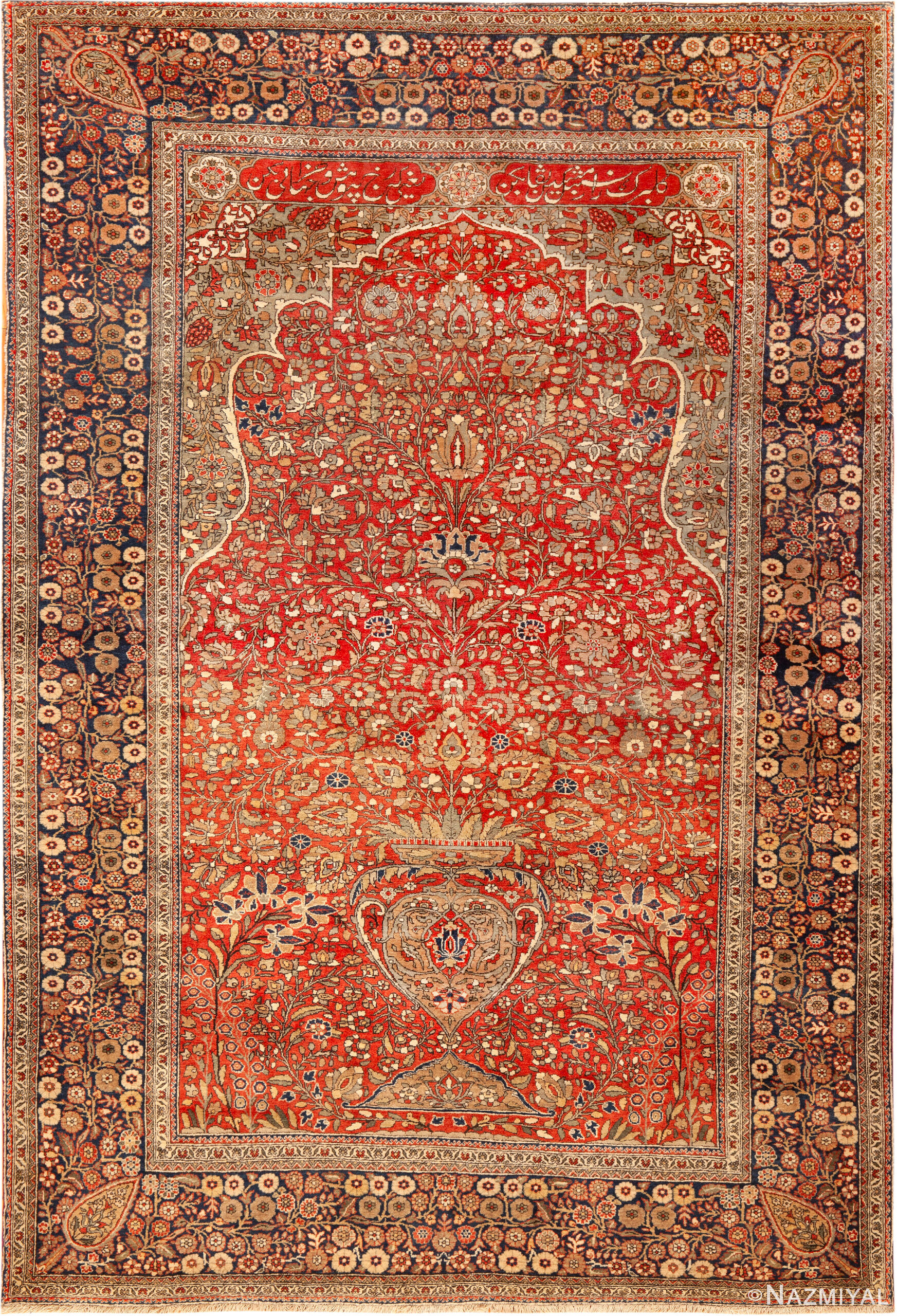
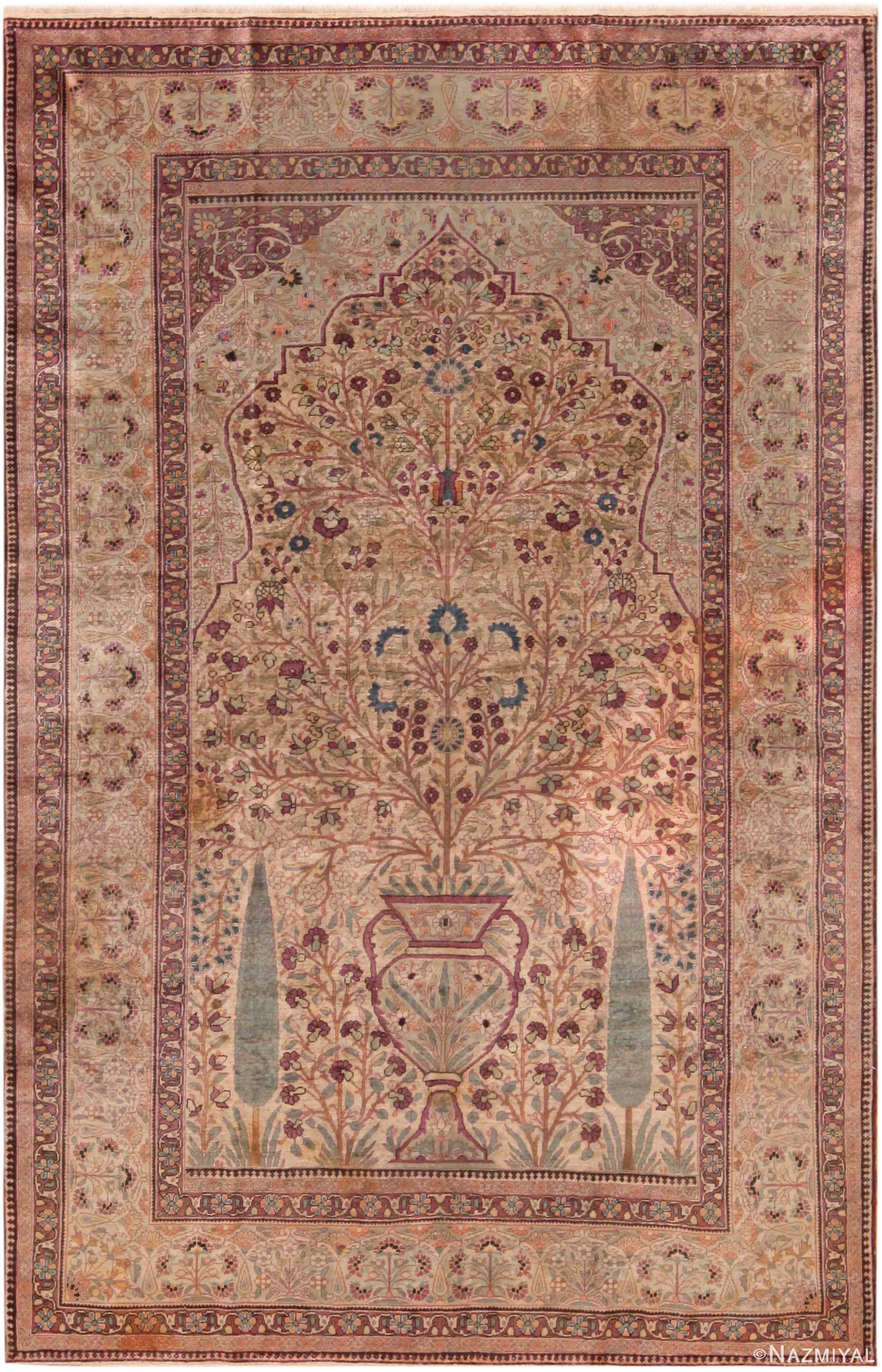
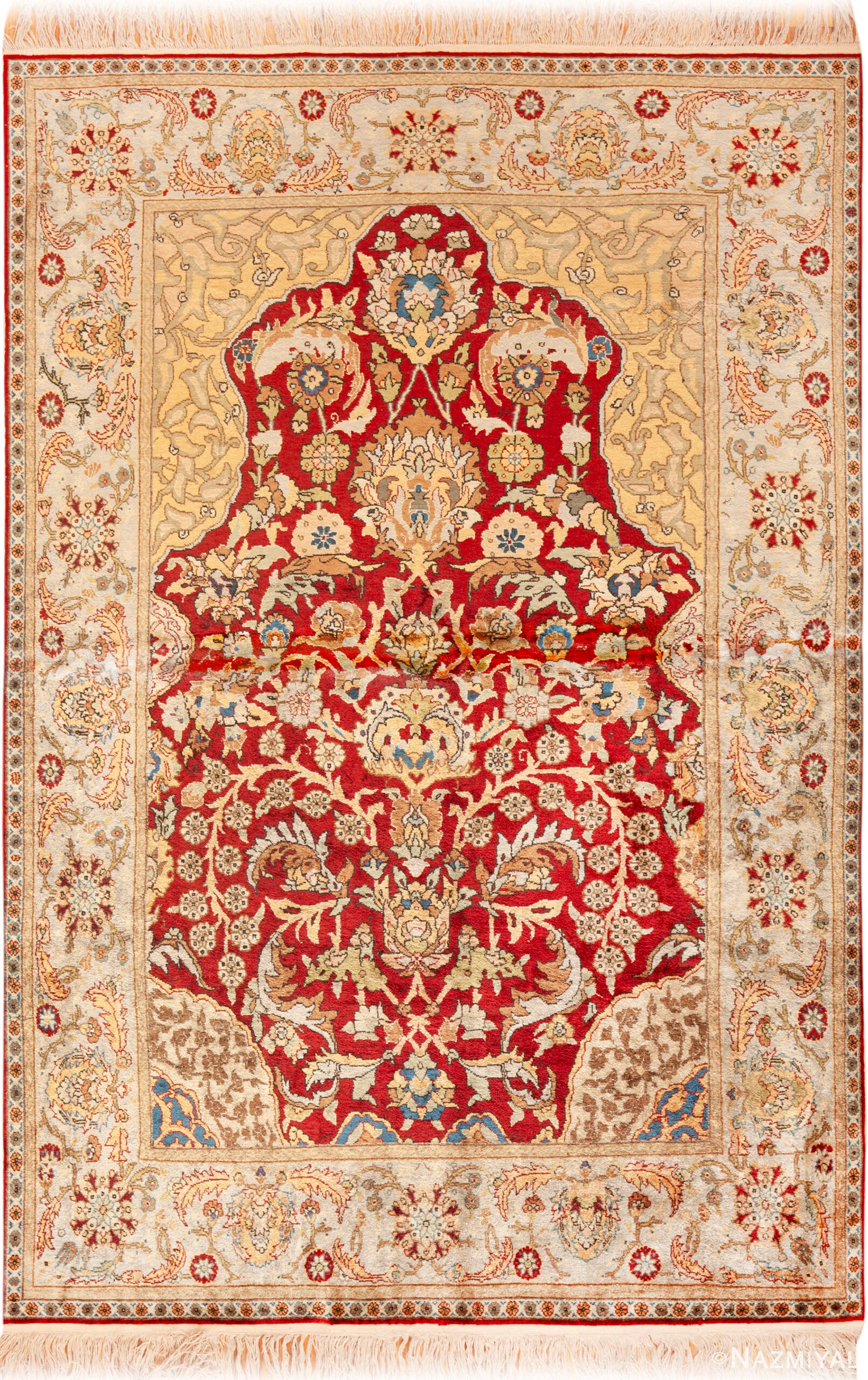
Antique Islamic and Muslim Prayer rugs represent a very special genre with the world of carpets. Technically any small carpet or rug can be used for the purpose of praying, so, by default, any small rug could be a prayer rug. Still, it seems that the prayer design rug as a specific type or genre emerged relatively early in the history of Islamic carpet design.
What is the proper name for a prayer rug in Arabic, Turkish, Urdu and Farsi?
The proper names for a prayer rug in various languages are as follows:
Arabic: سجادة الصلاة (Sajjādat al-Ṣalāh) or simply سجادة (Sajjāda)
Turkish: Namaz seccadesi
Urdu: جائمہ (Ja’ima) or نمازی جائمہ (Namazi Ja’ima)
Persian (Farsi): جاجیم (Jaajim) or جایمه نماز (Jaayemeh-e-Namaz)
These terms are used to refer to a prayer rug in the respective languages. Keep in mind that variations might exist in different dialects or regions.
What is so special about a Prayer rug?
Prayer rugs are special for several reasons, carrying cultural, religious, and artistic significance.
Here are some aspects that make prayer rugs unique and meaningful:
Religious Symbolism: Prayer rugs are primarily associated with Islamic culture and are used by Muslims during their daily prayers. The design of a prayer rug often includes a mihrab, an arch-shaped niche that indicates the direction of the Kaaba in Mecca, towards which Muslims pray. The mihrab serves as a symbolic gateway to the holy city.
Spiritual Connection: Prayer rugs are used as a designated and clean space for Muslims to perform their prayers. The act of laying out the rug and positioning oneself towards Mecca helps create a focused and sacred environment, enhancing the spiritual connection during prayer.
Cultural Tradition: The tradition of using prayer rugs has been passed down through generations in many Muslim-majority cultures. The rugs often reflect the artistic styles and design elements specific to the region, contributing to the rich tapestry of Islamic art and culture.
Artistic Expression: Prayer rugs are crafted with intricate and artistic designs. These designs may include geometric patterns, floral motifs, arabesques, and calligraphy. The combination of art and utility makes prayer rugs a unique form of artistic expression within the broader context of Islamic art.
Craftsmanship: Many prayer rugs are handmade with meticulous attention to detail. Skilled artisans often use traditional weaving and knotting techniques, contributing to the craftsmanship and quality of the rug. The use of high-quality materials, such as wool or silk, adds to their durability and texture.
Symbolic Elements: Beyond the mihrab, prayer rugs may feature other symbolic elements such as minarets, crescents, and verses from the Quran in intricate calligraphy. These symbols add layers of meaning and enhance the rug’s spiritual and cultural significance.
Personal Connection: Many Muslims develop a personal connection with their prayer rugs. The rug becomes a personal space for worship, and individuals may carry their prayer rugs with them when traveling to ensure a consistent and familiar environment for prayer.
Diversity of Styles: Prayer rugs come in a wide variety of styles, reflecting the diverse cultures within the Islamic world. Different regions and communities may have unique design traditions, resulting in prayer rugs with distinct patterns, colors, and motifs.
Tradition and Ritual: The use of prayer rugs is deeply rooted in Islamic tradition and ritual. The act of unrolling the rug, facing the designated direction, and engaging in the physical postures of prayer creates a structured and ritualistic practice that is central to Islamic worship.
The specialness of a prayer rug lies in its role as a religious and cultural artifact, a work of art, and a personal item that facilitates a spiritual connection during prayer. The combination of symbolism, craftsmanship, and tradition makes prayer rugs significant and cherished within the Islamic community.
How do people decorate with Prayer rugs?
Decorating with prayer rugs involves integrating these meaningful and often beautifully crafted pieces into a space while respecting their cultural and religious significance.
Here are some ideas for incorporating prayer rugs into interior decor:
Prayer Space Design:
Designate a Prayer Corner: Create a dedicated prayer corner or area in a room where the prayer rug can be the focal point. Position the rug in the direction of the qibla (Mecca) for proper orientation during prayers.
Use Symbolic Elements: Enhance the prayer space with other symbolic elements such as Islamic art, calligraphy, or religious texts. This can contribute to a spiritually uplifting environment.
Wall Hangings:
Frame and Hang: Consider framing a smaller prayer rug and hanging it on the wall as a piece of art. This allows the intricate designs to be showcased and adds a touch of cultural elegance to the room.
Create a Gallery Wall: If you have multiple prayer rugs or smaller pieces, create a gallery wall with framed rugs. Arrange them in an aesthetically pleasing manner to form a visually interesting display.
Layering and Contrast:
Layer with Other Rugs: In larger spaces, consider layering a prayer rug on top of a larger, solid-colored rug. This adds visual interest and allows the prayer rug to stand out.
Contrast with Modern Decor: Integrate prayer rugs into modern or contemporary settings to create a beautiful contrast between traditional and modern elements. The juxtaposition can be visually striking.
Furniture and Decor:
Pair with Complementary Colors: Choose furniture and decor items that complement the colors in the prayer rug. This helps tie the room together and creates a cohesive look.
Maintain Simplicity: If the prayer rug is intricate and vibrant, opt for simpler furniture and decor to avoid overwhelming the space. Let the rug be the focal point.
Functional Decor:
Use as a Tablecloth: For smaller prayer rugs, consider using them as tablecloths for coffee tables or dining tables. This adds a touch of cultural flair to the decor.
Drape over Furniture: Drape a prayer rug over the back of a chair or sofa to infuse the space with its unique design and cultural significance.
Ceremonial Occasions:
Display during Special Occasions: Unroll a prayer rug and display it prominently during special occasions or gatherings. This not only adds a decorative element but also emphasizes the cultural and religious aspects.
Educational Display:
Accompany with Information: If the prayer rug has specific cultural or historical significance, consider placing informational cards or books nearby to educate visitors about its origins and symbolism.
Incorporate Lighting:
Highlight with Lighting: Install focused lighting, such as spotlights or accent lights, to highlight the prayer rug and create a visually appealing display.
When decorating with prayer rugs, it’s important to approach the process with sensitivity and respect for their religious and cultural context. The goal is to integrate these special pieces into the decor in a way that enhances the overall ambiance of the space while acknowledging their significance in Islamic tradition.
What design element makes a rug specifically a prayer design rug?
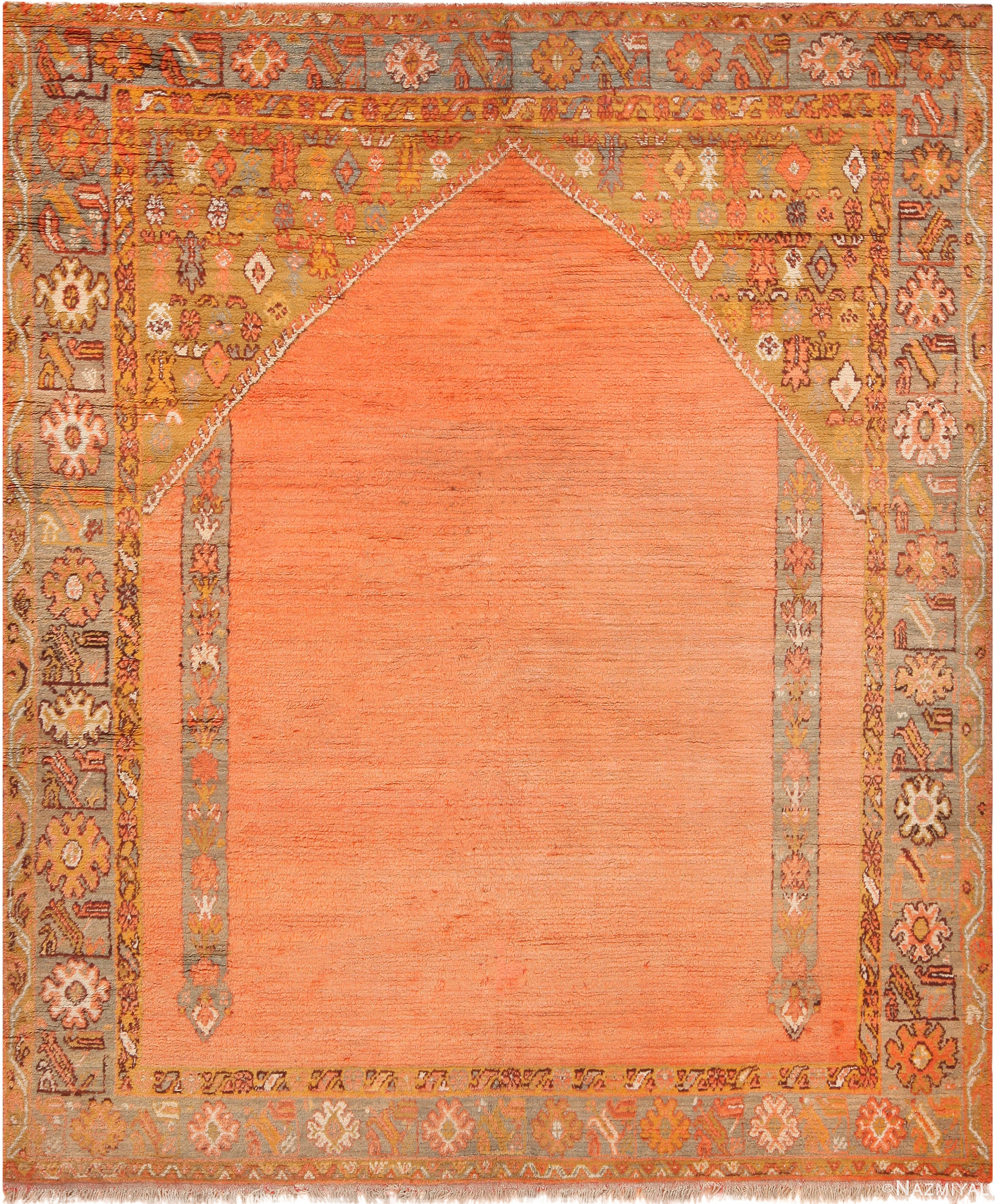
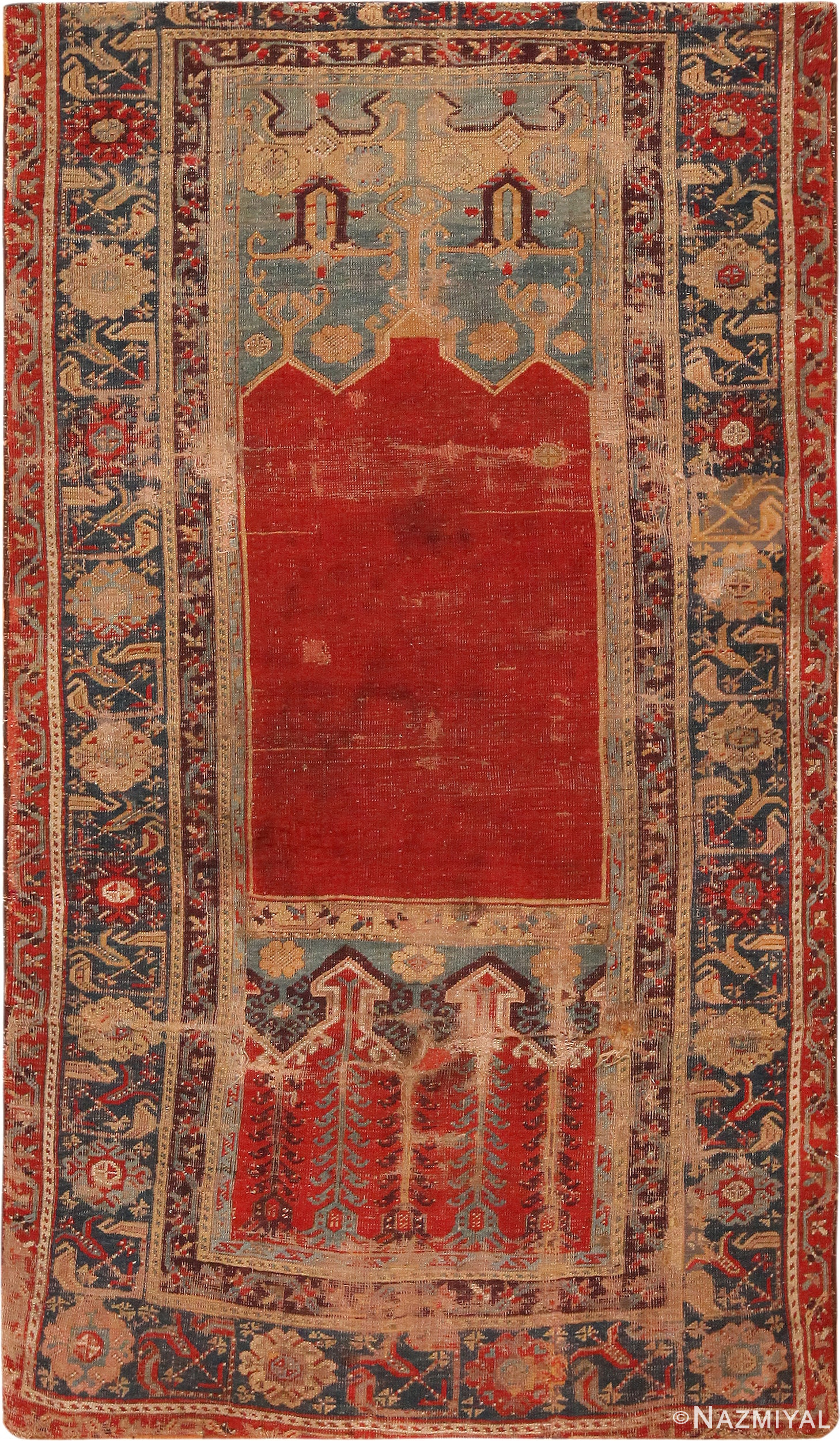
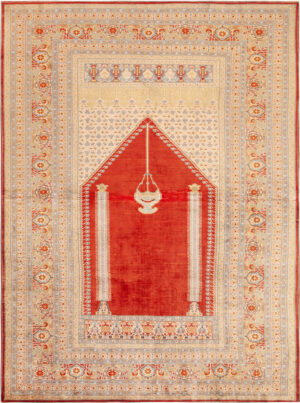
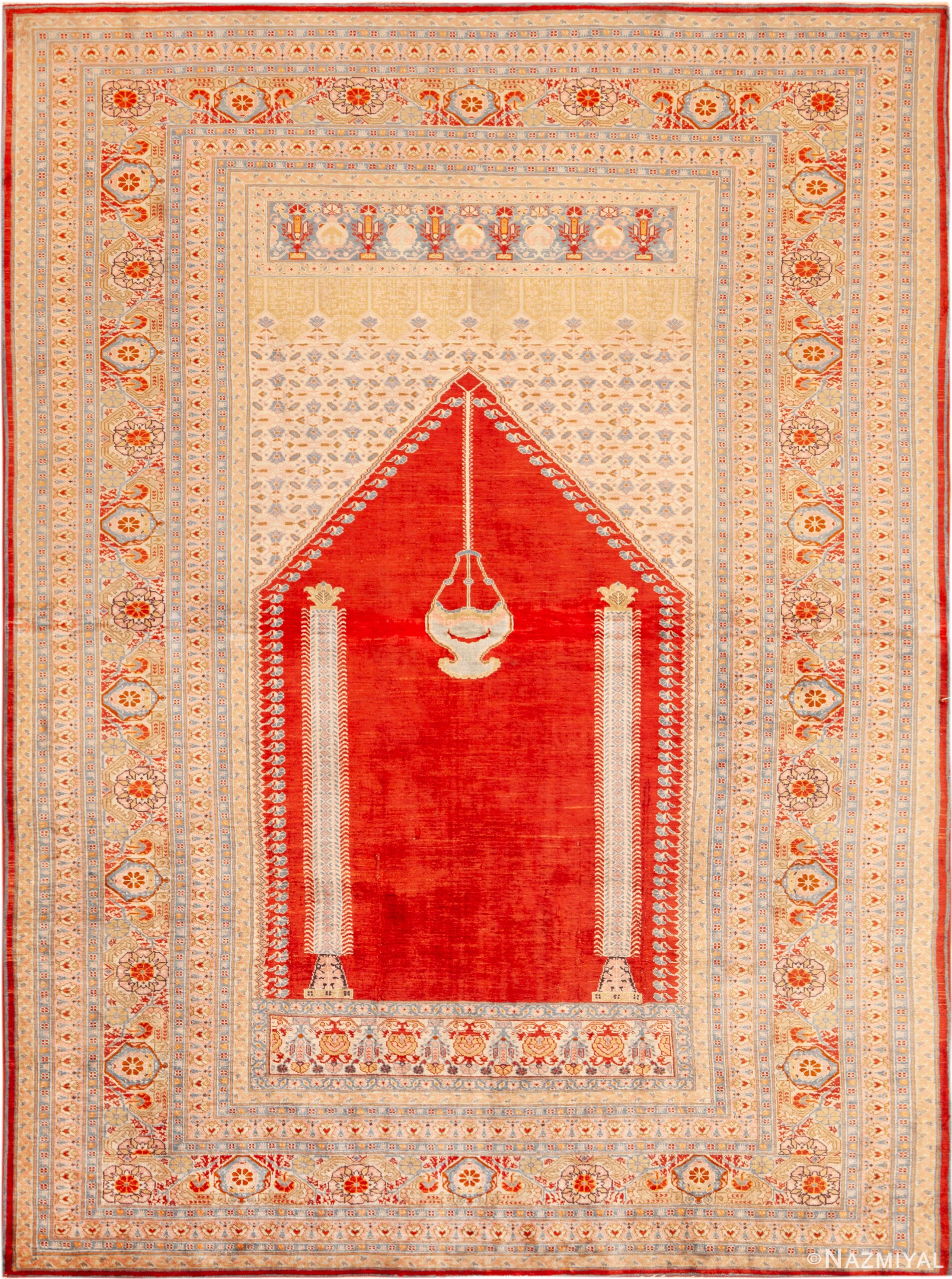
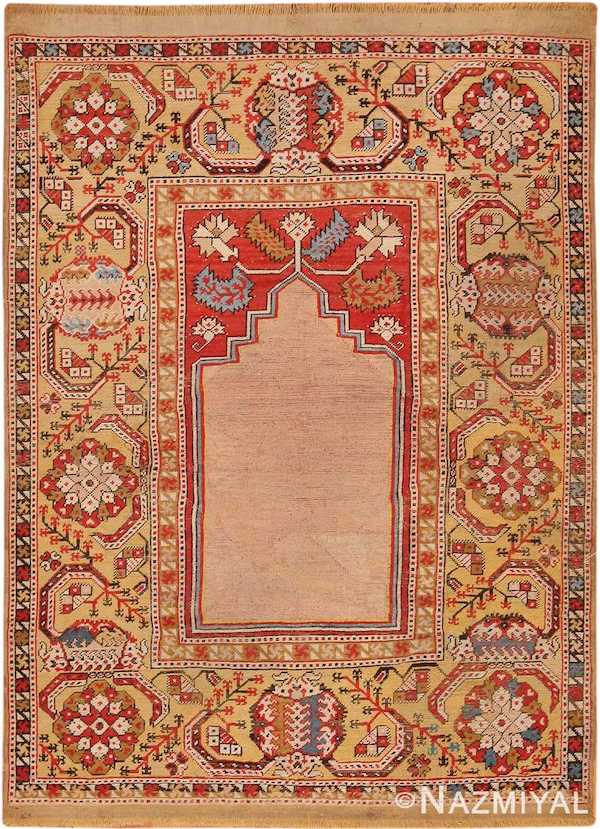
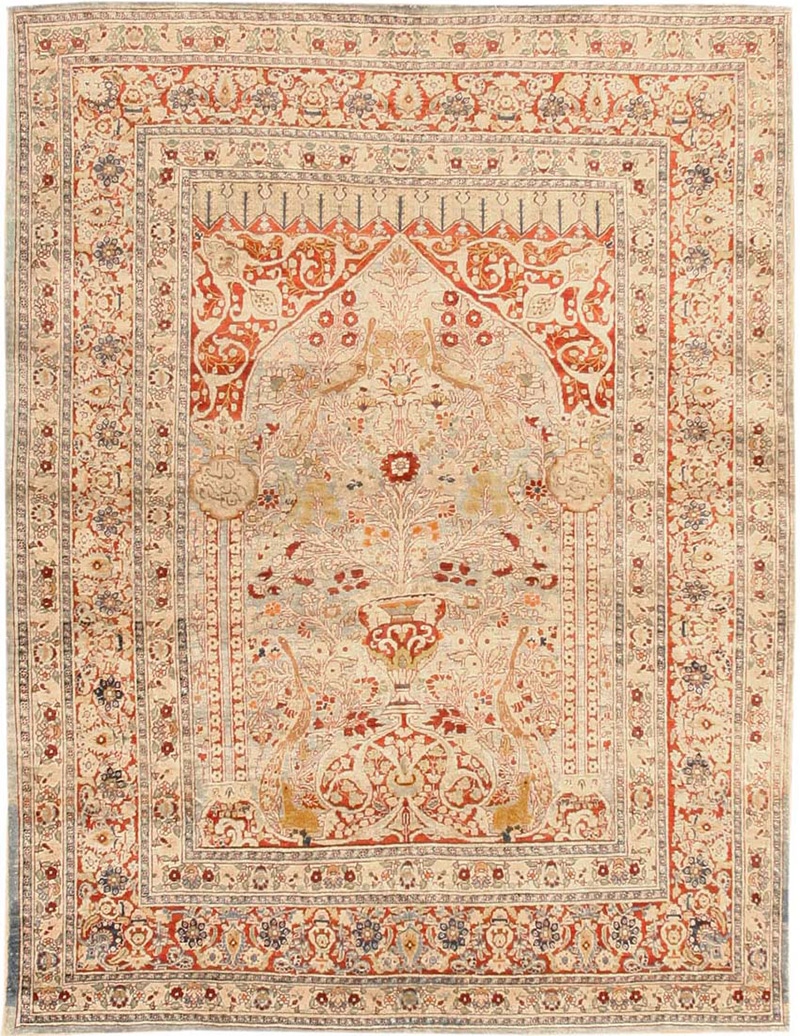
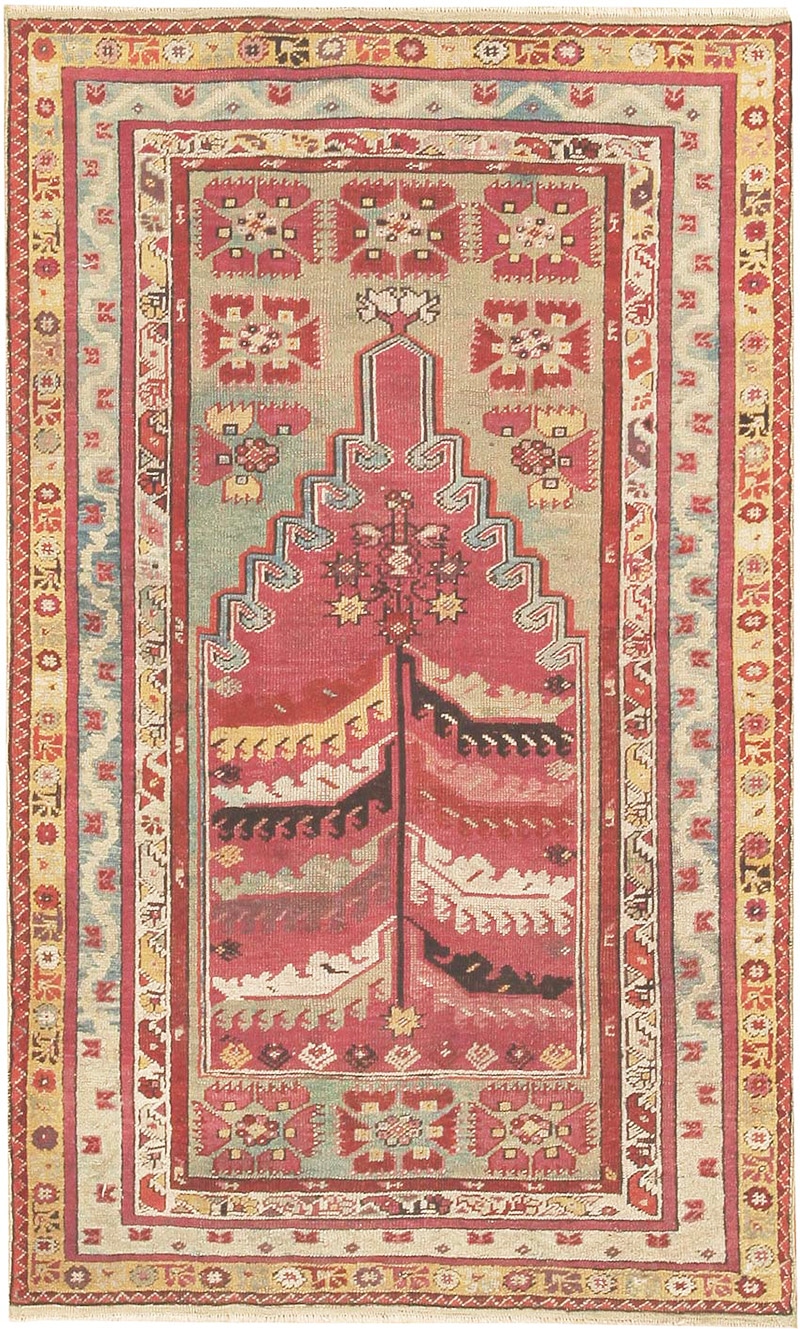
What distinguishes an antique prayer rug in terms of format is the use of an arched doorway, niche or “mihrab” design motif.
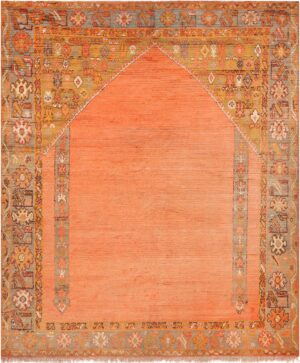
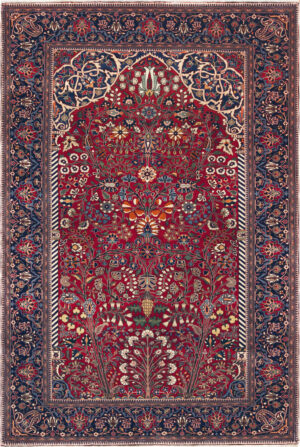
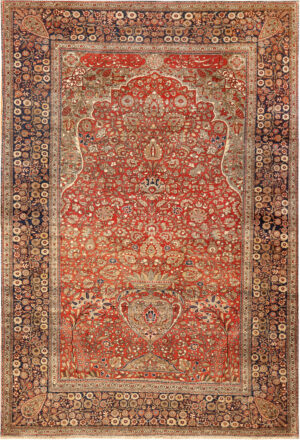
This mihrab replicates the “qibla “or niche in the main wall of a mosque, which enables the faithful to orient themselves toward Mecca when in engaged in prayer or “namaz.” Some mihrabs on payer rugs look overtly architectural like this silkTabriz prayer rug, with a pointed arch supported by columns to either side. Alternatively, they may simply approximate the shape of such an arched door, or the arch may become gable-like or stepped like this decorative geometric Turkish Milas prayer rug.
In time, the prayer rug became quite elaborate with additional panels above or below the mihrab, as well as several borders surrounding the whole composition.
What is a “Saph” prayer design rug?
Without a doubt, however, the most interesting and complex elaboration format of the antique prayer design rugs is the multiple-niche payer carpet or “Saph.”
At first glance Saphs look like runners, at least in terms of their long proportions. But unlike runners, where the design is longitudinal, emphasizing the length of the runner, Saphs are oriented toward the edges, rather than the ends. Their décor consists of niches running form one long edge to the other and placed side by side in serial repetition. Practically, they appear to function as a series of prayer design rugs connected side to side so that three or more people could simultaneously or communally pray.
The origin of this format is still not altogether clear. Some writers would see them as “family” prayer rugs, although there is no established format for family prayer in the Muslim world. Others would see them as serving the needs of a religious group or community of some kind, or simply as a means of facilitating group prayer. We simply do not know, but it seems likely that they were invented for use in mosques rather than at home.
Muslim Prayer Rug
Saphs are attested at least as early as the fifteenth century when they are depicted in the manuscript illumination of Timurid Persia. They appear to have been produced in all parts of the Muslim world where rugs were made – Persia, Turkey, Turkestan, and India, and the Caucasus. There are Ottoman Saphs, Mogul Saphs, and well as examples from nomadic Turkoman weaving and East Turkestan. They are even attested in the relatively humble or domestic genre of Anatolian kilims, which suggests that they were a well integrated cultural feature rather than something extraordinary.
Nevertheless, Saphs are not common. Their relative rarity makes them a highly desirable type for collectors.
The Antique Prayer Rugs: From Muslim Prayer to Islamic Art
Where are prayer rugs made?
In Islamic countries, prayer rugs are usually made locally and often named after the place of their origin. The patterns, motifs and colors may also vary from place to place. However, because of the image of the mihrab, each of these antique rugs is immediately recognizable as a prayer rug.
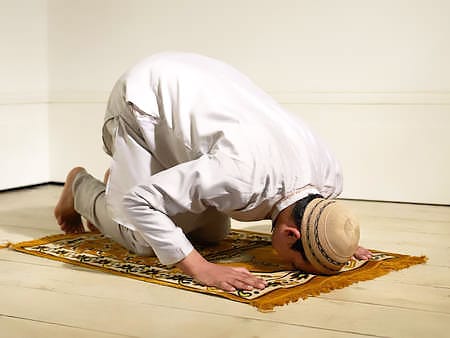
Muslim Man Praying on an Islamic Prayer Rug
How Are Islamic Prayer Rugs Used by Muslims For Praying?
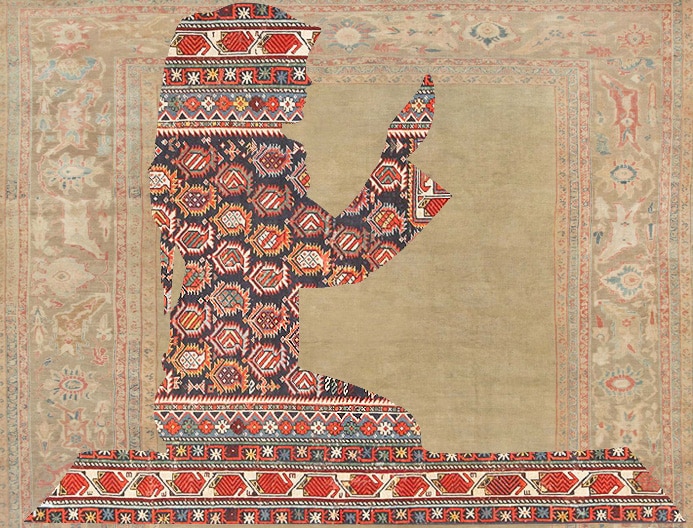
A prayer rug mat is a rug that Muslims use when praying. Islamic prayer involves sitting and prostrating, with the hands and face repeatedly touching the ground; so they need a clean and dry place.
At each prayer time, which comes five times a day, they unroll the rug, place it on the ground and sit on it to pray.
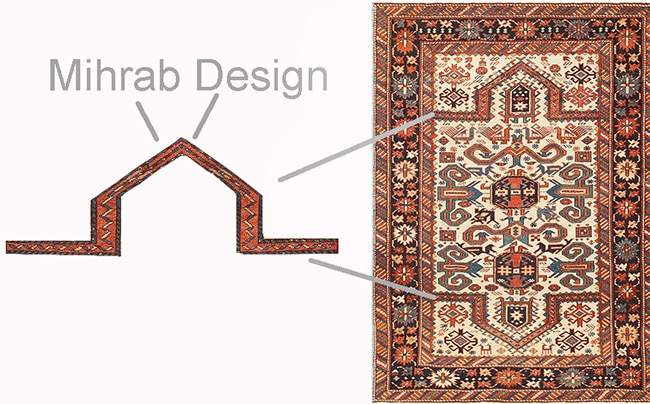
Mihrab Design In Islamic Muslim Antique Prayer Rugs
How do Muslims pray on these rugs?
During the prayer, they bow several times offering “Salat” (homage) to Allah. After the prayer, they roll it up and place it in a clean place.
Are there specific attributes or design elements that are specific to Prayer rugs?
The prayer mat is traditionally woven with a rectangular design, with the size ranging from 2.5 ft × 4 ft to 4 ft × 6 ft, enough to kneel above the fringe at one end and bend down and place the head at the other. Within the rectangle area are beautiful patterns and motifs forming images of mosques, architecture and other Islamic symbols.
Decorations are not only for aesthetic purposes, but have a deep religious value. So, great care is given in the design of prayer rugs.
The most important feature of a prayer rug is the niche at one end representing the mihrab, which is a directional point that directs the worshiper towards Mecca. Every mosque has a mihrab to direct the congregation towards the general direction of the holy city; so does every prayer mat.
But in the case of the Muslim prayer rug itself, the worshiper has to determine the direction and place the rug with the mihrab pointing in the right direction.
Mirhab Design Prayer Rug
A mihrab is an arch-shaped form that occupies one end of the rug, often referred to as the top end. Some rugs may, however, have mihrab at both ends. Such rugs are called double-ended prayer rugs. Besides representing the actual mihrab of a mosque, it also represents the spiritual archway to paradise.
The mirhab is often flanked by the “Pillars of Wisdom”. The area below the mihrab is known as the prayer field and symbolizes the floor of the mosque. This is where the worshiper kneels down when praying.
Some prayer rugs may have images of hands to tell the worshiper where to place his hands when praying, a comb to remind the worshiper to comb his hair or a pitcher to remind him to wash his hands before praying.
In addition to the mihrab, prayer rugs may also have images of mosque lamps in reference to the Verse of Light in the Quran. Some may also have images of famous mosques and Islamic architecture, especially of those in Mecca, Medina, and Jerusalem, the three holiest cities of Islam.
How do Muslim people take care of their antique Islamic prayer rugs?
Because of the important role a prayer rug plays in a Muslim’s life, it has to be handled with the utmost care and respect. It is considered disrespectful to place it in a dirty place, throw it around or kick it.
It should be cleaned and washed regularly. It should be removed from the floor as soon as the prayer is over and neatly rolled up and placed in a clean location.
Prayer Rugs as Unique Beauty in the Home
When you’re searching for unique rugs to highlight your space, prayer rugs attract attention with their distinctive designs.
Although initially designed for religious purposes, they have a special place in Islamic art today.
Using one of these rugs is a perfect way to add an antique-style look to any room. The designs that are unique to this carpet style will help you claim your personal space with flair.
The Islamic Prayer Design in Rugs As An Art Form
Prayer rugs always have a uniform rectangular design because of their devotional nature. Although Islamic art does not feature figures depicting people or animals, the designs are rich in architectural figures, including those of mosques. Green is a color that often appears in designated areas of the rug.
Prayer design rugs used as interior art are offer a beautiful display of quality. They enhance antiques or other decor in the same room. Because of their original status as devotional items, rugs with Muslim prayer designs will feature a high quality and attention to detail because of their original status as religious items.
             Posted on Google        Victor Florintsev     Trustindex verifies that the original source of the review is Google. The only ones I'd ever buy rugs from. The best.         Posted on Google        Jeffrey NeumanB     Trustindex verifies that the original source of the review is Google. I bought two gorgeous Serapi rugs from Farhad at Nazmiyal Rugs!  Beautiful carpets, fair prices and great service.  Very happy customer.  Farhad (the sales person) was very patient and gave us great service.         Posted on Google        john haid     Trustindex verifies that the original source of the review is Google. Alen is a gentleman and an expert.  Really great to work with.         Posted on Google        Edward Yasuna     Trustindex verifies that the original source of the review is Google. I recently purchased a modern Kandinsky rug from Nazmiyal Auctions.  It was just as described, and the director (Farhad) of the auctions had it sent to me quickly and safely.  Payment was easy, the rug was reasonably priced, and I highly recommend Nazmiyal Auctions and Antique Rugs.  Quality merchandise and first-class service.         Posted on Google        Nicholas Carr     Trustindex verifies that the original source of the review is Google. Had a excellent experience buying a rug in Nazmiyal's 1/18/26 online auction.  First, prior to the auction, viewing a number of lots at the 32nd St showroom (I had prepared a list from the online catalog). The staff were great to work with: helpful, knowledgable, honest, and flexible.  Second, after placing an online bid and winning the desired item, arranging payment and pickup was simple and straightforward. Everything went seamlessly and the overall experience was educational and fun. Many thanks to Jason and his team.         Posted on Google        Andrea Gared     Trustindex verifies that the original source of the review is Google. Everyone at Naziyal is proffessional, especially Jason and Farhad.
They are knowledgeable, truthful, and true gentlemen. I have sold several rugs through them and will always go to them first, to buy or sell. The best in the business!         Posted on Google        Lori Silverberg     Trustindex verifies that the original source of the review is Google.          Posted on Google        Jesse Zilberman     Trustindex verifies that the original source of the review is Google. Excellent customer service! Alen was very helpful over the phone and email. The rug we acquired was stunning, and photos do not do it justice. I would definitely work with Alen and team again!         Posted on Google        Rachel Paul     Trustindex verifies that the original source of the review is Google. Jason was incredibly kind and helpful! I work for a small museum that had some rugs we had no information on. Jason responded to us quickly and gave us the information we needed for free! Incredible service, we are super thankful for his help!

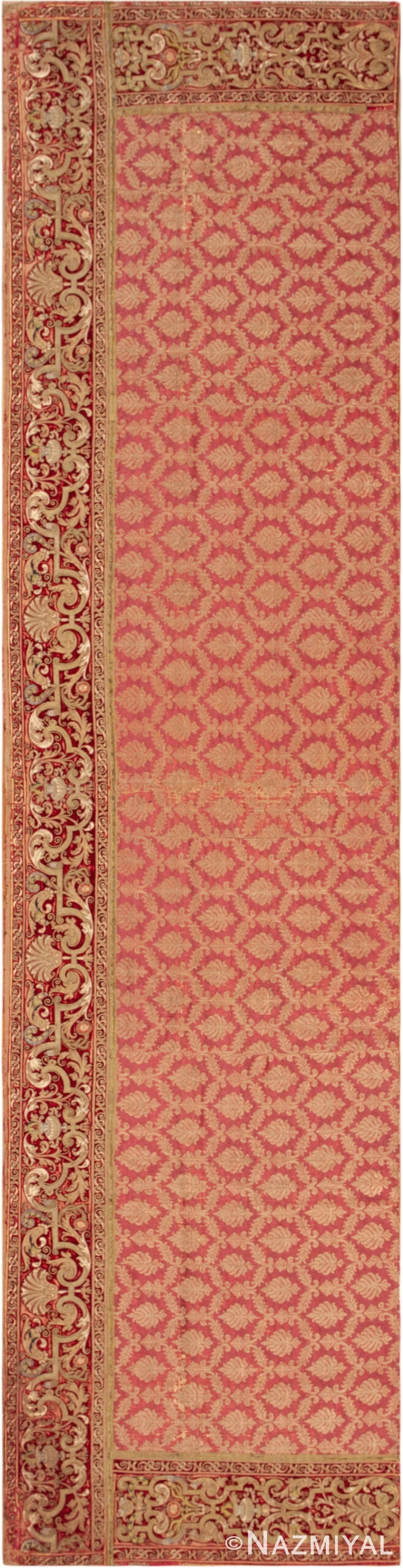
 Size: 3 ft 2 in x 13 ft 2 in (0.97 m x 4.01 m)
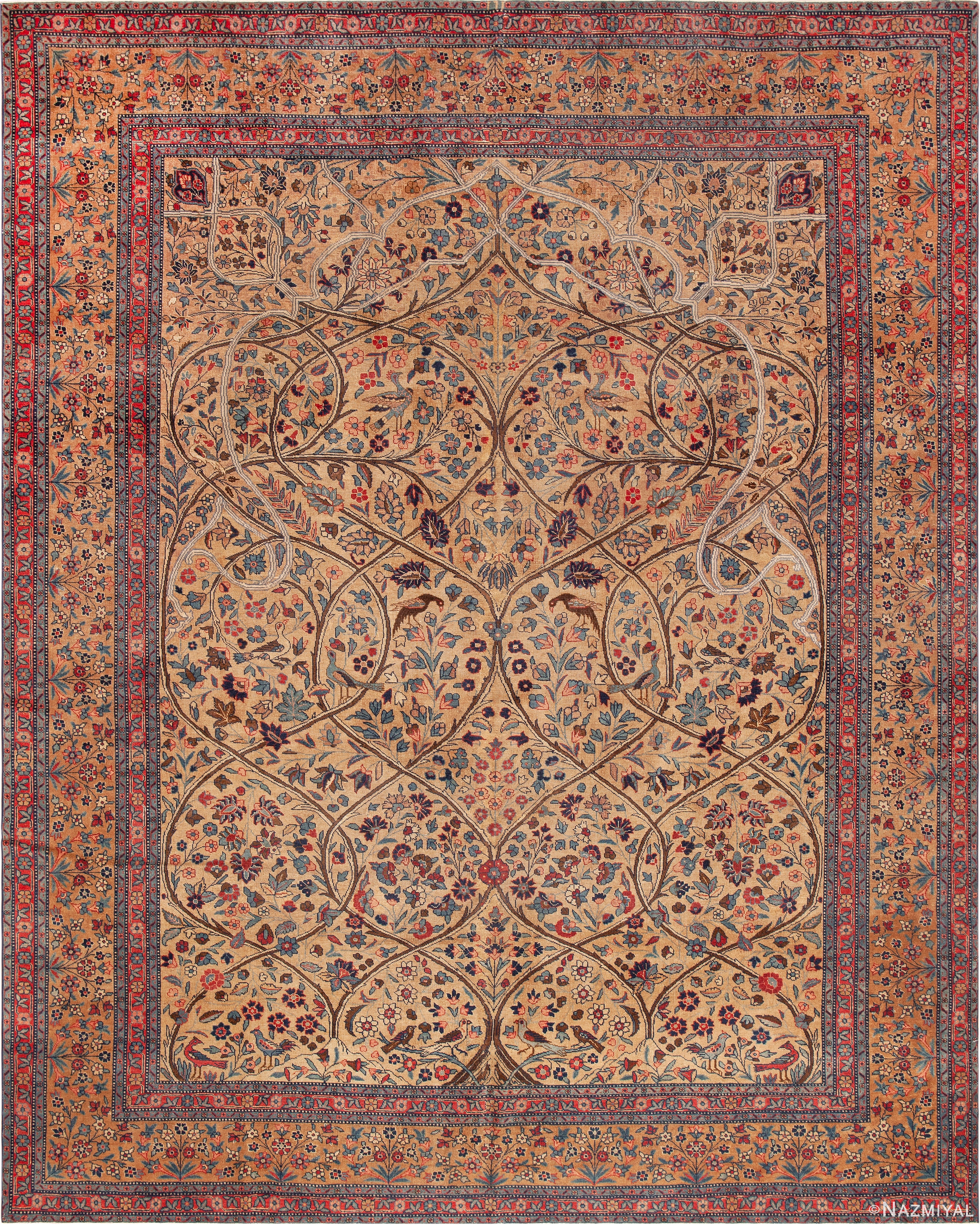
 Size: 8 ft 10 in x 11 ft 2 in (2.69 m x 3.4 m)
 Size: 6 ft 6 in x 7 ft 8 in (1.98 m x 2.34 m)
 Size: 4 ft 10 in x 7 ft 2 in (1.47 m x 2.18 m)
 Size: 4 ft 7 in x 6 ft 7 in (1.4 m x 2.01 m)
 Size: 4 ft 3 in x 6 ft 6 in (1.3 m x 1.98 m)
 Size: 3 ft 10 in x 5 ft 8 in (1.17 m x 1.73 m)
 Size: 3 ft 3 in x 5 ft 8 in (0.99 m x 1.73 m)
 Size: 4 ft 2 in x 5 ft 7 in (1.27 m x 1.7 m)