The interest and involvement of Europeans in the later nineteenth and
twentieth centuries gave enormous incentive to Oriental rug production, but
it also had negative effects. The most important of these was in the realm
of dyes. At about the mid nineteenth century German scientists developed
synthetic, chemically based dyes that involved far less time and labor than
vegetable-derived colors. By the late 1860's and 70's they had become
common in Turkey, and a decade or so later, in Persia and Central Asia as
well. However, these colors soon proved to be fugitive on exposure to light,
or when washed. This resulted in the production of many carpets with badly
faded colors or ugly dye runs that resulted from routine cleaning. At the
same time western industrialization also introduced the commodity of
machine-spun wool, which helped in the production of carpets on an
ever-increasing scale. Eventually in the 1920's and 30's western technology
perfected synthetic dyes. This now made it possible to produce huge dye lots
of uniform color.
The ultimate result was the loss of the lovely variegated color effects or “abrash” that were common with less controllable vegetable dyes, and that
lent so much character and charm to antique carpets. Also, the machine spun
wool imparted a uniformity of texture which, along with the uniformity of
color, tended to make the effect of light on the surface of the carpets less
animated and rich. While the designs of Oriental carpets remained true to
tradition, these technical changes gradually led to a readily perceptible
difference in quality between new rugs and those produced before, say, 1920.
As a result, the concept and the commodity of the “antique carpet” as the
superior, the more desirable, and therefore the more expensive type became
established. Throughout the twentieth century, many well- made rugs
continued to be produced across the Middle East, but they could never
compete for the the most discerning or the most demanding buyers, who
preferred the depth of color and reflective quality of vegetable dye and
hand-spun wool, and who were willing to pay for it.
In the last twenty years or so there has been a revival of traditional
weaving, relying once again on on vegetable dyes and hand-spun wool. This
development began in Turkey as a government-funded experiment, Project DOBAG, designed
to recover or restore a lost traditional craft. To some extent this program
also focused on reviving traditional designs, which had degenerated somewhat
in the course of the twentieth century. Its success prompted similar
attempts in Afghan and then Persian weaving, and eventually in virtually all
Oriental rug-producing regions. Today it is once again possible to encounter
outstanding carpets which are not only well woven and nicely designed, but
which also have the textural and color quality of the finest antique rugs.
|

Reproduction of Mamluk rugs by Woven Legends

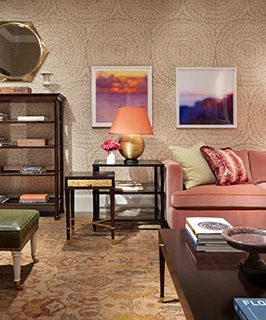
Designed by Barbara Barry from Tufenkian Collection

Modern Gabbeh from Rugs by Robinson Collection
|